

Most travel agencies don't have a vendor problem. They have a vendor visibility problem. You know the big suppliers — the GDS, the payment gateway, maybe the CRM. But if you actually mapped every third party that touches a booking, you'd probably find 15 to 30 vendors, and half of them are quietly holding passport scans, card tokens, or supplier login credentials that nobody's reviewed since the day you signed up.
That's the real exposure. Not the vendor you scrutinized. The seven you forgot about.
This is a systems piece, not a compliance checklist. The goal is to help you see how vendor risk moves through your operation the same way a booking does — from enquiry to payment to supplier fulfillment — and where the weak joints are. Because when a vendor fails, it rarely fails in isolation. It fails at the exact seam where your data hands off to theirs.
Why vendor risk in a travel agency is different
Vendor risk frameworks written for generic small businesses assume your data is boring. Customer name, email, maybe a card on file. Travel agencies don't work that way. A single leisure booking can involve:
-
Full PII including passport and visa details
-
Payment card data (yours, the client's, sometimes the supplier's)
-
Date of birth, sometimes health, dietary, or accessibility info
-
Loyalty program numbers and credentials
-
Emergency contact details for people who never consented to anything
And that data doesn't sit still. It flows outward to airlines, DMCs, hotel channel managers, insurance providers, ground operators, and increasingly to a stack of SaaS tools glued together with integrations. Every one of those handoffs is a vendor relationship, and every relationship is a place where data can leak, get mishandled, or become someone else's breach headline with your name attached.
The pattern worth sitting with: your risk is not the sum of your vendors — it's the sum of your data flows through those vendors. A low-risk vendor that handles high-risk data is a high-risk vendor. Agencies get this backwards constantly, spending review energy on the big-name supplier that barely touches PII while ignoring the tiny automation tool routing passport images between systems.
Where it breaks as you grow
At two or three staff, informal vendor management sort of works. One person signed up for everything, roughly remembers who has access to what, and can eyeball a problem. That memory is your entire security program. It doesn't scale, and it tends to fail in three pretty predictable stages.
Eliminate booking chaos and streamline operations.
Travexly helps you manage, confirm, and track travel bookings effortlessly.
- Unified booking management
- Automated client communications
- Team scheduling & itinerary tracking
No credit card required
Stage one — the founder's memory expires. You hire agent number four, they sign up for a scheduling tool and a WhatsApp automation. Nobody logged it. Now client data is flowing to a vendor leadership has never seen.
Stage two — offboarding stops happening. You stop using a supplier or a tool. The contract lapses, but the API key is still live and the vendor still has a copy of everything you sent them over the past 18 months. Dead integrations are one of the most common quiet leaks in a growing agency — the connection nobody turned off.
Stage three — you can't answer the questionnaire. A corporate client or large supplier sends you a security questionnaire asking which sub-processors touch their data. You can't answer it because you never tracked it. That deal stalls, and suddenly vendor risk isn't an IT concern, it's a revenue concern.
The through-line: informal vendor management doesn't collapse dramatically. It erodes. By the time you notice, you've got a dozen unreviewed relationships and no clean way to reconstruct who has what.
Risk-tiering: stop treating every vendor the same
The single most useful move is to stop reviewing vendors as a flat list and start tiering them by what data they touch and what happens if they fail. A boutique agency doesn't have time to run a full security review on 25 vendors. It does have time to run a serious one on the four that matter and a lighter one on the rest.
Here's a workable tiering model:
| Tier | What defines it | Examples | Review depth |
|---|---|---|---|
| Tier 1 – Critical | Handles payment data or large volumes of PII; outage stops bookings | Payment gateway, GDS, core CRM/booking platform | Full security review, annual, contract-level |
| Tier 2 – Sensitive | Touches PII but not payments; failure disrupts but doesn't halt ops | DMCs, insurance partners, document-collection tools | Questionnaire + annual check |
| Tier 3 – Limited | Minimal or no PII; easily replaced | Marketing tools, analytics, scheduling | Light questionnaire at onboarding |
| Tier 4 – Peripheral | No client data at all | Design tools, internal accounting (non-client) | Register only, no review |
The part most agencies miss: tiering is about data and blast radius, not vendor size. A three-person ground operator holding your clients' full passport details is Tier 2 at minimum, even though they're tiny. A well-known marketing platform with none of your client PII is Tier 3, even though they're massive. Size feels like the obvious sorting logic. It's the wrong one.
Prioritise vendor reviews by the sensitivity of data they handle rather than their market size.
A three-person ground operator holding your clients' full passport details is Tier 2 at minimum, even though they're tiny. A well-known marketing platform with none of your client PII is Tier 3, even though they're massive. Size feels like the obvious sorting logic. It's the wrong one.
The onboarding questionnaire that fits travel data
Generic vendor questionnaires ask about SOC 2 and firewalls and put everyone to sleep. For a travel agency, the questions that actually predict trouble are tied to your specific data flows. You want a short questionnaire at onboarding that scales in depth by tier.
For any vendor touching client data, the baseline:
-
What specific client data will you store, and for how long?
-
Where is that data physically hosted?
-
Do you use sub-processors, and can you name them?
-
How is data encrypted at rest and in transit?
-
How do we get our data back or deleted when we leave?
For Tier 1 and payment-touching vendors, add:
-
Are you PCI DSS compliant, and to what level? (Ask for the attestation, not just a yes.)
-
Is card data tokenized so you never hold raw PANs?
-
What's your breach notification timeline to us?
For PII-heavy travel vendors (DMCs, document collectors, insurance):
-
How do you handle passport and visa images specifically?
-
Can you segregate our clients' data from other agencies' data?
-
Who on your side can actually see our clients' records?
The point isn't to grade vendors like a security auditor. It's to force a conversation that surfaces the answer nobody wants to hear: "we email passport scans around in plain text and store them in a shared Google Drive." That answer alone tells you everything. If you're still working on your own internal handling, the practical PCI and client-data basics piece pairs directly with this — your vendor standards can't exceed your own.
Periodic checks: the part everyone skips
Onboarding review is the easy discipline. Periodic review is where programs die, because there's no natural forcing function. Nobody wakes up wanting to re-check a vendor they onboarded two years ago.
Build the cadence into the tier:
-
Tier 1 — annually, plus on any trigger. A trigger is a vendor breach report, a major ownership change, or a new integration expanding what data they touch.
-
Tier 2 — annually, lightweight. Confirm the questionnaire answers still hold. Has their sub-processor list changed? Are they still hosted where they said?
-
Tier 3 — every 18–24 months, or on offboarding. The main check here is: are we even still using this?
-
All tiers — access review quarterly. This is the cheap, high-value one. Walk the list of active API keys and vendor logins and kill anything dead.
That quarterly access review catches the stage-two failure from earlier — the live key on a dead vendor. A fairly typical scenario: an agency running 40 or so bookings a month does their first honest access review and finds three integrations still authenticated to tools they stopped using over a year ago. One was a document-collection tool still holding a folder of passport images. Nothing had breached. But the exposure had been sitting there, unwatched, the entire time.
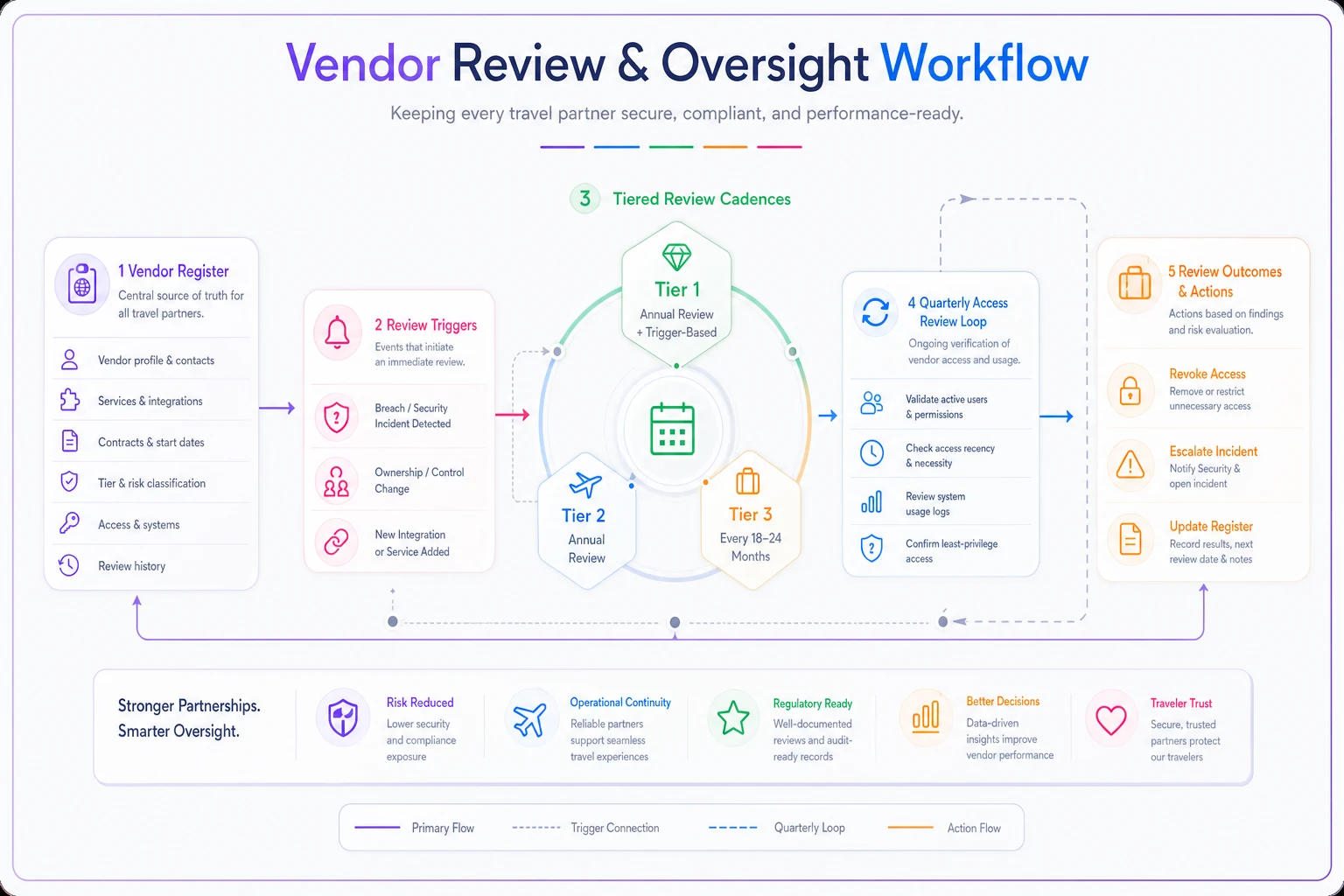
This sketch shows the cadence and triggers for periodic vendor reviews.
Vendor risk connects tightly to your integration architecture here — the operational integration blueprint for supplier feeds covers how those connections should be structured and monitored. A monitored integration is a reviewable one. If you don't know a connection exists, you can't secure it.
Incident expectations: write them before you need them
The worst time to figure out what you expect from a vendor during a breach is during the breach. When a supplier's system gets compromised, they'll tell you when they feel like it, in the language they choose, on their timeline. That's not acceptable when it's your clients' passport data.
Set incident expectations at contract or onboarding, in plain terms:
-
Notification window. For Tier 1 and PII vendors, define a specific window — many agencies push for 48–72 hours. "We'll let you know" is not a window.
-
What they tell you. What data, how many records, which of your clients, what they're doing about it.
-
Who your contact is. A named person or team, not a general support inbox that responds in five business days.
-
Your right to notify affected clients. You may have legal obligations that don't wait for the vendor's PR schedule.
Agencies that have been through a third-party incident will tell you the same thing: the damage usually isn't the breach itself — it's the silence. A vendor that reports fast and clearly is manageable. One that goes quiet for two weeks turns a contained problem into a trust collapse with your own clients. You're effectively choosing their communication behavior when you sign, whether you realize it or not.
When a full program makes sense — and when it's overkill
There's a version of this that gets overcomplicated fast, so it's worth being direct about who actually needs a formal program.
Worth building out: You're past three or four staff, you've picked up corporate or group business, you're handling international bookings with heavy document requirements, or you're stitching together multiple SaaS tools. The moment you can't reconstruct your vendor list from memory, you need the register.
Lighter is fine when: A solo or two-person agency running mostly domestic leisure bookings through two or three well-known platforms doesn't need a 25-question vendor process. You need a one-page register, PCI-compliant payment handling, and a habit of not emailing passport scans around. Don't build enterprise vendor governance for a two-person shop — you'll create paperwork nobody maintains, which is worse than no process, because it looks like coverage.
Fix your own house first: If your internal data handling still has raw card details in spreadsheets and passport images in email threads, a vendor program sitting on top of that is theater. Vendor risk assumes your side of the fence is in reasonable shape. There's no point auditing suppliers for data hygiene you're not practicing yourself.
A short real scenario
A mid-sized agency — around 11 staff, mix of leisure and small corporate accounts — got asked by a new corporate client to complete a third-party security questionnaire before signing. They couldn't answer it. No vendor list, couldn't name their sub-processors, no incident terms with any supplier. The deal stalled for weeks.
They built a basic tiered register over about a month: roughly 22 vendors identified, four in Tier 1, eight in Tier 2. The first access review killed two dead integrations. They added incident-notification language to their two payment-adjacent contracts at renewal.
The corporate deal closed. But the more useful outcome was internal — they stopped signing up for tools without logging them, because now there was a place they had to log them. The register didn't just answer the client's questionnaire; it changed the behavior that created the risk in the first place. That's the actual win. Not the document — the discipline the document forces.
How this ties back to the rest of your operation
Vendor risk isn't a security silo. It's threaded through your money, your data, and your fulfillment. The vendors reconciling your supplier invoices touch financial data — which is why automated invoice reconciliation and vendor review overlap more than people expect. The tools moving client data between your systems are both an operational dependency and a security exposure. When you tier and review vendors, you're really mapping how your whole business hands off information — and every handoff is a place something can break or leak.
This is also where AI-powered operational software starts to earn its place in a real way. Platforms that centralize vendor records, track integration statuses, and flag access that hasn't been reviewed in a set period take a lot of the manual discipline out of the equation. You're still making the decisions — but the system is holding the list, surfacing the gaps, and reminding you when a review is due rather than letting it drift. For agencies managing 20-plus vendor relationships across multiple booking systems, that kind of operational support isn't a nice-to-have.
The agencies that handle this well aren't the ones with the fanciest security tooling. They're the ones who can answer a simple question at any moment: who touches our clients' data, what do they hold, and what happens if they fail? If you can answer that today without guessing, you're ahead of most of the industry. If you can't, that's your starting point — not a policy document, just an honest list of who has your data and why.
Ready to elevate your travel agency workflow?
Join 1,200+ travel agencies using Travexly to save time, improve client satisfaction, and boost operational efficiency.