

Most agencies don't discover their integration is broken until a client calls, furious, holding a confirmation for a room the hotel says doesn't exist. By then the failure has already spread — the inventory feed went stale hours ago, three quotes went out with old pricing, and nobody noticed because the feed didn't error. It just went quiet.
That's the thing about travel agency integration architecture: the failures rarely announce themselves. A supplier API doesn't crash with a big red banner. It returns a 200 OK with yesterday's availability. It sends a partial batch and skips the reconciliation. It updates 90% of your rates and silently drops the other 10%. Your agents keep quoting, keep booking, keep confirming — on data that's wrong.
This article isn't about how to connect to a supplier. If you're still at that stage, the pre-integration checklist for supplier APIs covers the field mapping and smoke-tests you need first. This is about what happens after you're live with five, ten, fifteen feeds running at once — how they interact, where they collide, and how a non-technical owner can actually keep the whole thing from falling over.
Event vs batch: the decision that shapes everything downstream
Almost every integration problem I've traced back to root cause comes down to a mismatch between how a feed delivers data and how the agency assumes it delivers data.
There are really only two patterns underneath all of it.
Event-driven feeds push updates to you the moment something changes — a room opens up, a price shifts, a booking gets canceled on the supplier's side. You react in near real-time.
Batch feeds hand you a big file or a bulk pull on a schedule — every 15 minutes, every hour, overnight. You process the whole set at once.
| Dimension | Event-driven | Batch |
|---|---|---|
| Freshness | Seconds to minutes | As stale as your interval |
| Failure mode | Missed/dropped events (silent gaps) | Late or partial files (visible-ish) |
| Debugging | Hard — you don't know what you didn't receive | Easier — you can diff the last file |
| Load spikes | Can flood you during big inventory changes | Predictable, but bursty at run time |
| Best for | Live availability, price changes, cancellations | Rate loads, catalog sync, commission statements |
The mistake almost everyone makes: treating a batch feed like it's live. An agency pulls hotel rates every hour, but agents believe they're seeing current prices at 11:47 when the last successful pull was actually 10:15 — and the 11:15 pull failed silently. Ninety minutes of stale rates going out in quotes, and the team has no idea because the system looks perfectly fine.
The fix isn't technical wizardry. It's making the freshness visible. Every feed should stamp a "last successful update" that agents can see next to the data they're using. When a rate is 90 minutes old and your batch interval is 60, that number should be turning yellow.
Why one broken feed poisons everything connected to it
Small agencies tend to think of feeds as independent lanes. Hotel feed here, flight feed there, transfer feed over there. In reality they're stacked on top of each other, and failures cascade.
Eliminate booking chaos and streamline operations.
Travexly helps you manage, confirm, and track travel bookings effortlessly.
- Unified booking management
- Automated client communications
- Team scheduling & itinerary tracking
No credit card required
A typical example: your hotel inventory feed goes stale. An agent builds an itinerary using a room that's no longer available. That itinerary flows into your booking record, which flows into your payment schedule, which flows into your supplier confirmation queue. By the time the confirmation bounces back rejected, you've collected a deposit, sent the client an itinerary, and blocked out an agent's afternoon. One stale feed, four downstream messes.
This is exactly why data integrity upstream matters so much. When feeds create bad records, you get the duplicate-customer and orphaned-booking problems covered in the data governance playbook — except now they're being generated automatically, at machine speed, faster than anyone can catch them.
The pattern across agencies that scale cleanly: they map their feed dependencies once, on paper, before they add a sixth or seventh supplier. Which feed depends on which? If the transfer supplier goes down, does it block the whole itinerary or just one line item? Knowing this ahead of time is the difference between "we degrade gracefully" and "the whole thing freezes."
The vendor ownership model nobody sets up until it's too late
When you had two suppliers, you knew who to call. When you have twelve, every feed becomes an orphan the moment something breaks — because "the integration" belongs to everyone and no one.
The single highest-leverage thing a small agency can do is assign an owner per feed. Not a developer. An operational owner. A named human whose job is to understand that feed's behavior.
For each feed, that owner should hold four things:
-
The contact chain — who at the supplier actually fixes things, not the general support line
-
The expected behavior — how often it updates, what a normal payload looks like, what "healthy" means
-
The blast radius — what breaks downstream if this feed fails
-
The fallback — what the team does manually while it's down
The insight most owners miss: the ownership model has to survive staff turnover. If the only person who understands the Amadeus feed's quirks leaves, that integration knowledge walks out the door with them. Write it down. A one-page profile per feed, stored somewhere the whole team can find it, beats a genius who quit.
This also ties into how you run operations more broadly — an ownership model only works inside an SLA-driven operations system where response times and escalation paths are already defined. Feed ownership without SLAs is just a list of names.
A monitoring and alerting playbook you don't need an engineer to run
Most agencies monitor nothing until something breaks, then over-correct into alert fatigue where everything pings and the team ignores all of it. The goal is a small number of alerts that actually mean "act now."
Three tiers, and only three:
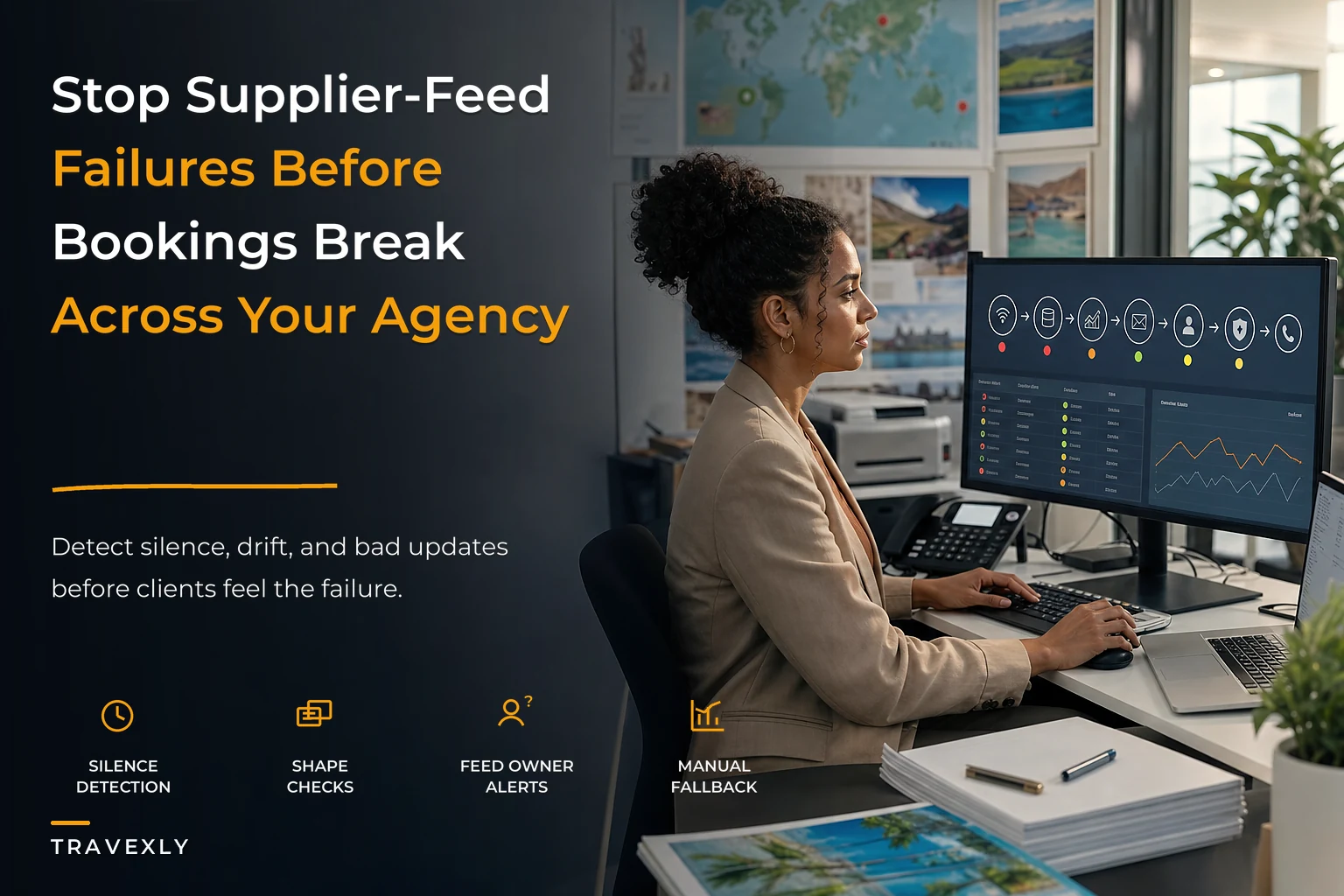
Tier 1 — Silence detection. Every feed should be expected to update on a rhythm. If a batch feed that runs hourly hasn't succeeded in 90 minutes, someone gets pinged. This catches the silent failures — the ones that don't error, they just stop. This single alert catches more real problems than anything else.
Tier 2 — Shape checks. The feed responded, but does the data look sane? A rate load that normally brings 4,000 hotel rates suddenly brings 200. A price field that comes back as zero. A currency that flipped. These aren't crashes — they're the 200 OK with garbage inside that ruins your day. A simple rule like "if today's row count is under half of yesterday's, hold the update and alert" catches most of it.
Tier 3 — Reconciliation drift. Over a day or a week, do the numbers add up? Bookings confirmed vs. bookings that reached the supplier. Commissions expected vs. commissions posted. This one is slower, but it's where money leaks quietly.
The mistake to avoid: routing all three tiers to the same channel with the same urgency. Tier 1 wakes someone up. Tier 3 is a Monday-morning review. Mix them and your team learns to mute the whole thing.
Start with silence detection on your highest-volume feeds; it catches more real problems than anything else.
The numbers that make this worth it
A mid-sized leisure agency — somewhere around 280–320 bookings a month across nine suppliers — was losing roughly two full agent-days a week to what they called "chasing ghosts": re-confirming bookings, re-quoting after finding stale prices, apologizing to clients. No monitoring, purely reactive.
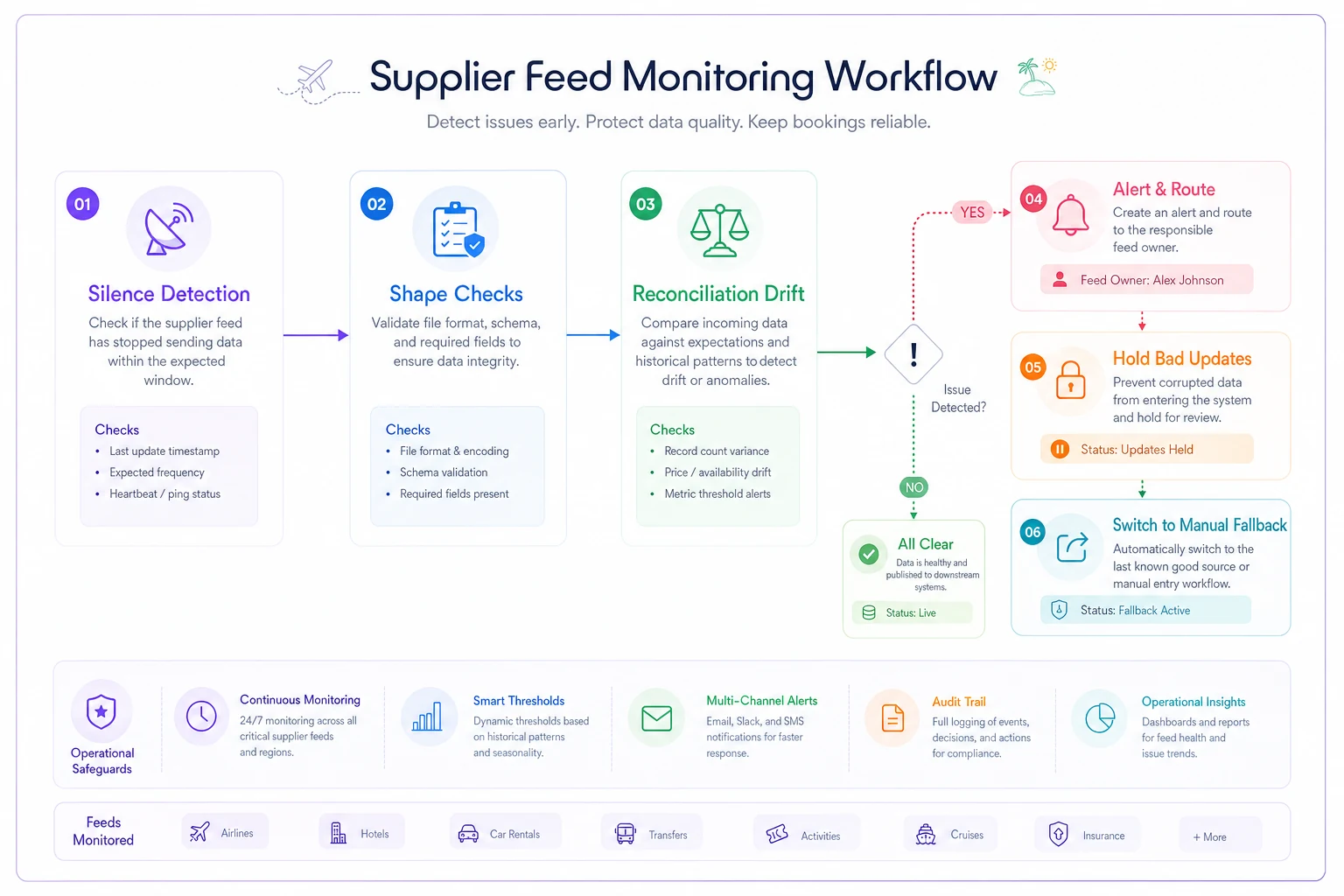
This simple workflow diagram shows the key checks and who to alert at each step.
Runbooks for the failures that keep happening
Every agency has the same handful of feed failures on repeat. The difference between a calm agency and a chaotic one is whether those failures have a written response or a panicked improvisation each time.
A runbook is just: when X happens, do these steps, in this order. Here's the structure for the most common one — a stale or missing feed.
-
Confirm it's actually down. Check the last successful update timestamp. Is it the feed, or one record?
-
Contain the blast radius. Flag the affected inventory as "do not quote" so agents stop building on bad data. This is the step people skip, and it's the most important one.
-
Switch to the fallback. Manual pull, phone the supplier, or use the secondary feed if you have one.
-
Notify the team, not the whole company. A short message
"Hotel feed X is stale, don't quote those properties, check direct until cleared."
-
Escalate to the vendor owner using the contact chain — not the generic support queue.
-
Log it. One line
what broke, when, how long, what fixed it. This is how you spot the feed that fails every Tuesday at 2am and finally get it fixed at the source.
The recurring failures worth having runbooks for:
-
Stale/silent feed (above)
-
Partial batch — file arrived but incomplete
-
Duplicate records — the same booking or customer created twice
-
Currency/pricing anomaly — values that don't make sense
-
Confirmation mismatch — you booked it, the supplier didn't register it
You don't need fifteen runbooks. Five solid ones that every agent knows where to find is plenty.
Operational guardrails a non-developer can actually run
This is the part that keeps the whole system from depending on one technical person.
Guardrail one: hold, don't publish, when data looks wrong. The default behavior for any feed that fails a shape check should be to keep the last known good data and refuse to overwrite it with garbage. Stale-but-consistent is safer than fresh-but-wrong. This one rule prevents most of the client-facing disasters.
Guardrail two: make freshness visible in the workflow. If an agent is looking at a rate that's older than the safe threshold, they should see that right where they're building the quote. Not buried in a log file they'll never open.
Guardrail three: a manual fallback for every feed. Every automated feed needs a documented "here's how we do this by hand" path. When the transfer supplier's API is down for a day, the agency doesn't stop selling transfers — they work the manual process and keep moving.
Guardrail four: change control on the integration itself. When you add a supplier or a supplier changes their API, that's usually when things break. The guardrail is straightforward: no new feed goes live without running the same smoke-tests you'd run on day one, plus a check that it doesn't collide with an existing feed's records.
The reason these are operational guardrails and not technical ones is deliberate. As you scale, your integration can't depend on the one person who understands the code. The owner, the ops lead, a senior agent — they all need to be able to run the response without opening a terminal.
When to invest in this — and when not to
Not every agency needs a full monitoring stack.
This makes sense when you're running four or more live feeds, when a single stale feed can generate real client-facing errors, or when you've already had the "why is my confirmation wrong" call more than once or twice. At that point the cost of not having guardrails shows up as agent hours and refunds.
This is overkill when you're running one or two suppliers and mostly booking manually anyway. Building a three-tier alerting system for a single hotel feed is solving a problem you don't have. Start with a visible freshness timestamp and a manual fallback — that's probably 80% of the value for a fraction of the effort.
Who should not do this alone: if you're about to bolt monitoring onto an integration that was never properly reconciled in the first place, you'll just be alerting on chaos. Get the foundational reconciliation and field mapping solid first. Monitoring a broken foundation just tells you loudly that it's broken.
Where good operational software fits
Once you're past a handful of feeds, a lot of this is genuinely hard to manage out of spreadsheets and Slack messages. A proper operations platform earns its place here — one that can watch feed freshness, apply shape-check rules, hold bad updates automatically, and route the right alert to the right owner without someone babysitting it. AI-assisted monitoring handles the boring-but-critical shape checks well: noticing that a payload is shaped wrong even when it didn't technically error, and holding it before it reaches an agent's screen.
But the software is the last step, not the first. The value is in the model — event vs. batch clarity, feed ownership, tiered alerts, runbooks, guardrails. An agency that understands its own integration architecture on paper can run these guardrails manually and get most of the benefit. Buying a tool before you understand your own dependency map usually just automates the confusion.
The takeaway
The agencies that scale past a dozen suppliers without constant fire-drills aren't the ones with the fanciest tech. They're the ones who treated their integration as an operational system — with owners, visible freshness, tiered alerts, and written responses to the failures that keep coming back.
Start with the two things that cost almost nothing: put a visible "last updated" timestamp next to any feed-driven data your agents rely on, and write a runbook for the one feed failure that's burned you most this year. Do those two things, and you've already started catching failures before your clients do.
Ready to elevate your travel agency workflow?
Join 1,200+ travel agencies using Travexly to save time, improve client satisfaction, and boost operational efficiency.