


Most agencies treat supplier management as a relationship problem. You have a good rep at the DMC, you send them business, they take care of you when things goes sideways. That works fine until you're running enough volume that "the relationship" stops scaling and starts hiding problems.
Supplier performance is a measurement problem long before it's a relationship problem. If you can't see which suppliers are quietly costing you refunds, re-bookings, and unhappy clients, you can't fix anything. You just keep sending volume to whoever you happen to like and hope for the best.
This is a playbook for turning that gut-feel process into something with actual teeth: scorecards, the right KPIs, incentives and penalties that mean something, remediation steps, and a quarterly review structure that ties back to your operational numbers.
Start with what actually breaks, not what's easy to measure
The mistake almost everyone makes when building a supplier scorecard for the first time is measuring what's easy to pull — response time on emails, number of bookings, invoice accuracy — and skipping the stuff that actually hurts the business.
The metrics that matter are the ones tied to money leaving your pocket or clients walking away. A hotel supplier who responds to emails in four hours but botches 1 in 15 room-type confirmations is far more expensive than a slow-but-accurate one. The fast responder feels better to work with. The scorecard has to cut through that feeling.
-
Confirmation accuracy — did the client get what was booked and priced?
-
Change and cancellation handling — how fast, how clean, how many escalations?
-
Commission accuracy and payment timing — are you actually getting paid what you're owed, on time?
-
Failure recovery — when something breaks on the ground, does the supplier fix it or dump it on you?
That last one almost never makes it onto a scorecard, and it's often the biggest driver of client churn. A supplier who screws up but recovers fast keeps your client. A supplier who screws up and goes quiet costs you the relationship.
Picking KPIs that trigger action, not just reporting
A KPI without a threshold attached is just trivia. Every metric you pick needs three things: a definition everyone agrees on, a target, and a trigger point where the supplier lands in remediation.
Eliminate booking chaos and streamline operations.
Travexly helps you manage, confirm, and track travel bookings effortlessly.
- Unified booking management
- Automated client communications
- Team scheduling & itinerary tracking
No credit card required
Here's a practical starting set for most agencies. You won't use all of these for every supplier type — a flights consolidator gets measured differently than a villa rental partner — but this is the menu.
| KPI | What it measures | Target | Action trigger |
|---|---|---|---|
| Confirmation accuracy | % of bookings confirmed exactly as requested | ≥ 98% | Below 95% |
| Response time (urgent) | Time to first response on same-day issues | < 2 hrs | Over 4 hrs repeatedly |
| Change turnaround | Time to process a modification | < 24 hrs | Over 48 hrs |
| Commission accuracy | % of statements matching your records | ≥ 97% | Below 93% |
| Payment timeliness | Commission paid within agreed terms | ≥ 95% on time | Two late cycles |
| Escalation rate | % of bookings needing manager involvement | < 5% | Over 8% |
| On-trip failure recovery | % of ground issues resolved without client refund | ≥ 90% | Below 80% |
Two things worth noting. The targets aren't clean round numbers because real performance isn't. If your target is 100% across the board, you've built a scorecard that's always red and everyone learns to ignore it.
Commission accuracy and payment timeliness are on this list for a reason — supplier performance isn't just about the client experience, it's about whether the money reconciles. If you're constantly chasing statement errors, that's a performance failure even if every trip runs smoothly. There's more on the mechanics of that in this piece on fixing commission leakage and resolving supplier commission errors, which pairs directly with the scorecard work here.
The scorecard itself: keep it boring and consistent
A supplier scorecard doesn't need to be fancy. It needs to be consistent enough that the same supplier gets measured the same way every quarter, and simple enough that whoever runs your ops actually maintains it.
A workable structure: each supplier gets a weighted score across the KPIs relevant to their category. Weighting matters — for a luxury villa partner, confirmation accuracy and on-trip recovery might make up 60% of the total, while for a flight consolidator, payment and commission accuracy might dominate.
The scoring workflow, in plain terms:
-
Pull the raw data for each KPI from your booking system and accounting records for the period.
-
Score each KPI against its target (green / yellow / red, or a 1–5 scale).
-
Apply category weights to get a composite score.
-
Compare against last quarter — the trend is often more useful than the absolute number.
-
Flag anyone who dropped a tier or crossed a trigger threshold for remediation.
One operational note: scoring falls apart when the underlying data is scattered across inboxes, spreadsheets, and someone's memory.
The trend point is underrated. A supplier sitting at 88% but sliding from 96% two quarters ago is a bigger problem than a steady 85% partner. Something changed on their end — new staff, a systems migration, you lost account priority — and steady decline usually accelerates before it plateaus.
Booking and workflow platforms with built-in performance tracking help here — not because they're magic, but because they capture raw events (confirmations, changes, escalations, payment dates) as they happen, so you're not reconstructing a quarter of history from email threads. When data collection is handled automatically, the scorecard goes from "a project someone dreads" to "a report that already exists."
Here's a quick visual of the scoring workflow.
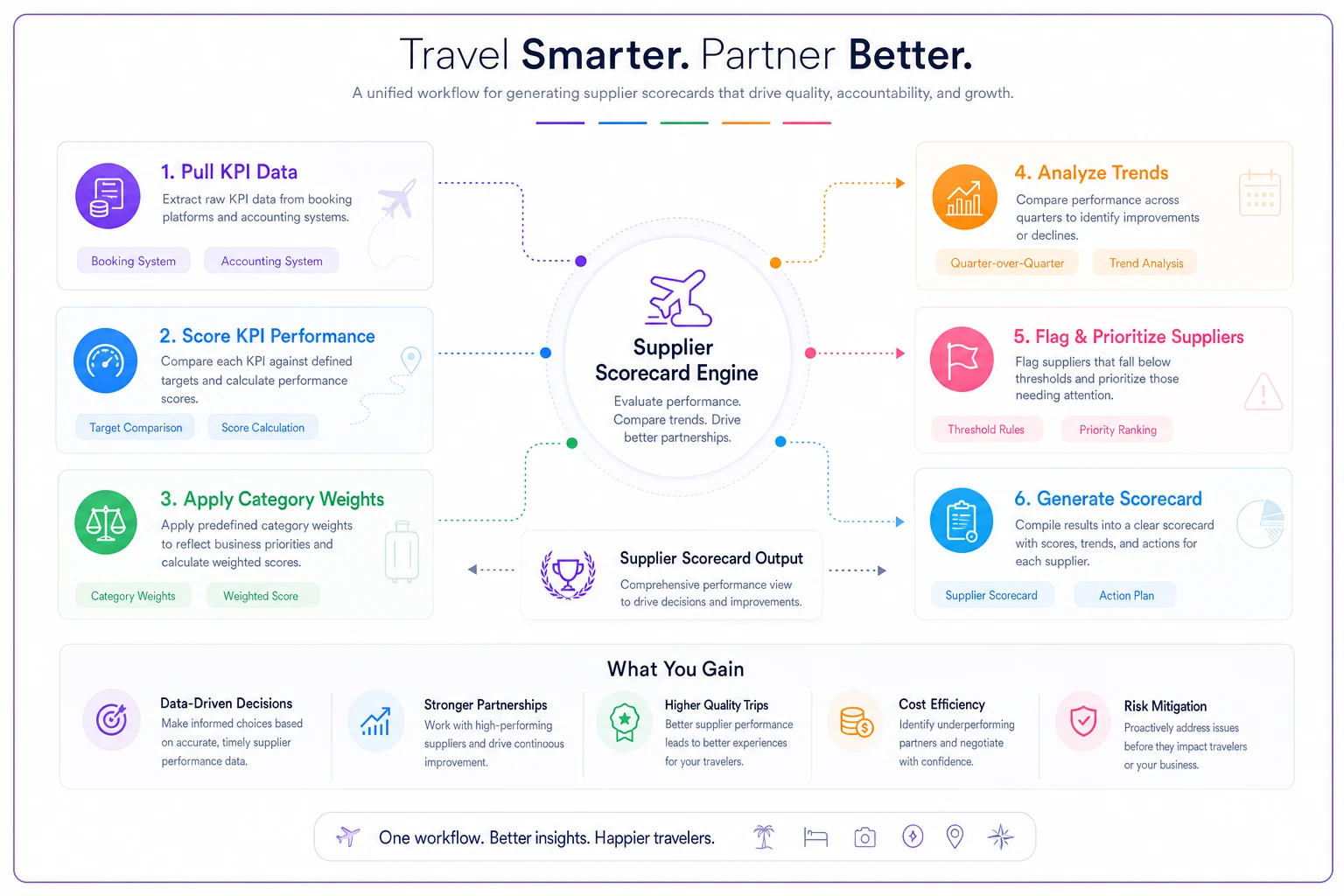
When data collection is handled automatically, the scorecard goes from "a project someone dreads" to "a report that already exists."
Incentives and penalties that suppliers actually feel
A scorecard with no consequences is a diary. The point of measuring performance is to shift behavior, and behavior only shifts when there's something on the line.
The clumsy version of this is "we'll send more business to good suppliers." True in theory, but too vague to change anything in the moment. Suppliers rarely connect a slow quarter of bookings to a confirmation they botched three months ago. You need constructs that are specific and close to the behavior.
-
Volume tiers tied to performance, not just spend. A supplier hits Tier 1 pricing only if they stay above your accuracy and recovery thresholds. Volume alone shouldn't unlock better terms if the service is sloppy.
-
Priority placement in your itineraries. Being the default recommended option in a category is worth real money to a supplier, and it's a lever you fully control.
-
Faster payment terms as a reward. Suppliers care about cash timing. Offering net-15 to top performers instead of net-30 costs you some working-capital flexibility but buys genuine loyalty.
-
Commission clawbacks for confirmed errors. If their mistake forces you to refund or re-book, the cost comes off their statement. This has to be in the contract up front — see the supplier commercial-lifecycle playbook on structuring these terms from negotiation to settlement.
-
Reduced placement. Sliding from default option to third-listed hurts, and it's proportionate.
-
Remediation status. Being formally flagged with a review timeline signals you're serious without immediately cutting ties.
The mistake most agencies make is treating penalties as binary — either everything's fine or you fire the supplier. Real leverage lives in the middle: graduated consequences that give a supplier room to correct before you blow up the relationship. Firing a supplier is expensive for you too. You lose negotiated rates, retrain your team, rebuild ground contacts. Remediation is almost always cheaper than replacement.
When incentives are a bad idea
Incentives assume the supplier can control the outcome. Don't penalize a supplier for something structurally outside their hands — an airline's schedule change, a force-majeure closure, a currency swing that wrecked a rate. Build penalties around noise the supplier can't influence and they stop taking the scorecard seriously, which means you lose the one thing that makes it work: credibility.
The remediation process: what happens when a supplier goes red
Flagging a supplier is easy. Walking them back to acceptable performance is where most agencies drop the ball, because there's no defined process — just a frustrated email and hope.
A remediation loop should be predictable enough that both sides know what comes next.
-
Document the specific failures. Not "you've been slow lately" — the actual bookings, dates, and dollar impact. Vague complaints get vague responses.
-
Hold a corrective conversation, not an ambush. Share the scorecard, the trend, and the specific misses. Ask what's happening on their end. Sometimes there's a real reason — a team change, a systems issue — that reframes the fix.
-
Set a written improvement target with a deadline. "Confirmation accuracy back above 96% within 60 days," in writing. A remediation with no number and no date is theater.
-
Reduce exposure during the window. Don't route your highest-value or most complex bookings through a supplier in active remediation. Protect your clients while you wait to see if the fix holds.
-
Re-measure and decide. At the deadline, they've recovered, they're trending up, or they haven't moved. Each outcome should have a pre-agreed response.
Suppliers who recover usually show movement within the first 30 days. If you're 45 days into a 60-day window and nothing has changed, it almost never turns around in the last two weeks. Start lining up alternatives early rather than waiting for the deadline to formally acknowledge what you already know.
Quarterly reviews that tie back to operations
The quarterly supplier review is where the whole system either becomes real or becomes a formality people sit through. The difference is whether the agenda connects supplier performance to your actual operational numbers — refund rates, escalation volume, margin — instead of just reciting scores.
A quarterly review agenda that earns its time:
-
Scorecard walkthrough by category. Which suppliers moved, which held, which slid.
-
Cost of failures. Total refunds, re-bookings, and comped services traced back to supplier errors this quarter. This is the number that makes owners pay attention.
-
Remediation status. Who's in it, who exited it, who's about to enter it.
-
Commission and reconciliation health. How much time did the team spend chasing statement errors, and with whom? Persistent reconciliation problems are a performance issue — the commercial governance playbook on supplier contracts and commission disputes goes deeper on the contract side of this.
-
Concentration risk. How much of your volume sits with one supplier? A great supplier you're 70% dependent on is still a serious risk.
-
Tier and placement decisions. Based on the quarter's data, who moves up, who moves down.
Run this every quarter, not annually. Annual reviews let bad quarters get buried and averaged away. A quarterly cadence catches decline while it's still cheap to fix.
A real scenario
A mid-sized leisure agency running roughly 40–50 bookings a month was leaning heavily on two DMCs for their Europe product. Everyone liked both reps, so nobody was measuring anything.
When they finally built a basic scorecard and looked back over two quarters, the pattern was ugly. One DMC had confirmation accuracy hovering around 91%, and those misses were driving nearly all their client-facing refunds and re-bookings — somewhere in the range of $4k–$6k a quarter in comped upgrades and lost margin, most of it invisible because it was scattered across individual bookings.
They put that supplier into a formal 60-day remediation with a documented target and pulled their high-value clients off them during the window. The DMC, once they saw the actual booking-level data, traced most of it to a new junior on their side and reassigned the account. Accuracy climbed back into the high 90s within about six weeks.
The interesting part wasn't the one supplier fix. It was that the agency finally had a number for what supplier failures were actually costing them, and they used it to renegotiate placement and payment terms across the board the following quarter. The scorecard paid for itself many times over — not through any software magic, but through basic visibility.
Who should not build this out yet
If you're running a handful of bookings a month with one or two suppliers you talk to constantly, a formal scorecard is overkill. You already have all the information in your head, and maintaining scores would cost more than it returns.
This system earns its keep once you're juggling enough suppliers and volume that no single person can hold the whole picture. Usually that's when you've got multiple agents booking across a dozen-plus suppliers and failures are getting lost in the noise. That's when "the relationship" stops being enough and you need measurement to see what's actually happening.
Bringing it together
Supplier performance management isn't really about being tough on suppliers. It's about seeing clearly. Most of the money that leaks out through supplier failures leaks quietly — a refund here, a re-book there, a commission statement that's off by a little every month. None of it feels like a crisis, so none of it gets fixed, and it compounds over time.
The scorecard, the KPIs with real triggers, the graduated incentives, the remediation loop, and the quarterly review tied to operational numbers — those pieces work together as a system. Any one of them alone is weak. The scorecard without consequences is a diary. The penalties without measurement are arbitrary. The reviews without cost data are a formality.
Put together, they turn supplier management from a relationship you hope holds up into a process you can actually run and scale.
Supplier performance management isn't really about being tough on suppliers. It's about seeing clearly. Most of the money that leaks out through supplier failures leaks quietly — a refund here, a re-book there, a commission statement that's off by a little every month. None of it feels like a crisis, so none of it gets fixed, and it compounds over time.
The scorecard, the KPIs with real triggers, the graduated incentives, the remediation loop, and the quarterly review tied to operational numbers — those pieces work together as a system. Any one of them alone is weak. The scorecard without consequences is a diary. The penalties without measurement are arbitrary. The reviews without cost data are a formality.
Ready to elevate your travel agency workflow?
Join 1,200+ travel agencies using Travexly to save time, improve client satisfaction, and boost operational efficiency.