



Most agencies don't lose margin in one big dramatic hit. They lose it in fractions — a commission that never showed up, a supplier who quietly changed their net rates mid-season, a refund clause that got interpreted in the client's favor because the contract language was vague. None of these feel urgent on the day they happen. That's exactly why they compound.
The agencies that keep their margins tight aren't necessarily negotiating better deals. They're running a commercial governance travel agency system — a repeatable set of contract patterns, audit routines, and enforcement rules that make sure the money you're owed actually lands, and the liability you agreed to is the liability you actually carry. This post is about building that system, not just plugging individual leaks.
Why margin leakage is a governance problem, not a negotiation problem
There's a common belief that if you just negotiate harder with suppliers, your margins improve. In practice, the negotiation is maybe 30% of it. The other 70% is enforcement — whether the terms you agreed to actually get honored across hundreds of bookings and dozens of supplier relationships.
Here's a pattern that shows up constantly. An agency signs a supplier agreement with a 12% commission. Six months later they're actually collecting closer to 9.5% once you account for missed commissions, delayed payments that got written off, and bookings reclassified into lower-commission categories. Nobody decided to give away 2.5 points. It leaked out through gaps in the system.
This happens across so many agencies for a structural reason. Contracts get signed by owners or senior staff, but the actual booking, invoicing, and reconciliation happens further down the chain — often by people who've never read the contract. So the terms live in one place and the execution lives somewhere else, and the two never reconcile. Multiply that across 15–40 supplier relationships and the leakage becomes invisible because no single person is responsible for the whole picture.
The mechanics of tracking down individual commission errors are worth understanding on their own — Fix commission leakage: calculate splits and resolve supplier commission errors covers that in detail. This post zooms out. Instead of chasing errors one at a time, we're building the governance layer that stops them systematically.
The four systems that actually control liability and margin
A working commercial governance setup has four moving parts that connect to each other. When one breaks, the others usually can't compensate.
Eliminate booking chaos and streamline operations.
Travexly helps you manage, confirm, and track travel bookings effortlessly.
- Unified booking management
- Automated client communications
- Team scheduling & itinerary tracking
No credit card required
-
A reusable contract clause library — standardized language you drop into every supplier and client agreement so terms are consistent and enforceable.
-
A commission audit cadence — a fixed schedule for checking that what you're owed matches what you received.
-
Dispute SOPs — a defined process for what happens when a supplier underpays, a client contests a charge, or terms get interpreted differently than you intended.
-
A supplier risk-rating and enforcement matrix — a way to grade suppliers so you spend your limited attention on the relationships most likely to cost you.
The mistake most growing agencies make is building one of these and assuming it covers them. You can have airtight contracts and still bleed margin if nobody audits whether the commissions arrived. You can have a great audit process and still get stuck if there's no dispute SOP telling staff what to do when the numbers don't match.
Building a reusable contract clause library
The biggest weakness in most agency contracts isn't missing clauses — it's that every contract is slightly different, so no one can enforce them consistently. When your cancellation terms are worded three different ways across three suppliers, your staff can't apply a single rule. They have to read each one, and under pressure, they guess.
A clause library fixes this by giving you a small set of pre-approved, reusable clause patterns. You write each one once, get it reviewed, and reuse it everywhere. The goal is consistency and enforceability, not legal perfection.
Here are the clause categories that actually protect margin, with the kind of language that holds up in real operations.
Commission protection clause. The single most valuable clause most agencies don't have. It ties the supplier to a payment window and gives you recourse when they miss it.
> "Commission of [X]% on the net booking value shall be payable within 30 days of guest checkout/travel completion. Any commission unpaid after 60 days shall be recoverable by offset against future amounts owed by Agency to Supplier, or invoiced directly with a 1.5% monthly late fee. Supplier shall provide a monthly commission statement itemized by booking reference."
That last sentence — the itemized statement requirement — is what makes your audit possible. Without it, you're reconciling blind.
Rate integrity clause. Protects you from mid-season net rate changes that silently compress your margin.
> "Net rates confirmed at time of booking are guaranteed for the duration of that booking. Supplier may not retroactively adjust rates, resort fees, or taxes on confirmed bookings. Any category or rate reclassification requires written Agency approval before it affects commission calculation."
Liability and force majeure boundary. Defines where your responsibility ends. Vague force majeure language is where agencies get pulled into refund fights they never agreed to fund.
> "Agency acts solely as an intermediary between Client and Supplier. Agency's total liability for any single booking shall not exceed the commission earned on that booking. Refunds arising from Supplier default, insolvency, or service failure are the sole responsibility of Supplier."
Chargeback and dispute cooperation clause. Requires suppliers to help you fight illegitimate chargebacks instead of leaving you holding the loss.
> "Supplier shall provide documentation (booking confirmation, service delivery proof, cancellation records) within 5 business days of Agency request in support of any payment dispute or chargeback."
Standardizing these isn't just about protection — it's about speed. When your clauses are consistent, a junior staffer can answer "are we liable for this?" by checking one place, instead of escalating every question upward.
Commission audit cadence: how often to check and what to check
An audit you run "when you get around to it" is not an audit. The value comes from the cadence being fixed, because commissions leak on a timeline — the longer you wait, the more of them slip past recovery windows.
| Audit type | Frequency | What it catches | Time investment |
|---|---|---|---|
| Booking-level reconciliation | Weekly | Bookings that closed without a commission record | 1–2 hours |
| Supplier statement match | Monthly | Underpaid or missing commissions vs. contracted rate | 3–5 hours |
| Rate integrity review | Quarterly | Silent net-rate creep, category reclassification | 2–4 hours |
| Full contract vs. actuals audit | Annually | Systemic gaps, suppliers consistently underperforming terms | 1–2 days |
The weekly booking-level check is the one most agencies skip and the one that matters most. It's simple: every booking that reached "travel completed" status should have a corresponding expected-commission entry. If it doesn't, you've found a leak before it disappears into the noise.
The weekly booking-level check is the one most agencies skip and the one that matters most.
Here's a worked example of what a monthly statement match actually catches. An agency with roughly 280 monthly bookings pulls a supplier's statement showing $14,200 in commissions paid. Their own booking records say they should have received closer to $15,600. The $1,400 gap breaks down like this: four bookings the supplier never recorded because the guest reference didn't match, three bookings paid at 9% instead of the contracted 11% because they got tagged as "promotional," and one booking where a resort fee was deducted from the commission base against the rate integrity clause. None of those would individually trigger alarm. Together they're a 9% haircut on that supplier's commissions — and they'll repeat every month until someone catches the pattern.
That's the argument for cadence over vigilance. You can't watch everything all the time. A schedule catches what attention misses.
Dispute SOPs: what staff should do when the numbers don't match
Once your audit surfaces a discrepancy, someone has to act on it — and this is where most agencies fall apart. The finding sits in a spreadsheet because nobody's sure whose job it is to chase it, or how hard to push, or when to escalate.
A dispute SOP removes the guesswork. It should define three things clearly: who handles it, what the escalation ladder looks like, and what evidence gets attached at each step.
-
Tier 1 — Documented discrepancy (under $500) Assigned staffer sends a standard reconciliation query to the supplier with the booking reference and expected-vs-received amounts attached. 5-business-day response window. Most legitimate errors resolve here.
-
Tier 2 — No response or disputed (over $500 or ignored Tier 1) Escalate to the account owner. Invoke the commission protection clause in writing. Apply the offset provision if the supplier has nothing else pending — this becomes a direct invoice with late fee.
-
Tier 3 — Pattern or material sum Owner-level review. This isn't one booking anymore — it's a supplier relationship question. Feeds directly into the risk-rating matrix below.
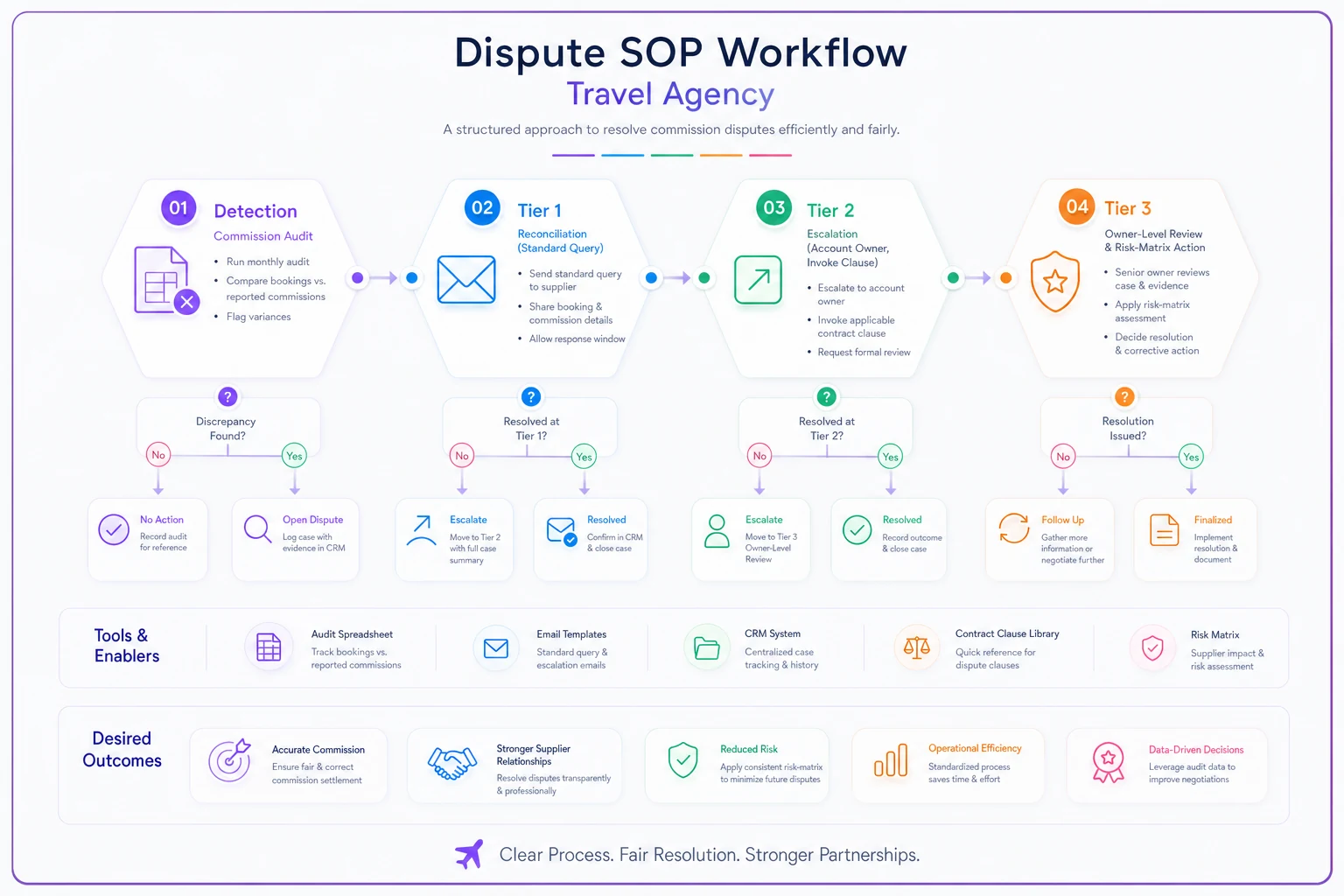
A visual workflow like this helps staff see where a single discrepancy travels and who owns each handoff.
The thing most agencies miss: a dispute SOP isn't really about winning individual disputes. It's about signaling to suppliers that you check. Suppliers who know you reconcile every month and enforce your clauses stop "accidentally" underpaying you. The ones who've learned you never notice treat your commissions as flexible.
For international suppliers this gets more complicated. Currency conversion, VAT treatment, and invoicing timing all create legitimate-looking discrepancies that can mask real errors. Avoid costly errors: handling cross-border payments, VAT and invoicing for international bookings goes deep on that, and it's worth pairing with your dispute SOP so your staff can tell a currency-timing gap from an actual underpayment.
Supplier risk-rating and the enforcement matrix
Not every supplier deserves the same level of scrutiny. You have finite time. The enforcement matrix is about pointing your governance effort at the suppliers most likely to cost you money.
-
Payment reliability — do commissions arrive on time, in full, without chasing?
-
Volume exposure — how much of your booking value flows through them?
-
Dispute history — how often do discrepancies show up?
-
Financial stability — any signs of cash-flow stress, delayed payments, or restructuring?
-
Contract quality — do you have your clause library in place with them, or some old one-sided agreement?
Combine those into a simple rating and match it to an enforcement level:
| Risk rating | Profile | Enforcement level |
|---|---|---|
| Green | Reliable, low dispute rate, solid contract | Standard monthly audit, light touch |
| Yellow | Occasional discrepancies or high volume | Monthly audit plus rate integrity checks, faster escalation |
| Red | Frequent disputes, payment delays, or weak contract | Weekly review, deposit/offset protections, renegotiate or reduce exposure |
Worth naming explicitly: your highest-volume supplier and your highest-risk supplier are often not the same one — but the highest-volume one deserves scrutiny regardless. A green-rated supplier handling 40% of your bookings can leak more absolute dollars through a small percentage error than a red-rated supplier you barely use. Weight your attention by exposure, not just by how much a supplier annoys you.
A red rating doesn't automatically mean you drop the supplier. Sometimes they hold inventory you can't get elsewhere. The matrix just tells you to protect yourself differently — shorter payment terms, offset provisions, tighter audit frequency, and a plan to reduce dependence over time.
When this level of governance actually makes sense
Not every agency needs the full system on day one. If you're doing 30 bookings a month across three suppliers, a heavy governance framework is overkill — you can hold most of it in your head.
The tipping point usually hits somewhere around 150–200 monthly bookings or 10+ active supplier relationships. Past that, no one person can track the terms, the payments, and the disputes across everything. The informal system quietly stops working, and margin starts leaking without anyone noticing exactly when it began.
The other trigger is staff growth. The day you hire someone who books and invoices without having read your supplier contracts, you need a governance layer — because now the people executing the terms aren't the people who agreed to them. That gap is where enforcement dies.
Who should not over-invest in this yet
If you're a solo agent or a two-person shop with a handful of long-standing, reliable suppliers, don't build a five-part governance system before you have the volume to justify it. Start with just two pieces: a standard commission protection clause and a monthly statement match. Those two alone catch most of the leakage at small scale. Add the rest as you grow into it.
A real scenario: mid-size leisure agency
A leisure-focused agency running roughly 220 bookings a month across about 18 suppliers had margins that looked fine on paper but kept coming in 2–3 points under projection every quarter. They couldn't explain the gap.
When they finally ran a full contract-vs-actuals audit, the picture came together. Two suppliers were consistently paying commissions 30–45 days late, and about a third of those late payments were simply never followed up on — they got written off quietly. One supplier had moved a whole category of bookings from 12% to 10% commission and nobody caught the reclassification. And their client-side cancellation language was inconsistent enough that they'd eaten several partial refunds they contractually didn't owe.
None of it was dramatic on its own. Added up, it came to roughly $28k–$34k a year walking out the door on maybe $1.2M in booking value. After they standardized their clause library, set a monthly audit cadence, and moved the two chronically-late suppliers to yellow rating with faster escalation, most of that gap closed within two quarters. Not because they renegotiated a single deal — just because they started enforcing the terms they already had.
Where tooling fits — quietly
You can run all of this in spreadsheets at first, and plenty of agencies do. The reason it eventually breaks down is that the four systems need to talk to each other. Your audit needs booking data. Your dispute SOP needs contract terms. Your risk matrix needs dispute history. When those live in separate files maintained by different people, the governance layer develops the same gaps it was supposed to close.
This is where an operational platform that centralizes bookings, supplier terms, and reconciliation earns its place — not by being clever, but by making sure the commission that's owed automatically shows up as expected against every completed booking, and flagging the ones that don't match. The value isn't automation for its own sake; it's that nothing falls into the gap between "we agreed to this" and "did we actually get it." The broader financial framing in our revenue-ops framework to stop margin leakage in travel agencies connects the governance layer to the rest of your money operations if you want to see how it all fits together.
Pulling it together
Commercial governance sounds like a big corporate concept for something that, in practice, is fairly mechanical: write your terms once and reuse them, check every month whether you got paid what you're owed, know exactly what to do when you didn't, and spend your attention on the suppliers most likely to cost you.
The agencies that do this well don't have better suppliers or sharper negotiators. They just close the gap between what they agreed to and what actually happens — and over a year of bookings, that gap is where the margin was hiding the whole time. Start with the two pieces that pay for themselves fastest: a standard commission protection clause and a monthly statement match. Get those running, watch what they surface, and build the rest of the governance layer around what you find.
Commercial governance sounds like a big corporate concept for something that, in practice, is fairly mechanical: write your terms once and reuse them, check every month whether you got paid what you're owed, know exactly what to do when you didn't, and spend your attention on the suppliers most likely to cost you.
The agencies that do this well don't have better suppliers or sharper negotiators. They just close the gap between what they agreed to and what actually happens — and over a year of bookings, that gap is where the margin was hiding the whole time. Start with the two pieces that pay for themselves fastest: a standard commission protection clause and a monthly statement match. Get those running, watch what they surface, and build the rest of the governance layer around what you find.
Ready to elevate your travel agency workflow?
Join 1,200+ travel agencies using Travexly to save time, improve client satisfaction, and boost operational efficiency.