


Commission reconciliation in travel agencies breaks at three predictable points: split calculations between agents, monthly close procedures, and supplier dispute workflows. Most agencies only discover these breaks after losing thousands in unclaimed commissions — or after overpaying agents for months without realizing it.
The real damage happens in the gaps between your booking system and accounting software. Supplier statements arrive in different formats. Agent splits get calculated on gross instead of net. Override commissions disappear into general revenue. Each mistake compounds month over month until your actual commission income looks nothing like your projections.
Why commission reconciliation fails (and where money disappears)
Commission tracking fails because travel agencies treat it like basic bookkeeping instead of an operational workflow. You're not just matching numbers — you're managing relationships with dozens of suppliers who all report differently, pay on different schedules, and make errors constantly.
The typical agency loses somewhere between 3–7% of commission income through reconciliation gaps. On $2 million in annual bookings at a 12% average commission rate, that's $7,000 to $16,000 vanishing every year. Not from fraud. From spreadsheet formulas, missed deadlines, and disputes nobody followed up on.
The split calculation nightmare
Agent commission splits create immediate problems when calculated wrong. Take a simple scenario: two agents share a $12,000 Europe package with $1,440 in supplier commission. Agent A sourced the client (40% split), Agent B handled all logistics (60% split).
Eliminate booking chaos and streamline operations.
Travexly helps you manage, confirm, and track travel bookings effortlessly.
- Unified booking management
- Automated client communications
- Team scheduling & itinerary tracking
No credit card required
-
The agency keeps 30% house commission first
-
Override commission of $200 arrives three months later
-
Client cancels one hotel, reducing commission by $180
-
Supplier pays in euros, creating a $43 currency variance
Without proper formulas and tracking, Agent A might get paid on the full $1,440 instead of their actual $403.20 share after house commission. The override gets lost. The cancellation adjustment never processes. By year-end, agent compensation is off by thousands.
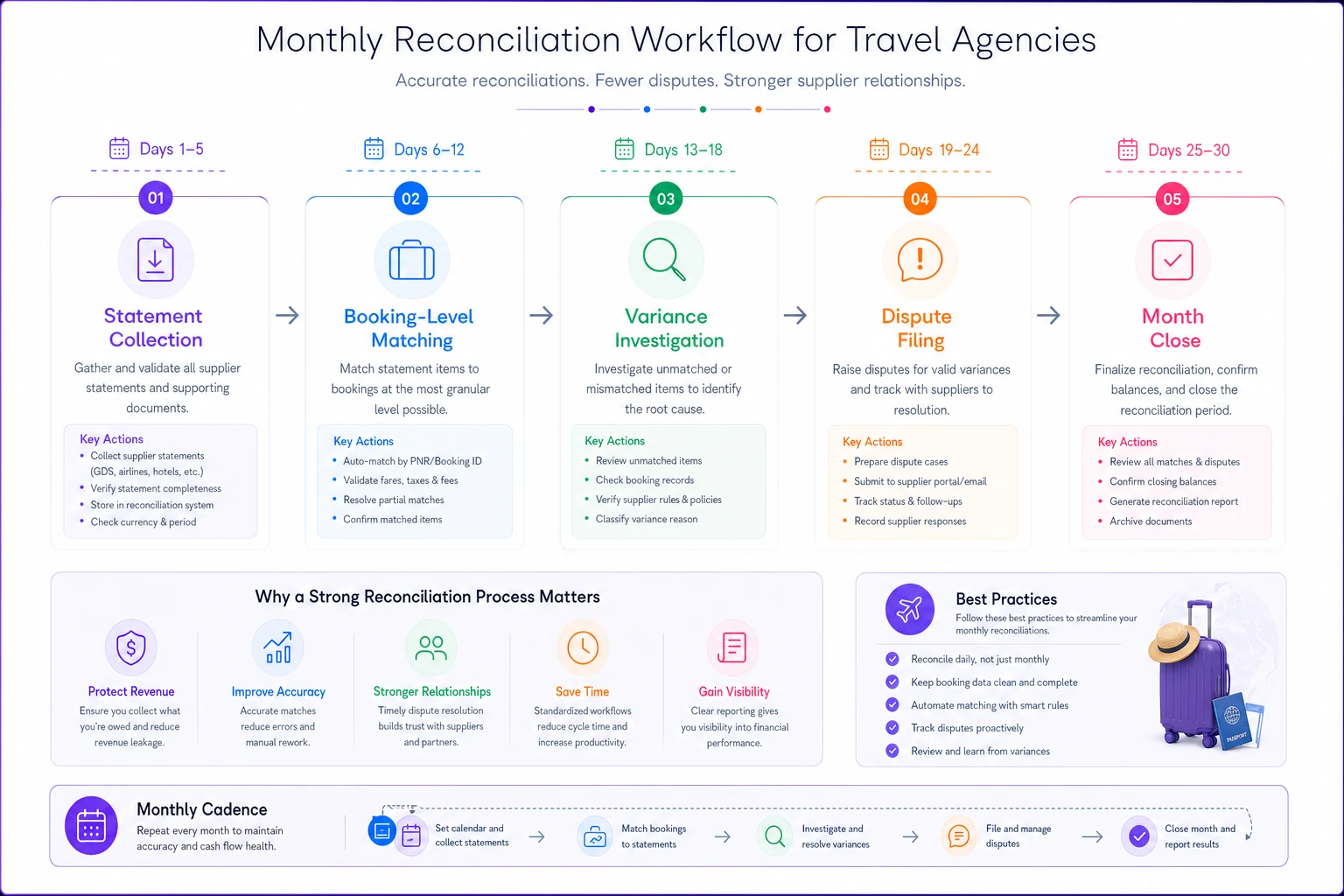
Build a bulletproof monthly reconciliation routine
-
Statement Collection (Days 1–3)
-
Initial Booking-Level Matching (Days 4–6)
-
Variance Investigation & Documentation (Days 7–9)
-
Dispute Filing Through Proper Channels (Days 10–12)
-
Month Close, Final Report & Agent Commission Lock (Day 15)
Days 1–3: Statement collection — Pull every supplier statement. Don't wait for emails — log into portals and download everything directly. Create a folder structure: Year > Month > Supplier. If a supplier hasn't posted by day 3, flag it immediately.
Days 4–6: Initial matching — Match bookings to statements line by line. Not totals — individual bookings. Mark each one with a status:
-
Matched (amount correct)
-
Variance (different amount)
-
Missing from statement
-
Unknown (on statement, not in system)
Days 7–9: Variance investigation — Every variance has a reason. Common causes include booking modifications that weren't updated, currency conversion differences, tax inclusion errors, wrong commission tiers, and partial cancellations. Document each with a specific reason and resolution plan.
-
Booking modifications not updated
-
Currency conversion differences
-
Tax inclusion or exclusion inconsistencies
-
Wrong commission tier applied
-
Partial cancellations or refunds
Days 10–12: Dispute filing — File disputes within this window through proper channels. Email alone leaves a weak audit trail — use supplier portals where available. Include the booking confirmation number, original commission amount, statement amount, the specific discrepancy, and any supporting documentation.
Day 15: Close and report — Lock the month. Calculate final numbers. Report variances over $100 to ownership. Update agent commission calculations based on actual received amounts, not expected amounts.
The spreadsheet template that actually tracks everything
Your reconciliation spreadsheet needs a specific structure to prevent errors. Use separate tabs for booking data, statement imports, reconciliation, agent splits, and dispute tracking.
Tab 1: Booking Master
-
Booking ID | Client | Supplier | Travel Date | Booking Date | Gross Amount | Commission % | Expected Commission | Agent Split | Override Expected
Tab 2: Statement Import
-
Supplier | Statement Date | Booking Reference | Statement Amount | Currency | Exchange Rate | USD Amount | Status
Tab 3: Reconciliation
-
Booking ID (vlookup) | Expected Commission | Statement Amount | Variance | Variance Reason | Action Taken | Resolution Date | Final Amount
Tab 4: Agent Splits
-
Month | Booking ID | Total Commission | House % | House Amount | Agent 1 | Agent 1 % | Agent 1 Amount | Agent 2 | Agent 2 % | Agent 2 Amount | Override Received | Override Split
Tab 5: Dispute Tracker
-
File Date | Supplier | Booking ID | Dispute Amount | Reason | Status | Response Date | Resolution | Amount Recovered
Critical formulas you need:
=IF(Override="","",TotalCommission(1-HousePercent)AgentPercent)
=IF(ABS(Expected-Actual)>10,"REVIEW",IF(Expected=Actual,"MATCHED","VARIANCE"))
=SUMIFS(AgentAmount,AgentName,A2,Month,CurrentMonth,Status,"CONFIRMED")
The supplier dispute workflow that gets results
Supplier disputes fail because agencies handle them too casually. You send an email mentioning a discrepancy. Maybe someone responds. Maybe not. Meanwhile the money is gone. Effective dispute resolution requires process and persistence — not just a friendly follow-up.
Initial dispute filing — Within 48 hours of identifying a discrepancy, file formal notice. Use a clear, factual message that includes booking confirmation number, original commission amount, statement amount, specific discrepancy, and supporting documentation.
Example message: "Booking #7849302 shows $1,440 commission on our contract terms of 12%. Statement #MAR-2024-847 reflects $1,320. Please review and adjust."
The 7-day follow-up — No response in 7 days? Escalate. Reference the original dispute and ask for confirmation of receipt and an expected resolution timeline.
The 14-day escalation — Still unresolved after 14 days? Loop in your regional manager or sales rep, attach all documentation, and request immediate action.
The 30-day decision — After 30 days, make a business call. Document the loss, adjust your records, and reassess the supplier relationship if necessary.
| Supplier | Monthly Bookings | Error Rate | Avg Dispute Time | Recovery Rate |
|---|---|---|---|---|
| Marriott | $45,000 | 2.1% | 9 days | 95% |
| Royal Caribbean | $67,000 | 5.3% | 18 days | 78% |
| Delta Vacations | $34,000 | 1.8% | 6 days | 100% |
| Sandals | $28,000 | 8.2% | 23 days | 62% |
Use this data to drive decisions. High error rates paired with slow resolution times should trigger contract renegotiation conversations or a review of your supplier mix.
Automate before you scale (or drown in spreadsheets)
Manual reconciliation holds up at around 30 bookings a month. Beyond that, errors multiply faster than you can catch them. The spreadsheet that worked fine in year one quietly becomes a liability by year three.
-
Monthly reconciliation is eating 20+ hours of staff time
-
You're finding errors from 3 or more months back
-
Agents dispute their commission calculations on a regular basis
-
Supplier disputes stack up and sit unresolved
-
Commission projections almost never match actuals
Decision thresholds and staffing formula — To determine when to transition away from manual spreadsheets, evaluate bookings/month and hours/month. See mid- and back-office travel software guidance at https://coaxsoft.comMid and Back Office Software for Travel Agencies.
Formula
Reconciliation FTE = Monthly reconciliation and dispute hours ÷ 160
In plain English: This calculation measures how many full-time equivalent employees are consumed by manual statement matching, variance investigation, and supplier dispute management each month.
Example: If your operations team spends 40 hours per month downloading statements, checking bookings, and chasing variances, 40 ÷ 160 = 0.25 FTE.
AI-powered operational software handles this differently than any spreadsheet can. Automated workflows pull statements directly from supplier portals, run commission calculations in real time, flag variances immediately, and create tasks and escalations when exceptions age.
This isn't about replacing your team. It's about redirecting their time away from data entry and toward negotiating better commission tiers and building supplier relationships.
Stop accepting commission leakage as normal. Commission reconciliation problems feel inevitable until you recognize them as process failures, not accounting issues. Every missing override, calculation error, and unresolved dispute represents a broken workflow.
Fix your reconciliation process in stages. Start by locking down the monthly routine, then implement a spreadsheet template with the right formulas, and finally establish a disciplined dispute workflow with escalation triggers.
Small improvements compound. Catching one $200 override monthly is $2,400 a year. Reducing calculation errors by 2% might recover $5,000. The commission you're losing isn't disappearing mysteriously — it leaks through specific, fixable gaps. Don't wait until the problem forces your hand.
Ready to elevate your travel agency workflow?
Join 1,200+ travel agencies using Travexly to save time, improve client satisfaction, and boost operational efficiency.