


Most agency owners think their supplier margin is decided at negotiation. Sign the rate agreement, lock the commission, done. But the real erosion happens after the contract is signed — in the eighteen months of bookings, invoices, chargebacks, rate loading errors, and quiet override clawbacks that nobody's tracking because everyone assumes "we already agreed the terms."
That gap between the terms you negotiated and the money that actually lands in your account is where supplier lifecycle management lives or dies. For most small and mid-sized agencies, it's leaking somewhere between 2% and 5% of net margin without anyone being able to point at exactly where.
This isn't a negotiation post. Plenty of people can teach you to squeeze a better commission tier. What's harder — and what actually moves the needle — is running the whole relationship like a repeatable commercial lifecycle: contract clauses that give you leverage later, scorecards that catch drift early, an audit rhythm that isn't just "when someone complains," and settlement governance that makes sure the money reconciles before the dispute window closes.
Why the money leaks *after* the deal, not during it
Negotiation gets all the attention because it feels decisive and it happens once. Everything after it is repetitive, boring, and spread across different people — which is exactly why it gets ignored.
A typical breakdown looks like this. Your ops lead negotiates a 12% base commission with an override tier at volume. Then bookings happen across six months. The supplier's back office loads some of those bookings at 10% because of a rate-code mismatch. Nobody catches it because your finance person reconciles against the invoice, not against the contracted rate. The invoice looks internally consistent, so it gets paid. You just ate 2 points on that segment and you'll never notice.
Multiply that across a dozen suppliers, seasonal rate changes, and staff turnover, and you get slow, structural margin decay. It doesn't show up as a crisis. It shows up as "our margins are a little tighter than they used to be and we're not sure why." That vagueness is the tell.
The leak tends to cluster in four predictable places:
-
Rate/commission drift — contracted rate ≠ paid rate, quietly
-
Override and incentive slippage — you hit the volume tier but the retro bonus never gets applied or paid
-
Settlement timing — money owed sits past the point where you can legally dispute it
-
Attrition and clawbacks — cancellations trigger commission recall clauses you forgot were in the contract
None of these are negotiation failures. They're lifecycle governance failures. The deal was fine. The management of the deal wasn't.
The five stages of the supplier commercial lifecycle
Treat every supplier relationship as moving through the same five stages, on repeat. The point of naming them is that each stage has its own failure mode and its own controls. When you skip a stage — or let it happen informally — that's where the money goes.
Eliminate booking chaos and streamline operations.
Travexly helps you manage, confirm, and track travel bookings effortlessly.
- Unified booking management
- Automated client communications
- Team scheduling & itinerary tracking
No credit card required
| Stage | What it's actually for | The failure mode when skipped |
|---|---|---|
| 1. Negotiation & contracting | Locking operational clauses, not just rates | Vague terms you can't enforce later |
| 2. Onboarding & data setup | Getting rate codes, IDs and mapping correct | Silent mismatches that corrupt reconciliation |
| 3. Live operations | Booking, invoicing, settlement | Drift accumulates unnoticed |
| 4. Audit & scorecard | Catching drift, measuring performance | Problems surface only during disputes |
| 5. Quarterly review & renewal | Renegotiating from data, not feelings | You renew blind and lose leverage |
Most agencies do stages 1 and 3 well enough and basically ignore 2, 4 and 5. That's the whole problem in one sentence.
A simple visual of this lifecycle makes the handoffs and recurring nature easier to scan.
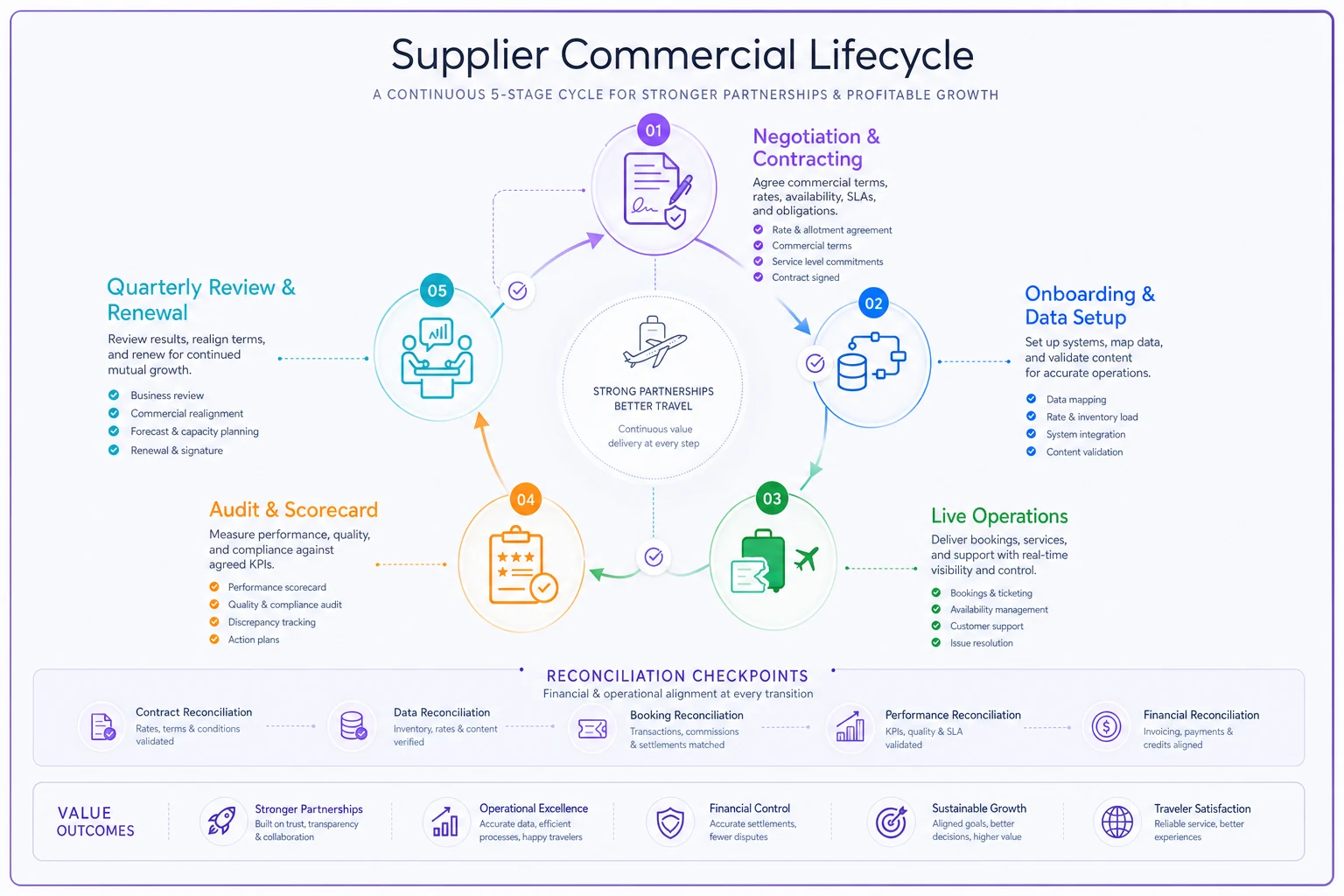
The visual ties back to why standardizing stages matters: each stage has distinct controls and failure modes, so treating them as a repeatable flow stops ad-hoc drift.
Stage 1: Contract clauses that actually protect you later
The negotiation everyone remembers is about the commission number. The negotiation that saves you money eighteen months out is about the operational clauses nobody reads twice.
A few that earn their keep:
-
Rate-integrity clause. The supplier warrants that bookings will be loaded and paid at the contracted rate, and any underpayment discovered within, say, 180 days is recoverable without a fight. This one clause is what turns "we think they underpaid us" into "here's the clause, please remit."
-
Settlement window and interest clause. Define exactly when commission and overrides are paid, and what happens if they're late. Ambiguity here is why money sits for months.
-
Clawback caps. If cancellation triggers a commission recall, cap the window and the conditions. Open-ended clawback clauses are a slow bleed on a book with normal attrition.
-
Audit-access clause. You get the right to reconcile against their booking records on request. Without this, an audit depends on their goodwill.
-
Override calculation transparency. Spell out exactly how volume tiers are measured — net vs gross, which product lines count, what the measurement period is. "We'll figure it out later" almost always resolves in the supplier's favor.
The deeper commercial-governance mechanics — how to structure the contract language itself and handle disputes when they arise — are worth reading in the commercial governance playbook for supplier contracts and commission disputes. This post is about the lifecycle; that one goes deep on the contract mechanics.
Stage 2: Onboarding is where reconciliation quietly breaks
This is the most under-appreciated stage. Onboarding feels administrative — set up the supplier code, map the products, done. But every reconciliation you'll ever run against this supplier depends on getting the data setup right once, at the start.
The classic breakage: a supplier has three rate codes for what looks like the same product, and your booking system maps all three to a single internal rate. Now some bookings pay 12%, some pay 9%, and your reconciliation treats them as identical. You can't catch a discrepancy you've flattened into invisibility.
-
Capture every rate code and commission tier the supplier uses — not just the headline one.
-
Map each code to a distinct internal reference, never merge them.
-
Record the contracted rate per code somewhere your finance workflow can check against.
-
Run a test booking and reconcile it end-to-end before going live.
-
Document the settlement schedule and dispute contact in the same place.
That last step matters more than it looks. When a discrepancy shows up eight months later, the person handling it usually has no idea who to email or what the payment schedule even was. Front-loading that information is the difference between a five-minute recovery and a three-week chase.
Stage 3: Live operations — where drift accumulates silently
Once bookings are flowing, the risk is that nobody's comparing what should have been paid against what was paid, transaction by transaction. Manual reconciliation catches the big obvious errors and misses the drip.
The mechanics of catching commission discrepancies — how to calculate splits correctly and resolve errors when the numbers don't match — are covered in detail in this breakdown on fixing commission leakage. The lifecycle point is simpler: this reconciliation has to be a standing operational rhythm, not something someone does when they're suspicious.
This is where reconciliation software actually earns its place — not as a magic fix, but because comparing contracted-rate-per-code against paid-amount-per-booking across hundreds of transactions is exactly the kind of repetitive matching that humans do slowly and inconsistently. An AI-assisted reconciliation layer that flags "this booking paid 2 points under the contracted code" turns a task nobody has bandwidth for into an exception list someone can clear in twenty minutes. The value isn't the automation itself — it's that drift stops being invisible.
Stage 4: The supplier scorecard and audit cadence
You can't renegotiate well against a supplier you haven't measured. A scorecard turns a fuzzy sense of "they're a bit of a pain" into something you can put on the table at renewal.
Keep it small and honest. Four or five metrics, tracked per supplier, per quarter:
-
Rate accuracy — % of bookings paid at contracted rate
-
Settlement timeliness — average days from due to paid
-
Dispute rate — how often you have to chase them
-
Override reliability — did earned tiers actually get paid
-
Support responsiveness — time to resolve an operational issue
The audit cadence sits underneath the scorecard. A workable rhythm for most agencies: a light monthly reconciliation sweep, a deeper quarterly audit on your top five or six suppliers by volume, and a full contract-to-payment audit annually or before any renewal. The mistake is auditing everyone equally — most of your leakage is concentrated in a handful of high-volume relationships, so weight your effort there.
Stage 5: The quarterly review agenda
The quarterly review is where the whole lifecycle pays off — if you walk in with data instead of impressions. Most supplier reviews are a friendly catch-up where nothing gets decided. A governed review has an actual agenda:
-
Walk the scorecard together — accuracy, timeliness, disputes.
-
Review any rate discrepancies found and confirm recovery.
-
Confirm override/incentive tiers and reconcile them.
-
Flag upcoming volume shifts (seasonality, new products) that affect tiers.
-
Agree action items with owners and dates before anyone leaves.
One thing worth noting: when a supplier knows you run a quarterly reconciliation and you show up with a scorecard, the accuracy of their payments quietly improves. Suppliers underpay agencies that aren't watching. Being visibly organized is itself a margin control.
A real scenario
A mid-sized leisure agency — roughly 300–350 bookings a month across about nine suppliers — kept noticing net margin sliding by a point or two year over year with no clear reason. When they finally ran a contract-to-payment audit on their top four suppliers, two things surfaced: one supplier had been loading a chunk of bookings under a rate code paying 3 points below contract, and an override tier from the previous year had never been paid because nobody submitted the volume claim.
The recovery on those two items came to somewhere around $9k–$11k. But the more useful outcome was structural: they set up a quarterly scorecard and a monthly reconciliation sweep, and over the following two quarters the "mystery" margin slide basically stopped. The leak wasn't one big theft — it was drift, compounding, that nobody was positioned to catch.
When this level of governance makes sense — and when it doesn't
When it's worth it: You're running more than a handful of suppliers, your booking volume is high enough that manual spot-checks miss things, or you've noticed margin drifting without a clear cause. Once you're past roughly a few hundred bookings a month, the drift is almost certainly there — you just can't see it.
When it's overkill: If you're a very small agency with two or three suppliers and low volume, a full scorecard-and-audit-cadence system is probably more process than the leakage justifies. Get the contract clauses right and do a solid annual reconciliation. Don't build governance heavier than the money it protects.
Who should not do this: Anyone who won't actually maintain it. A scorecard nobody updates and a quarterly review nobody prepares for is worse than nothing, because it creates a false sense that the relationship is managed. Either commit to the cadence or keep it simple and honest.
The reason supplier margin erodes isn't bad negotiating — it's that most agencies stop managing the relationship the moment the ink dries. The deal becomes background noise, and the money leaks in the boring operational gaps between contract and payment.
Running suppliers as a lifecycle — clauses that give you leverage later, clean onboarding data, standing reconciliation, honest scorecards, and a quarterly review with actual teeth — is how you protect margin you already earned. It's less glamorous than winning a better commission tier. It's also usually worth more, because it stops the slow bleed that no single negotiation can fix.
Ready to elevate your travel agency workflow?
Join 1,200+ travel agencies using Travexly to save time, improve client satisfaction, and boost operational efficiency.