

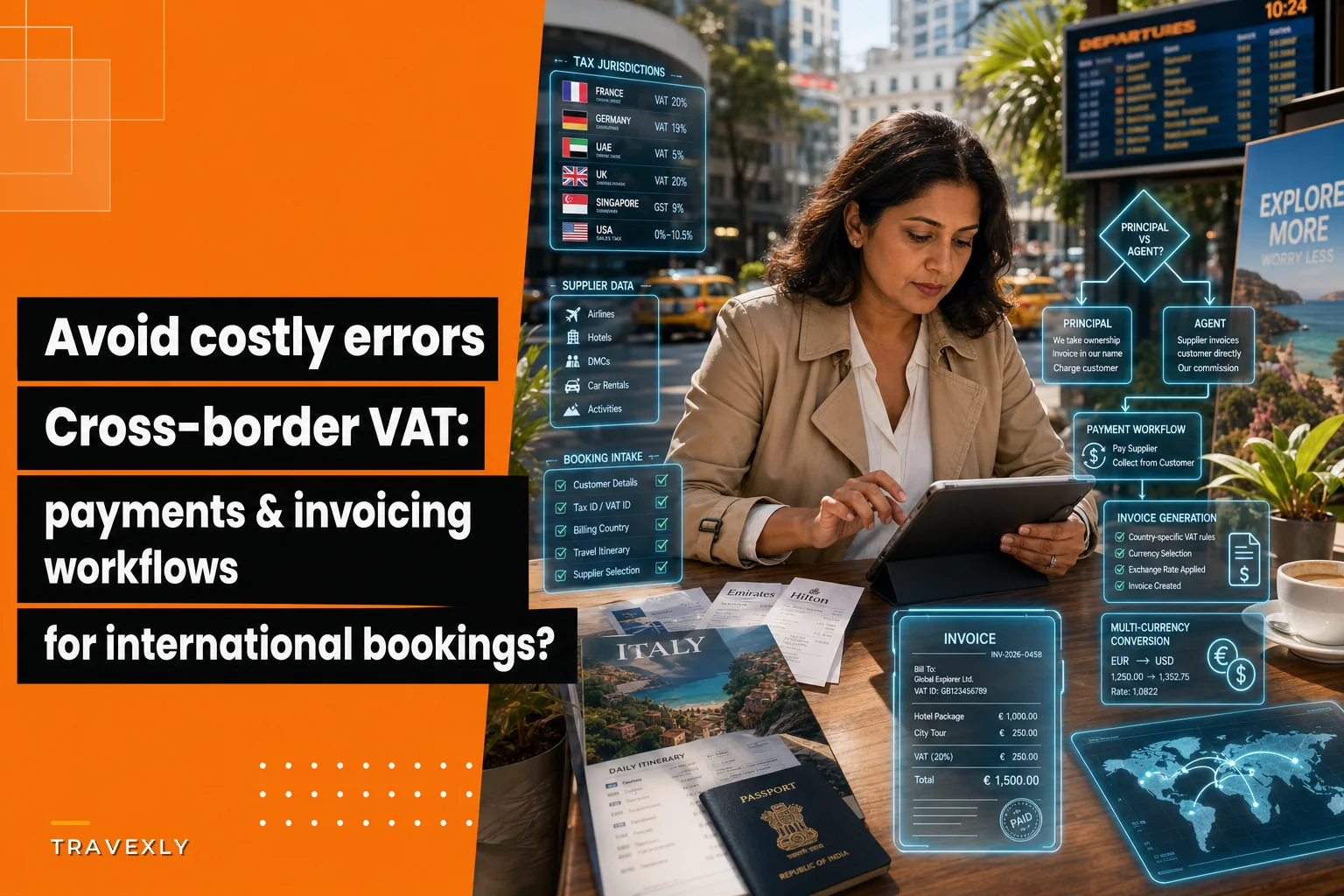

Cross-border payments, travel agency VAT issues, and invoicing gaps create thousands in unnecessary costs every year for agencies handling international bookings. The problem isn't just different currencies or tax rates—it's the operational mess that happens when your invoicing system, payment processing, and tax documentation don't align with how different countries actually handle travel services.
Most agencies realize they have a problem when their accountant calls with questions about VAT reverse charges on European hotel bookings, or when a corporate client refuses to pay because the invoice doesn't show tax breakdowns in the format their country requires. By then you're already dealing with payment delays, compliance headaches, and margin erosion from currency conversion fees you didn't account for.
The €23,000 VAT surprise that changed how we think about European bookings
A mid-sized adventure travel agency based in Colorado learned this lesson painfully last year. They'd been booking European tours for American clients for three years, growing from $800K to $2.4M in annual revenue. Everything seemed fine until they received a letter from the German tax authority claiming they owed €23,000 in uncollected VAT.
The agency had been treating all their bookings as B2C transactions exempt from European VAT because their clients were American consumers. What they missed: when you book directly with European hotels and ground operators as an intermediary, you're often considered the buyer of those services—not just a pass-through agent. The VAT treatment depends on who holds the merchant relationship, how payments flow, and whether you're acting as principal or agent.
Their invoices showed simple line items like "7-day Bavaria tour package - $4,500." No VAT registration numbers. No reverse charge notations. No breakdown between accommodation, transport, and guide services that carry different VAT treatments. When German authorities audited one of their main hotel partners, the trail led straight back to hundreds of improperly documented bookings.
Why standard invoicing breaks down with international bookings
The core problem is that travel agencies operate across multiple tax jurisdictions simultaneously while most invoicing systems assume single-country operations. When you book a hotel in France for a client in Japan through your US-based agency, you're dealing with at least three different invoice requirements at once:
Eliminate booking chaos and streamline operations.
Travexly helps you manage, confirm, and track travel bookings effortlessly.
- Unified booking management
- Automated client communications
- Team scheduling & itinerary tracking
No credit card required
Japanese clients need:
-
Consumption tax (JCT) handling for international services
-
Specific formatting for expense reimbursement
-
Company registration numbers in exact positions
French suppliers require:
-
VAT identification numbers displayed prominently
-
Reverse charge mechanism notation when applicable
-
Service location determination for tax purposes
Your US operations need:
-
State sales tax considerations for agency fees
-
Proper documentation for international service exemptions
-
Currency conversion tracking for IRS reporting
Each booking creates multiple invoice relationships. You issue an invoice to your client. The supplier invoices you. Sometimes there's a wholesaler in between. Each document needs different information, different tax treatments, and different payment terms. Most agencies handle this with manual adjustments, spreadsheet tracking, and crossed fingers that nothing falls through the cracks.
The five invoice elements that vary most between countries
These five elements cause the most operational problems across international bookings:
1. Tax identification display requirements
US agencies often list their EIN casually at the bottom of invoices. European recipients need VAT numbers in specific formats (like "DE123456789" for Germany) displayed prominently near the company name. Australian businesses require ABN numbers. Japanese companies need both corporate numbers and invoice numbers in specific sequences.
Getting this wrong means corporate clients can't process payments through their systems. Their accounts payable literally cannot enter an invoice missing required identifiers. You end up with emails requesting "corrected invoices" weeks after sending the original, delaying payment by 30-60 days.
2. Service location determination
Where did the travel service actually occur for tax purposes? A tour package might include:
-
Hotel accommodation (taxed where the property is located)
-
Transportation (complex rules based on departure/arrival points)
-
Guide services (usually where performed)
-
Booking fees (typically where the agency is located)
Your invoice needs to break these down separately with clear location indicators. A single line item reading "European tour package" makes it impossible for clients or tax authorities to determine proper tax treatment. The burden of splitting every package into components feels excessive until you're explaining to auditors why you can't provide proper documentation.
3. Currency and conversion disclosure
International bookings involve multiple currency conversions that affect both pricing and tax calculations. Consider a typical flow:
You quote the client $5,000 USD. They pay you in USD. You pay the European supplier €4,200 EUR. The supplier charges VAT on the EUR amount. Your client needs the invoice to show:
-
USD amount paid
-
EUR amount for the service
-
Exchange rate used
-
Date of rate determination
-
VAT calculated on EUR base
Many agencies only show the USD total, creating reconciliation nightmares when clients need to match payments to supplier invoices for their own tax purposes. Corporate travel managers spend hours figuring out why the $5,000 they paid doesn't reconcile with the €4,200 + VAT on the hotel's direct invoice.
4. Tax calculation transparency
Different countries have different expectations for how taxes appear on invoices. US businesses are used to seeing tax as a single line item added to the subtotal. European invoices must show:
-
Net amount
-
Tax rate applied
-
Tax amount
-
Gross total
-
Reverse charge notations where applicable
Japanese invoices need to distinguish between standard rate (10%) and reduced rate (8%) consumption tax, even within the same booking. Australian invoices must clearly state "GST inclusive" or "GST exclusive" pricing.
The operational challenge: your booking system probably wasn't designed for this level of tax complexity. You end up maintaining separate invoice templates for different regions, manually calculating tax breakdowns, and hoping you're applying the right rules.
5. Regulatory text and compliance statements
This is the element most US agencies completely miss. European invoices often need specific regulatory text like:
"Reverse charge - Customer to account for VAT to the relevant tax authority"
or
"VAT exemption under Article 151 of Council Directive 2006/112/EC"
These aren't optional additions—they're legal requirements that determine who's responsible for remitting VAT. Missing this text can make your agency liable for taxes you never collected.
Real invoice examples that actually work
Here's how proper international invoicing looks in practice. These formats have passed audit scrutiny.
Example 1: US agency invoicing a German corporation for Italian hotels
| Example 1 Invoice |
|---|
| Invoice #2847 |
| Adventure Trails LLC |
| EIN: 83-1234567 |
| Bill to: Siemens AG |
| VAT ID: DE129274202 |
| Invoice Reference: PO-48271 |
| Service Details: |
| 1. Accommodation Services - Rome |
| Hotel Palazzo (VAT IT09182901) |
| May 15-19, 2024 |
| Service location: Italy |
| Net Amount: €3,200.00 |
| VAT 0% - Reverse charge applicable* |
| 2. Accommodation Services - Florence |
| Villa Tuscany (VAT IT08271822) |
| May 19-22, 2024 |
| Service location: Italy |
| Net Amount: €2,400.00 |
| VAT 0% - Reverse charge applicable* |
| 3. Agency Booking Fee |
| Service location: USA |
| Net Amount: $850.00 |
| No VAT - Service performed outside EU |
| Currency Conversion: |
| EUR/USD rate 1.0892 (May 1, 2024) |
| €5,600.00 = $6,099.52 |
| Total Services: $6,949.52 |
| Total Due: $6,949.52 |
| *Reverse charge - Customer to account for VAT per Article 196 of |
| Council Directive 2006/112/EC. Intra-community service supply. |
Example 2: Handling mixed B2B/B2C bookings for Japanese clients
| Example 2 Invoice |
|---|
| Invoice #3021 |
| Global Adventures Inc. |
| Federal EIN: 91-7654321 |
| Bill to: Mitsubishi Corporation |
| Corporate Number: 8010001008767 |
| Booking Reference: MC-2024-0482 |
| Travel Dates: June 10-17, 2024 |
| Business Travel Components (Qualified Invoice): |
| 1. Accommodation - Business Portion |
| Marriott Tokyo (5 nights @ ¥32,000) |
| Subtotal: ¥160,000 |
| Consumption Tax (10%): ¥16,000 |
| 2. Meeting Room Rental |
| June 12, 2024 |
| Subtotal: ¥25,000 |
| Consumption Tax (10%): ¥2,500 |
| Business Total: ¥203,500 |
| Personal Extension (Receipt): |
| 3. Accommodation - Personal |
| Marriott Tokyo (2 nights @ ¥32,000) |
| Total including tax: ¥70,400 |
| Currency Settlement: |
| ¥273,900 @ 0.0071 USD/JPY = $1,944.69 USD |
| Payment received via wire transfer May 28, 2024 |
These examples show detailed line-item breakdowns, tax identifiers, currency conversion details, and regulatory text that auditors expect.
Building operational workflows that prevent invoice problems
The examples above only work if your operations can actually generate this level of detail. Here's what needs to happen behind the scenes.
Booking intake must capture tax information
Your booking forms need fields for:
-
Client's tax identification numbers
-
Whether the booking is business or personal
-
Billing address country for tax determination
-
Corporate purchase order numbers
-
Specific invoice requirements
This information can't be an afterthought. One agency started requiring tax IDs upfront and saw their average payment timeline drop from around 47 days to 22. Corporate clients could process invoices immediately instead of going back and forth requesting corrections.
Require tax IDs at booking to reduce invoice correction cycles and speed payments.
Supplier data needs structure
You can't generate proper invoices without organized supplier information. For each vendor, track:
-
Legal entity name (not just trade name)
-
Tax registration numbers for each country they operate in
-
Which tax rules apply to their services
-
Whether they're registered for reverse charge mechanisms
-
Required invoice language for their jurisdiction
This means building a supplier database that goes well beyond contact information. It's tedious setup work, but consider the alternative: manually looking up tax numbers and regulations for every international invoice you generate.
Payment flows affect tax treatment
How money moves through your agency determines tax obligations. There's a significant difference between:
Scenario A: Client pays you → You pay supplier (You're the principal, full tax obligations)
Scenario B: Client pays supplier directly, you invoice commission (You're the agent, limited tax exposure)
Scenario C: Client pays you → You immediately transfer to supplier (Grey area, depends on contractual relationships)
Many agencies drift between these models without realizing the tax implications shift with each flow. An agency in Miami discovered they'd been treating all European bookings as Scenario B (agent) when their contracts actually established Scenario A (principal) relationships. The fix required restructuring how they processed payments across 400+ bookings per year.
Here's a quick workflow visualization to make the operational steps clearer.
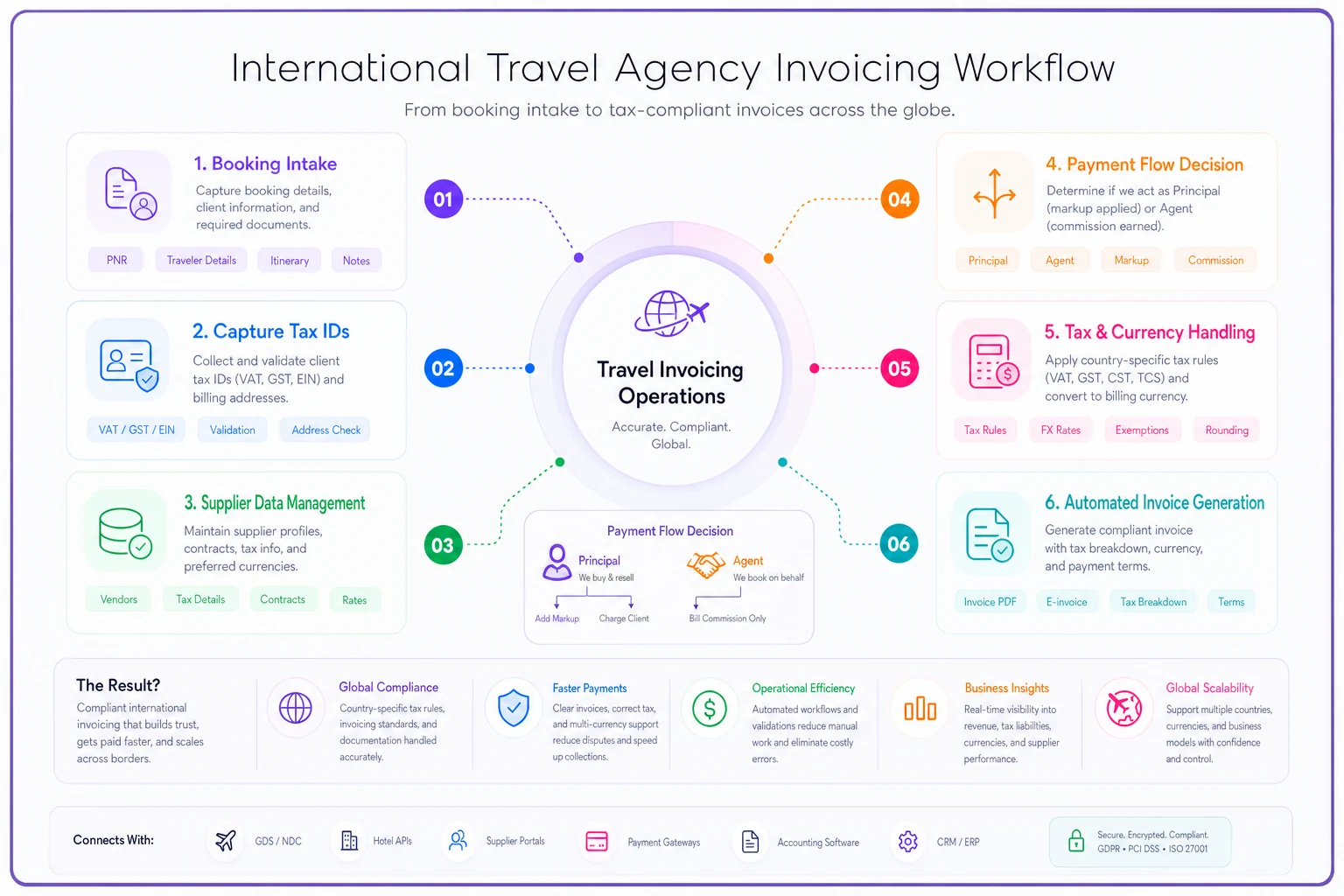
Use this workflow to map where data needs to be captured and how payment flows change tax treatment.
Country-specific requirements that catch agencies off-guard
Beyond general principles, specific countries have requirements that regularly trip up international bookings:
European Union nuances
France: Requires "Mentions Légales" (legal notices) on all invoices, including company registration details, share capital, and registered address. Missing these makes invoices legally invalid.
Spain: Tourist accommodation has a special reduced VAT rate (10% vs. the standard 21%). But the reduction only applies if invoiced correctly with proper service descriptions.
Netherlands: Has specific "small entrepreneur" exemptions that affect whether Dutch suppliers charge you VAT. You need to know their status to handle invoicing correctly.
Asia-Pacific complexity
Singapore: GST applies to services "consumed" in Singapore, but determining consumption location for travel services involves complex rules about where the customer "belongs."
Thailand: Requires specific withholding tax certificates for many service payments. Without proper documentation, clients may withhold 3-5% of your payment for tax purposes.
South Korea: Corporate invoices need electronic tax invoice registration through their ETAX system. Paper invoices, even if perfectly formatted, won't work for many Korean businesses.
Middle East variations
UAE: Different emirates have different tourism fees and municipality taxes that must be separately itemized—not bundled into accommodation costs.
Saudi Arabia: Implemented VAT relatively recently and regulations have changed frequently. What was compliant six months ago might not be today.
Technology solutions vs. manual workarounds
Most agencies handle international invoicing through painful manual processes. Dozens of Excel templates, manually calculated taxes, and a lot of hoping they're staying compliant. This works until it doesn't—usually when you're growing fast or facing an audit.
The operational burden compounds as you scale. At 50 international bookings per month, spreadsheets might be manageable. At 200, the manual work becomes a near-full-time job. At 500+, errors become inevitable without proper systems in place.
AI-powered operational platforms built for travel agencies can automate much of this complexity. They maintain tax rules by country, generate compliant invoices from standard booking data, and flag changes in regulations before they become compliance problems. The key is finding systems that understand travel-specific tax scenarios—not generic invoicing software that treats every service the same way.
That said, even with automation, you still need the operational foundation. Proper data collection, clear payment flows, organized supplier records. Technology amplifies good processes; it doesn't fix broken ones.
The hidden costs of getting it wrong
Invoice errors in cross-border payment and VAT scenarios create cascading problems:
Direct costs: Tax penalties, interest on late payments, audit defense fees. That German VAT assessment mentioned earlier came with €4,000 in penalties on top of the €23,000 owed.
Payment delays: Corporate clients often take 60-90 days to pay incorrect invoices versus 15-30 days for clean ones. On $50,000 in monthly international bookings, that's a meaningful cash flow impact.
Operational burden: Staff time fixing invoices, responding to client queries, and managing corrections. One agency calculated they were spending around 30 hours per month on invoice corrections alone.
Relationship damage: Professional travel managers remember agencies that create paperwork problems. They'll book elsewhere to avoid the hassle, even if your tours are better.
Audit exposure: Once you're on a tax authority's radar, expect continued scrutiny. That Colorado agency now faces quarterly reporting requirements to German tax authorities—permanent additional overhead.
A practical action plan for fixing your international invoicing
Rather than overhauling everything at once, prioritize based on risk and volume:
Week 1-2: Audit your current situation
-
List your top 10 international suppliers
-
Document what tax information you have for each
-
Review 20 recent international invoices for compliance gaps
-
Identify which countries generate the majority of your bookings
Week 3-4: Fix critical gaps
-
Update booking forms to capture tax IDs
-
Create templates for your top 3 international markets
-
Document which suppliers use reverse charge mechanisms
-
Set up tracking for currency conversion rates used
Month 2: Systematize the process
-
Build or buy proper invoice generation capability
-
Train staff on country-specific requirements
-
Create a compliance checklist for international bookings
-
Establish a monthly review of invoice accuracy
Month 3+: Continuous improvement
-
Monitor payment speeds by country
-
Track invoice correction requests
-
Update templates as regulations change
-
Consider automation for high-volume routes
Prioritize the highest-risk markets and the suppliers that generate the most value. Fixing those first yields the fastest ROI on operational effort or technology spend.
When to get help vs. figure it out yourself
Small agencies under roughly $2M in revenue can often manage with good templates and careful processes. You don't need perfect global tax compliance—just enough to avoid major problems in your main markets.
Growing agencies in the $2M-$10M range should invest in proper systems. At that scale, the cost of errors tends to exceed the cost of solutions. Whether that's specialized software, expert consultation, or both depends on your booking patterns.
Larger operations above $10M need comprehensive solutions. Manual processes at that volume guarantee problems. The question isn't whether to systematize, but how quickly you can implement proper operational platforms.
Cross-border payment and travel agency VAT challenges aren't going away. As travel becomes increasingly global and tax authorities get better at enforcement, proper invoicing becomes an operational necessity—not an administrative nice-to-have.
The agencies doing well with international bookings aren't necessarily tax experts. They've built operational systems that capture the right information, generate compliant documents, and adapt as requirements change. They treat invoicing as part of service delivery, not an afterthought.
Start with your highest-volume international routes. Get those invoices right. Build templates that actually work. Track what's causing payment delays. Then expand systematically from there.
The goal isn't perfection—it's operational efficiency that prevents major problems while enabling growth. With the right foundation, international bookings become a competitive advantage instead of a compliance nightmare.
Ready to elevate your travel agency workflow?
Join 1,200+ travel agencies using Travexly to save time, improve client satisfaction, and boost operational efficiency.