



Walk into any travel agency doing $2-4M in annual bookings, and you'll find the same operational chaos. Commission reports scattered across 47 different supplier portals. Package pricing built on three-month-old rate sheets. Reconciliation happening whenever someone remembers to check. Meanwhile, thousands of dollars leak out through gaps nobody even knows exist.
Most owners have no clue where their actual margins come from. They think they do—pointing to their standard 10% commission or whatever markup they slap on packages. But between what gets quoted, what gets booked, what gets invoiced, and what actually lands in the bank account, there's a maze of operational breakdowns silently destroying profitability.
This has nothing to do with being disorganized or lacking fancy software. When packaging decisions, commission structures, reconciliation processes, and reporting systems don't work together as a coordinated revenue machine, margin leakage becomes the silent business killer that turns seemingly profitable agencies into break-even operations.
Why traditional travel agency operations guarantee margin erosion
Travel agencies operate with a broken revenue model that most owners never question. You quote a trip based on supplier rates from last month. The client books three weeks later when those rates have shifted. Your commission agreement says 10%, but the actual payment comes in at 8.5% because of some fine print about international bookings. Meanwhile, your agent thinks they're getting 40% of that 10%, but nobody tracked whether this was a repeat client with a different split structure.
The fundamental problem runs deeper than bad math. Travel agency revenue operations evolved from an era when agents worked off printed rate sheets and commission checks arrived by mail. Today's reality? Dynamic pricing changes hourly, commission structures vary by destination, booking class, season, and volume tiers, and clients expect instant quotes while comparing your prices against three online platforms.
A typical day at a $3M travel agency looks something like this:
Morning chaos: Agent pulls together a European package for a family of four. Uses hotel rates from a PDF downloaded six weeks ago. Adds flights from a GDS showing yesterday's pricing. Calculates transfers based on a rate sheet from Q2. Applies the standard 15% markup. Sends quote feeling confident.
Afternoon surprise: Client books. Agent goes to confirm. Hotel rates jumped 8%. Flight inventory shifted to a higher fare class. Transfer company now requires minimum four-hour booking instead of two. Margin just dropped from 15% to 7%, but the agent already promised the quoted price.
Month-end mystery: Accounting tries to reconcile. Hotel commission arrives at 8% instead of expected 10%—apparently, that property falls under a different agreement. Airline commission never shows up—turns out that fare class was net rate. Transfer company pays, but in euros, and the exchange rate shifted 3% since booking.
This pattern repeats across hundreds of bookings monthly. Each leak seems small—$50 here, $200 there. But multiply that across a year of bookings, and suddenly you're looking at $150,000 to $400,000 in lost margin that nobody tracked.
The four-pillar revenue operations framework that actually works
Revenue operations in travel agencies comes down to four interconnected pillars that must function as a unified system.
Eliminate booking chaos and streamline operations.
Travexly helps you manage, confirm, and track travel bookings effortlessly.
- Unified booking management
- Automated client communications
- Team scheduling & itinerary tracking
No credit card required
Pillar 1: Dynamic packaging architecture
Forget static markups and standardized packages. Revenue operations starts with understanding that every package component has its own margin profile, volatility pattern, and operational cost.
Build your packaging rules around margin targets, not markup percentages. A $5,000 Caribbean package and a $5,000 European tour require completely different margin strategies. Caribbean bookings might run on thin 8% supplier margins but require minimal operational overhead. European multi-city tours might offer 12% commissions but demand three hours of coordination work.
Component margin mapping: Hotels typically offer 10-12% but pay reliably. Airlines range from 0-7% and often pay late. Transfers offer 15-20% but require heavy coordination. Tours provide 12-15% but come with higher cancellation risk. Cruise lines pay 10-16% but include tons of hidden fees.
Operational cost allocation: That $500 flight booking earning 5% commission ($25) just consumed 45 minutes of agent time. The $8,000 cruise booking at 12% ($960) took 20 minutes. Which one actually makes money?
Volatility buffers: Build padding based on component stability:
-
Hotel rates in peak season need 5% buffer
-
Shoulder season needs 8% buffer
-
Off-season needs 3% buffer
-
Peak season inventory locks in early
-
Shoulder season shifts wildly
-
Off-season stays stable but at lower margins
Pillar 2: Commission intelligence system
Stop treating commissions as a single number. Every booking contains multiple commission streams, payment timelines, and calculation methods that affect real margin.
A proper commission mapping system tracks multiple variables. That Sandals resort offers 12% base commission. But hit $250k in annual bookings, and it jumps to 14% retroactively. Book their premium category, add another 2%. Include air, lose 1%. Send five bookings in a month, earn a $500 bonus. Miss any of these details, and margin projections fall apart.
Payment velocity patterns matter more than people realize. Marriott pays within 30 days. Boutique hotels take 60-90 days. Some European properties pay only after guest checkout. That Disney package commission? Might not arrive for four months. Cash flow planning without payment velocity mapping is pure fantasy.
True commission calculation gets messy fast. Gross booking shows $10,000. But that includes $890 in taxes. The resort fee of $400 is non-commissionable. The transfer add-on comes from a different supplier. Real commissionable base: $8,710. Actual commission at 10%: $871, not the $1,000 everyone assumed.
Pillar 3: Reconciliation engine
Most agencies check commissions when they remember to, usually months after payment should have arrived. By then, disputing shortfalls becomes nearly impossible.
30-day sweep protocol: Every booking gets flagged 30 days after travel date. No commission received? Automatic follow-up triggers. Commission arrived but amount wrong? Dispute process starts immediately.
Variance detection rules: Expected $500 commission but received $450? System flags for review. Pattern of 10% shortfalls from specific supplier? Escalation protocol kicks in. Three months of perfect payments suddenly drop? Investigation launches.
Supplier scorecarding: Track actual vs. promised commission rates by supplier. That tour operator promising 15% but consistently paying 13.5%? Either renegotiate terms or adjust package pricing. The hotel chain that always pays exactly as promised? They get preferred partner status.
Pillar 4: Margin visibility dashboard
You can't fix what you can't see. Most travel agencies run blind, discovering margin problems only during year-end tax prep.
Booking-level margin tracking: Every single booking should show quoted margin, expected margin, actual cost basis, received commissions, and true final margin. Not in a spreadsheet somewhere. Right in your daily operations.
Product line profitability: Caribbean packages might show 12% margins but 18% cancellation rates. European tours run 9% margins with 3% cancellations. Asia bookings offer 14% margins but require twice the service hours. Which actually makes money?
Agent performance metrics: Sarah books high-volume Caribbean at thin margins. Marcus focuses on complex Europe at higher margins but lower volume. Jennifer sells groups with massive commissions but enormous coordination costs. Who really drives profitability?
Here's a simple workflow showing how packaging, commissions, reconciliation, and reporting connect.
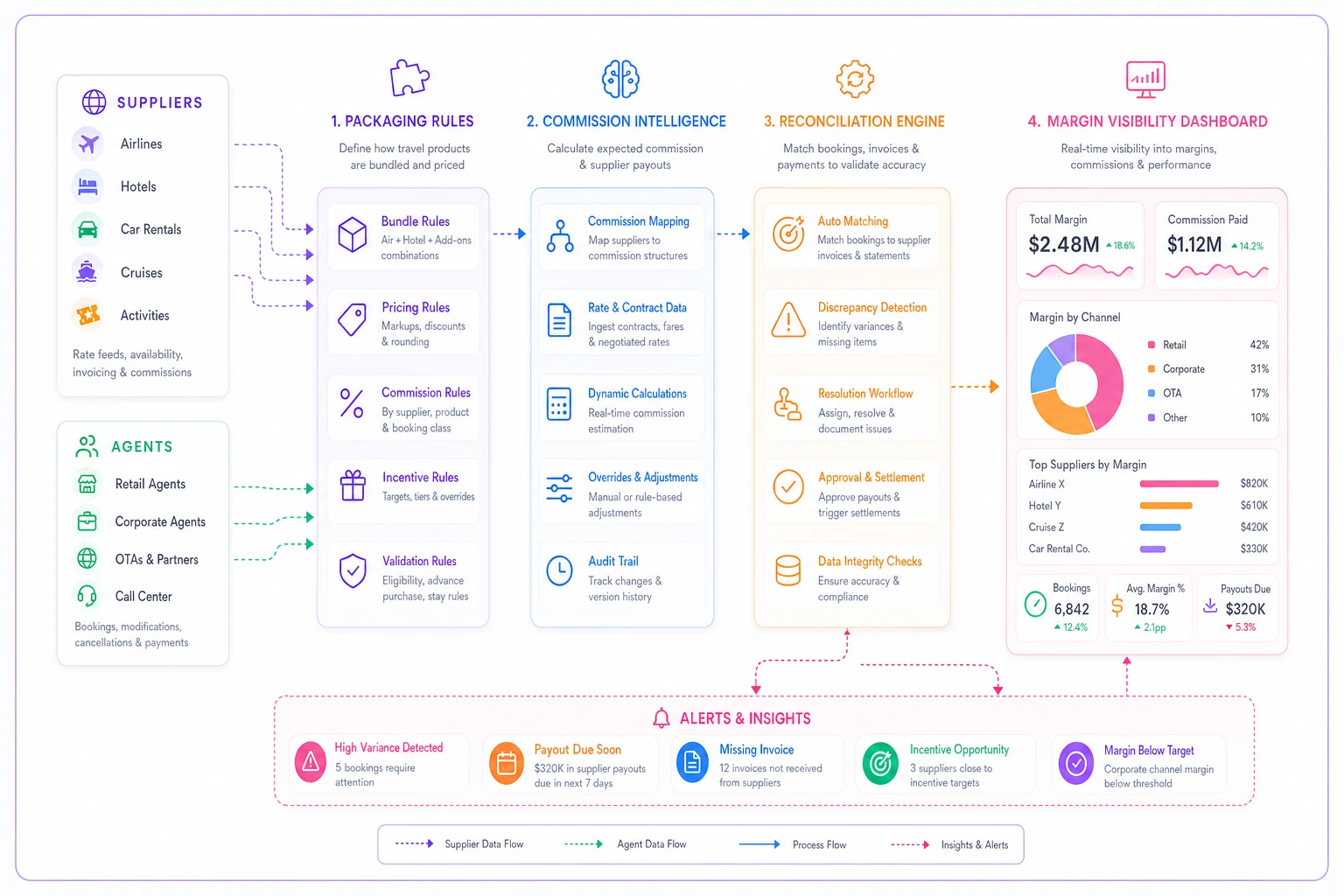
Use this to map your own workflows.
What margin leakage actually looks like (with real numbers)
Sarah Chen owns a boutique agency in Portland specializing in European and Asian travel. Last year, her numbers looked solid on paper—$2.8M in bookings, supposedly averaging 11% commission. Should have cleared $300k in gross commissions. But when we dug into her actual operations last fall, the story looked very different.
Her biggest problem? Pricing packages with stale rates. Sarah's team built quotes using rate sheets downloaded weeks earlier. During Europe's busy season, hotel rates shift almost daily. Their standard practice of quoting Monday rates for bookings that happened Thursday meant consistent margin erosion.
Take one specific example: a 10-day Germany/Austria package for a family of four. Quote built on rates from three weeks prior showed €180 per night for their preferred Munich hotel. Client loved the itinerary, booked immediately. When the agent went to confirm, that same room was €215. Flights had jumped from $890 to $1,040 per person. The cooking class they'd included was now fully booked—had to substitute something that cost €40 more per person.
| Package Component | Original Quote | Final Booking Cost | Difference |
|---|---|---|---|
| Hotel rates | €180/night | €215/night | +€35/night |
| Flights | $890/person | $1,040/person | +$150/person |
| Activities | Base price | +€40/person | +€160 total |
| Total Impact | $8,400 (14% margin) | $9,200 (6.8% margin) | -$650 margin |
That single booking lost $650 in expected margin. Sarah's team did roughly 180 European packages that year. Even if only half experienced similar erosion, that's $58,000 gone.
Commission reconciliation was another disaster. Sarah's bookkeeper checked payments monthly, sometimes less. By the time they caught shortfalls, suppliers often claimed the dispute window had closed. One particularly frustrating case: a $15,000 Greek island package where the tour operator paid 8% commission instead of the contracted 12%. The operator insisted their system showed that booking qualified for a reduced rate due to "promotional fare class restrictions" buried in page 47 of their contract. By the time Sarah's team noticed, six months had passed.
Total margin leakage we documented: approximately $85,000 annually. That's 28% of expected commission income, vanishing into operational gaps.
Building your margin protection system
Start with the highest-impact fixes that don't require massive overhauls:
Start with the 90-day commission audit—it's the fastest way to surface payouts you can reclaim.
Week 1-2: Commission audit Pull every booking from the last 90 days. Match expected vs. received commissions. You'll likely find $5,000-15,000 in missing payments immediately. Just this exercise often pays for months of operational improvements.
Week 3-4: Package template rebuild Take your top 20 most-sold packages. Rebuild pricing with current rates, true commission expectations, and operational overhead allocation. The difference between old and new pricing will shock you.
Week 5-6: Reconciliation rhythm Set up weekly reconciliation checkpoints:
-
Monday
Check all bookings that traveled in the past week
-
Wednesday
Follow up on missing commissions from the past 30 days
-
Friday
Dispute any shortfalls identified
Week 7-8: Margin dashboard creation Even if it's just a sophisticated spreadsheet at first, build visibility into yesterday's bookings with margin calculations, this week's expected commissions, outstanding reconciliation items, and supplier payment performance.
The technology layer that makes this sustainable
Manual margin protection works for about three weeks before people revert to old habits. The gap between good intentions and daily execution kills most operational improvements.
AI-powered operational software transforms theory into systematic execution. Not replacing human judgment, but augmenting it with consistent, automated workflows that catch margin leaks before they happen.
Modern revenue operations platforms for travel agencies can automatically pull supplier rates, calculate true margins, flag commission discrepancies, and trigger reconciliation workflows. The AI components handle the tedious tracking and pattern recognition that humans inevitably skip when busy.
Technology only works when it maps to actual operational workflows. A fancy commission tracking system means nothing if it doesn't integrate with how agents actually quote and book. An AI-powered reconciliation tool fails if it requires manual data entry that nobody maintains.
The effective approach combines human expertise with AI automation. Agents focus on crafting perfect itineraries while AI handles rate updates and margin calculations. Humans manage supplier relationships while automated systems track payment timing. Staff investigates anomalies while software maintains reconciliation schedules.
Stop accepting margin erosion as inevitable
Every travel agency owner says the same thing: "That's just how this industry works." They've accepted that quotes won't match final costs. That commissions arrive whenever suppliers feel like paying. That reconciliation happens when someone has time.
Margin leakage isn't an industry requirement. It's an operational choice.
The agencies thriving in today's market aren't necessarily selling more or better trips. They're operating tighter revenue machines. They know their true margins on every booking. They catch commission shortfalls within days, not months. They price packages based on real-time costs and verified commission rates.
This framework comes from real agency operations, tested across different markets and business models. Some agencies implement it manually with spreadsheets and calendar reminders. Others use integrated software platforms. The tool matters less than the discipline of connecting packaging, commissions, reconciliation, and reporting into a unified revenue operations system.
Your next step isn't buying new software or hiring a revenue operations manager. It's picking one margin leak and plugging it. Maybe that's auditing last quarter's commissions. Maybe it's rebuilding your top five package templates with accurate pricing. Maybe it's setting up a simple weekly reconciliation checkpoint.
Start small, but start today. Because every day you wait, another few hundred dollars quietly disappear from your bottom line. And in an industry where 2-3% often separates profitable agencies from struggling ones, those silent losses determine whether you build a thriving business or barely survive.
The choice between systematic revenue operations and continued margin erosion isn't really a choice at all. It's the difference between running a professional travel business and operating an expensive hobby that happens to book trips.
Start small, but start today. Because every day you wait, another few hundred dollars quietly disappear from your bottom line. And in an industry where 2-3% often separates profitable agencies from struggling ones, those silent losses determine whether you build a thriving business or barely survive.
The choice between systematic revenue operations and continued margin erosion isn't really a choice at all. It's the difference between running a professional travel business and operating an expensive hobby that happens to book trips.
Ready to elevate your travel agency workflow?
Join 1,200+ travel agencies using Travexly to save time, improve client satisfaction, and boost operational efficiency.