



Most travel agency owners don't get into trouble because they're bad at selling trips. They get into trouble because the money hits their bank account long before the trip actually happens, and nobody has a clear rule for when that money becomes revenue versus when it's still just a client's cash sitting in your account.
This is the quiet problem underneath almost every financial headache a growing agency runs into. You collect a deposit in January for a trip in September. The supplier invoices you in July. The commission lands in October. Meanwhile your P&L looks fantastic in Q1 and terrible in Q4, and you have no idea whether you're actually profitable or just temporarily holding other people's money.
Getting this right isn't about becoming an accountant. It's about building a few operational rules so your books reflect reality, your month-end doesn't turn into a guessing game, and you never accidentally spend money you were only holding in trust.
Why revenue recognition breaks down in travel specifically
Travel is unusually brutal on this front because of three overlapping timing gaps: the cash gap (when you get paid versus when you pay the supplier), the service gap (when you book versus when the client travels), and the commission gap (when you earn versus when the supplier actually settles).
In most industries, you sell something, you deliver it, and you recognize the revenue roughly at the same time. In travel, those three events can be spread across nine or ten months. And because the deposit money is real and spendable, it feels like revenue. That feeling is where agencies get into trouble.
The pattern that keeps showing up: an agency has a strong booking season, the owner sees a healthy bank balance, and they make a hiring or marketing decision based on that balance. Then trips get delivered, suppliers get paid, a few refunds come through, and suddenly the "profit" they thought they had was mostly deferred revenue — money owed to future trips and future suppliers.
The agent-versus-principal question sits right on top of all this, because it changes how much revenue you even recognize in the first place. If you haven't nailed that distinction yet, it's worth reading the principal versus agent decision framework before you set your recognition rules, because the two decisions are joined at the hip.
The agent vs principal split (and why it changes your numbers)
This is the single biggest thing non-accountant owners get wrong, and it's not particularly close.
Eliminate booking chaos and streamline operations.
Travexly helps you manage, confirm, and track travel bookings effortlessly.
- Unified booking management
- Automated client communications
- Team scheduling & itinerary tracking
No credit card required
When you act as an agent, you're arranging a service between the client and the supplier. You never "own" the trip. Your revenue is only your commission or service fee — not the full amount the client paid. So if a client pays $8,000 for a cruise and your commission is $1,200, you recognize $1,200 as revenue. The other $6,800 was never yours; it's pass-through money belonging to the cruise line.
When you act as a principal, you've packaged and taken responsibility for the trip yourself. You bought the components, assembled them, and sold a product under your own name and risk. Now the full $8,000 is your revenue, and the supplier costs are your expenses.
| Scenario | Client pays | What you recognize as revenue | What the rest is |
|---|---|---|---|
| Agent — commission on a cruise | $8,000 | $1,200 (commission) | Pass-through to supplier |
| Agent — flat service fee on flights | $2,400 | $150 (service fee) | Pass-through to airline |
| Principal — self-packaged tour | $8,000 | $8,000 (gross) | $5,900 supplier cost as expense |
| Mixed booking (flights as agent, hotel as principal) | $6,500 | $150 + hotel gross | Split by component |
Why this matters operationally: two agencies with identical bank deposits can show wildly different revenue figures depending on which model each booking falls under. Mixing them up inflates your top line, distorts your margins, and — if you ever get audited or try to sell the business — creates a mess that's expensive to untangle.
That last row is the one that quietly destroys bookkeeping accuracy. A single itinerary can contain both agent and principal components, and if you book the whole thing one way, your numbers are already wrong before month-end even starts.
When revenue is actually "earned"
The core rule is simple to say and easy to ignore: you recognize revenue when the service is delivered, not when the cash arrives.
For most travel bookings, "delivered" means the trip has been completed, or at minimum the departure date has passed. Before that, the money you're holding is deferred revenue — a liability on your books, not income. You literally owe a service in exchange for it.
-
Client pays deposit → Record as deferred revenue (liability). Nothing is earned yet.
-
Client pays balance → Still deferred revenue. More cash, same liability status.
-
Trip departs / is delivered → Recognize your revenue (commission if agent, gross if principal).
-
Supplier invoice received and paid → Match supplier cost against the recognized revenue (for principal bookings).
-
Commission settles from supplier → Confirm the earned commission; adjust if the actual differs from the estimate.
The trap sits between steps 2 and 3. That's where the cash feels most "real" and where owners are most tempted to treat it as profit. Until the client is wheels-up, assume the money might have to go back out — because sometimes it does.
If managing that gap between cash collected and revenue earned is straining your working capital, the deeper mechanics of sequencing deposits and smoothing that timing are covered in turning variable cashflow into predictable working capital.
Documentation: what you actually need on file per booking
Recognition rules are worthless if you can't prove when something happened. The documentation layer is what makes your month-end defensible and your audits painless. You don't need a document vault — you need five or six consistent fields captured per booking.
Minimum documentation to attach to every booking record:
-
Booking confirmation with departure/return dates (this is your recognition trigger date)
-
Agent/principal classification for the booking — and per-component if it's mixed
-
Client payment records with dates and amounts (deposit + balance)
-
Supplier invoice with cost breakdown and invoice date
-
Commission statement or expected commission with the rate and base amount
-
Refund/cancellation record if applicable, with the date and amount returned
The classification field is the one most agencies skip, and it's the most important. If you can't tell from the record whether a booking was agent or principal, your bookkeeper has to guess — and guessing is how the same trip ends up booked two different ways across two months.
At 20–30 bookings a month, you can hold this together with a clean spreadsheet and disciplined habits. By the time you're doing 150+ a month across multiple agents, manual classification breaks down. People get busy, fields get skipped, and the gaps don't show up until reconciliation finds a $4,000 hole nobody can explain.
Month-end reconciliation: the control that catches everything
Month-end is where your recognition rules, documentation, and cash all get checked against each other. Done properly, it takes an afternoon and catches problems while they're still small. Skipped or rushed, it lets errors compound until year-end, when fixing them costs significantly more.
-
Pull all bookings with a departure date in the closing month. These are your revenue-recognition candidates.
-
Confirm each one actually departed (no last-minute cancellations). Move revenue from deferred into earned only for trips that genuinely went.
-
Match supplier invoices to principal bookings. Every principal trip should have a cost sitting against its revenue. Missing invoices mean you're overstating margin.
-
Reconcile commission receipts to expected commissions for agent bookings. Flag anything that settled short.
-
Review your deferred revenue balance. It should equal the total cash you're holding for trips that haven't departed yet. If it doesn't, something is misclassified.
-
Log refunds and reversals in the correct period so they don't haunt you later.
Step 5 is the owner's single best early-warning signal. Your deferred revenue balance is essentially a measure of future obligations you've already been paid for. If that number is large and your cash balance is small, you have a timing problem brewing — you've spent money you're holding in trust.
The commission matching in step 4 is where real money hides. Supplier commissions come in short more often than anyone likes to admit, and without a reconciliation step those shortfalls just disappear quietly. If this is a recurring pain, the mechanics of matching invoices and commissions are covered in detail in automating supplier invoice reconciliation.
Here's a quick visual of the month-end process:
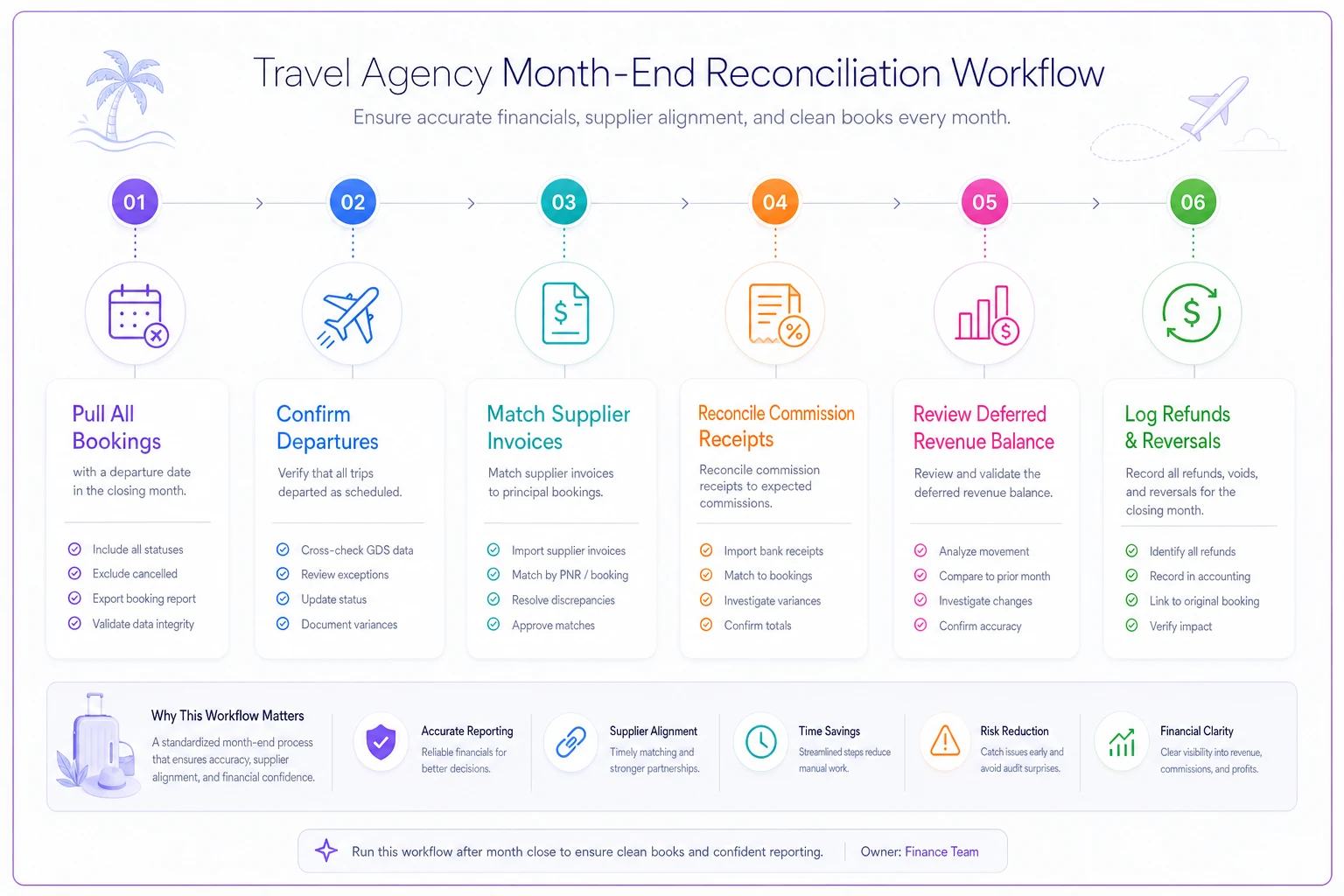
When run monthly, this sequence turns a chaotic closing into a short check that surfaces misclassifications, missing invoices, and commission shortfalls before they compound.
A real scenario: the Q1 profit that wasn't
A boutique agency doing roughly $1.4M in annual gross travel volume, mostly leisure trips booked 6–9 months out. Strong winter booking season, cash looked great.
By end of March, the owner saw about $240k in the bank and read it as a strong quarter. She greenlit a second full-time agent and a chunk of spring ad spend based on that balance.
The problem: most of that $240k was deferred revenue — deposits and balances for summer trips that hadn't departed. When they finally built a proper deferred revenue schedule, only around $55k–$60k of that balance was actually earned commission for Q1. The rest was money owed to suppliers and refundable client funds. Her real Q1 profit was a fraction of what the bank balance implied.
Nothing catastrophic happened — but it was close. A couple of large supplier payments and a wave of summer deliveries drew the balance down fast, and the new hire's salary suddenly felt a lot tighter than the January numbers suggested. After building a monthly recognition schedule and a deferred revenue control, the owner started making staffing and spend decisions off earned revenue instead of the bank balance. Same business, completely different decision quality.
When to formalize this (and when not to bother yet)
When this actually makes sense: You're past roughly 40–50 bookings a month, you're mixing agent and principal work, or you're starting to make hiring and spending decisions based on your cash position. At that point, a proper deferred revenue schedule and monthly recognition routine pays for itself in better decisions alone.
When it's overkill: If you're doing a handful of bookings a month as a pure commission agent, you don't need an elaborate deferral schedule. Your revenue is your commission, and the timing gaps are small enough to manage informally. Don't build accounting machinery you don't need yet.
Who should absolutely not DIY this: Agencies doing significant principal-model business, tour operators packaging their own trips, or anyone selling across multiple countries with VAT or tax-point complications. Once you're the principal, the stakes on getting recognition and expense matching right go up sharply, and a bookkeeper or accountant who understands travel is worth every penny.
Where software quietly carries the load
None of this requires fancy tools in principle — it requires discipline applied consistently across every booking, every month. The problem is that discipline is exactly what erodes as volume grows and the team gets busy.
This is where having your booking data, payment records, and classification live in one connected system instead of scattered spreadsheets starts to matter. When each booking carries its departure date, agent/principal flag, supplier cost, and expected commission in structured fields, the month-end recognition sequence stops being manual archaeology. The system already knows which trips departed this month, which still sit in deferred revenue, and which commissions haven't settled. AI-assisted reconciliation can flag mismatches — a commission that came in short, a principal booking missing its supplier invoice, a deferred balance that doesn't tie to cash held — before they compound into a year-end surprise.
The point isn't automation for its own sake. The controls described above only work if they actually run every month, consistently, even during busy season. Software earns its keep by making the right process the path of least resistance rather than another task that gets skipped when things get hectic.
The bottom line for owners
Revenue recognition for a travel agency isn't really an accounting topic — it's an operational discipline that happens to show up in your accounts. Know whether each booking is agent or principal. Treat deposits and balances as deferred revenue until the trip actually departs. Document the handful of fields that let you prove when things happened. Run a real month-end that ties your deferred revenue to the cash you're holding.
Do those four things consistently and you stop confusing other people's money with your own profit — which is the single most important financial habit a growing agency can build. The agencies that scale cleanly aren't the ones with the biggest bank balances; they're the ones who always know exactly how much of that balance they've actually earned.
Ready to elevate your travel agency workflow?
Join 1,200+ travel agencies using Travexly to save time, improve client satisfaction, and boost operational efficiency.