



Most travel agencies don't have a profit problem. They have a timing problem. The margin is real, the bookings are real, but the money shows up in the wrong order — supplier payments due before client balances land, a big FAM trip deposit hitting the same week payroll runs, a currency swing quietly eating the difference between what you quoted and what you paid.
The agencies that survive the lumpy months aren't the ones with the fattest margins. They're the ones who've decided, in advance, how money moves. Who gets paid first. What stays untouched. Which bookings the agency is actually holding money for versus money it's just passing through. That distinction alone — agent versus principal — changes how you should think about nearly every dollar sitting in your account.
This is a systems piece, not a list of cash tips. The goal is to help you build a set of operational rules so that when a $40k group booking lands, you already know exactly what happens to that money on day one, day 30, and day 90 — without a scramble.
The core problem: your bank balance is lying to you
Almost every owner-operated agency falls into the same trap. You look at the account, you see $85k, and it feels like the business is doing well. But a big chunk of that money isn't yours. It's client deposits for trips that haven't happened yet, and much of it is already committed to suppliers you just haven't paid yet.
In real operations, this usually shows up as a slow-motion accident. The agency spends against the balance — new hire, a marketing push, an owner draw — because the number looked healthy. Then three supplier invoices come due in the same fortnight, two clients push their travel dates, and suddenly you're financing your own operation on a credit card at 22%.
The root issue is that agencies rarely separate money they're holding in trust from money they've actually earned. Until you draw that line clearly and operationally, your balance is just noise.
-
Trust money — client funds for trips not yet delivered. Not yours to spend.
-
Committed money — trust money already promised to a supplier, just not paid out yet.
-
Earned money — commission and fees on completed or non-refundable bookings. This is what the business actually lives on.
Most agencies operate with all three sloshing around in one account, and that's fine mechanically — but only if your rules keep them separate on paper.
Agent vs principal: the single distinction that changes your cashflow model
This one gets overlooked constantly, and it quietly determines how much working-capital risk you're carrying.
Eliminate booking chaos and streamline operations.
Travexly helps you manage, confirm, and track travel bookings effortlessly.
- Unified booking management
- Automated client communications
- Team scheduling & itinerary tracking
No credit card required
When you book as an agent, you're arranging a service between the client and the supplier. The money largely passes through you. Your income is the commission. The supplier carries the delivery risk.
When you act as principal, you're selling your own package — you've bought the hotel nights, the transfers, the guide — and you're reselling them as one product under your name. Now you carry the risk. If the client cancels, you may still owe the supplier. If the supplier fails, the client comes to you.
| Factor | Agent model | Principal model |
|---|---|---|
| Cash held | Mostly pass-through | Large committed balances |
| Who carries cancellation risk | Supplier / client | The agency |
| Refund exposure | Limited to your fee | Full package value |
| FX exposure | Usually low | Can be significant |
| Working capital needed | Low | High |
| Margin potential | Lower (commission) | Higher (markup) |
Neither model is inherently better. Plenty of agencies run both. The mistake is running principal-model bookings with agent-model cash discipline — spending pass-through-style against money you're actually on the hook for.
When principal actually makes sense: you have negotiated net rates, reliable suppliers, and enough reserve to cover a cancellation or two without panic. When it's a bad idea: you're new to a destination, using an untested supplier, or your reserve wouldn't survive one group backing out. If you can't absorb the worst case, price the trip as an agent and keep the risk with the supplier.
Deposit sequencing: control the order money arrives
Deposit structure is a topic on its own — we covered how to design it without eroding margins in our deposit and payment-schedule breakdown. What this section is about is sequencing: making sure client money consistently arrives before you have to send supplier money, not after.
The failure pattern is almost always the same. The agency collects a small deposit to lock the booking, feels good, then discovers the supplier wants a 30% non-refundable deposit now — before the client's next installment is even due. That gap, repeated across a dozen bookings, is what forces short-term borrowing.
The fix is to work backwards from your supplier's payment calendar, not forwards from the client's convenience.
-
Map the supplier's payment milestones first. Deposit due date, balance due date, cancellation-penalty dates. These are fixed points you don't control.
-
Set every client milestone to land at least 7–10 days before the matching supplier milestone. That buffer absorbs slow payers and bank delays.
-
Never let a client's non-refundable date sit later than the supplier's. If the supplier's penalty kicks in on day 60 but the client can still cancel free until day 45, that 15-day window is pure agency risk.
-
Collect enough at each stage to cover the next supplier outflow — not the total trip. You're staging cash to match outflows, not front-loading the client.
A worked example. Say you're selling a $12,000 principal package. The supplier wants 25% ($3,000) at booking and the balance 45 days out. Instead of taking a token $500 deposit, you sequence it:
-
At booking collect $3,500 → covers the $3,000 supplier deposit plus a small buffer
-
Day 40 collect the remaining $8,500 → funds the $9,000 supplier balance (with the buffer already in hand)
-
Client non-refundable milestone set to day 38, two days before you need their money and comfortably ahead of the supplier's penalty date
Now the trip is essentially self-funding. You never front the agency's own cash. Multiply that discipline across your book and the "why is cash always tight?" feeling largely goes away.
Reserve policy: the number you decide once and defend forever
Most agencies don't have a reserve. They have "whatever's left." That's not a policy — it's an accident waiting to align with a bad month.
A reserve policy answers one question: how much cash must always stay untouched, no matter how good the balance looks?
A reserve tied to a fixed dollar figure ages badly — it made sense at $30k monthly volume and becomes meaningless at $120k. Tie it to something that scales:
-
Refund exposure total client money for trips not yet delivered that could still be legally refundable. Your reserve should cover a realistic chunk of this — not 100% for most agents, but a meaningful slice if you run principal bookings.
-
Fixed monthly costs aim to hold 1.5–2 months of payroll, rent, and software as a floor that never gets touched.
For an agency doing roughly $70k–$90k in monthly turnover with around $22k in fixed monthly costs, a defensible reserve floor might sit somewhere in the $35k–$45k range. The exact figure matters less than the rule: that money is invisible for spending decisions. When you check "can we afford this," you check the balance minus the reserve.
Tie the reserve to refund exposure and fixed monthly costs so it scales with your business.
The discipline breaks most often not from a crisis, but from a good stretch. Three strong months, the balance climbs, and someone reasons "we've clearly got margin now." The reserve exists precisely to survive the month after the good stretch.
Payment routing and supplier-credit playbooks
Once cash is arriving in the right order and your reserve is ring-fenced, the next lever is how and when money leaves. This is where supplier credit becomes a genuine working-capital tool rather than an afterthought.
Suppliers who offer credit terms — net-30, net-45, deposit-then-balance — are effectively financing your operation for free. The agencies that scale smoothly tend to be aggressive about earning those terms and disciplined about using them.
-
Rank suppliers by payment flexibility, not just rate. A supplier who's 2% more expensive but gives you net-45 might improve your cashflow more than the cheaper one demanding payment upfront.
-
Ask for terms once you have volume. After a supplier has seen consistent, on-time payment across several bookings, a request for net-30 is reasonable and often granted. Nobody offers it unprompted.
-
Route high-volume, reliable bookings through credit-term suppliers and reserve upfront-payment suppliers for one-offs.
-
Track your effective float. If a supplier gives you net-30 and your client pays 20 days before delivery, you're holding that cash for roughly 50 days. That float, compounded across your book, is real working capital.
One pattern worth flagging: agencies often chase the lowest net rate and unknowingly wreck their own cashflow by locking into upfront-payment suppliers. The margin looks better on paper and the cash reality is worse. Model both before deciding.
FX handling: stop letting currency quietly eat your margin
If you sell trips priced in USD but pay European suppliers in EUR, or Asian suppliers in local currency, you're carrying FX risk on every principal booking — often without pricing for it. We touched on the compliance side of this in our guide to cross-border payments, VAT and invoicing; here the focus is purely on protecting margin from currency movement.
The gap that hurts is the one between when you quote and when you pay the supplier. For a trip booked six months out, a 3–4% currency move is completely normal. On a $12,000 package with a 12% margin, a 3% adverse move against your supplier currency can wipe out a quarter of your profit on that booking.
Practical rules that don't require a treasury desk:
-
Build an FX buffer into principal pricing. For bookings more than 90 days out in a foreign supplier currency, add 2–3% to your cost assumptions. If the rate holds, it's extra margin. If it moves, you're covered.
-
Match currency where you can. If a supplier will invoice you in your selling currency, take it — you've handed the FX risk to them.
-
For large, long-dated bookings, consider locking the rate. A forward contract or a multi-currency account that lets you hold the supplier currency removes the guesswork entirely on your biggest exposures.
-
Track the quote-to-pay spread per booking. If you're routinely losing 2%+ to currency, your pricing buffer is too thin.
Who should not over-engineer this: if you're almost entirely an agent and suppliers bill clients or you directly in your home currency, FX hedging is a distraction. Don't build machinery for risk you don't carry.
A short scenario: the group booking that broke the month
A mid-sized agency — around $80k monthly turnover, mostly leisure with occasional groups — landed a 22-person group trip worth roughly $46k, running principal because they'd bundled hotel, transfers and a private guide.
The supplier wanted 30% (~$13.8k) within 14 days, non-refundable, plus the balance 60 days out. The agency collected a $6k deposit from the group leader and figured the rest would "come in." It didn't come in fast enough. Two families paid late, the supplier deposit came due, and the agency covered the ~$8k gap out of operating cash the same week two other supplier invoices landed. They ended up drawing on a credit line at just over 20% for about five weeks.
The trip was profitable on paper — around $6k margin. After financing costs, a rushed FX payment on the balance, and the owner's time firefighting, the real margin was closer to $4k. Not a disaster, but a meaningful chunk of profit lost to sequencing, not to the deal itself.
The rework was straightforward: collect enough at booking to cover the supplier deposit plus buffer, set individual traveler non-refundable dates ahead of the supplier's, ring-fence a reserve so the next month's group didn't depend on this one clearing, and add a 2.5% FX buffer to the package price. Same trip, same suppliers — the money just moved in the right order.
Where software quietly earns its keep
None of this requires software to design. It requires software to hold, because rules that live only in your head break the moment volume climbs. Once you're juggling dozens of bookings, each with its own supplier milestones, client installments, non-refundable dates and currency exposure, the sequencing you carefully designed becomes nearly impossible to track manually.
This is where an operational platform with AI-assisted scheduling and reconciliation genuinely helps — not by making decisions for you, but by flagging misalignments before they cost you. Surfacing every booking where a client's non-refundable date sits later than the supplier's. Warning when a supplier outflow is due before the matching client payment has cleared. Watching FX exposure across long-dated bookings and highlighting the ones drifting past your buffer. The rules stay yours; the system just makes them harder to quietly forget under pressure.
A simple workflow visualization can make those checks obvious at a glance.
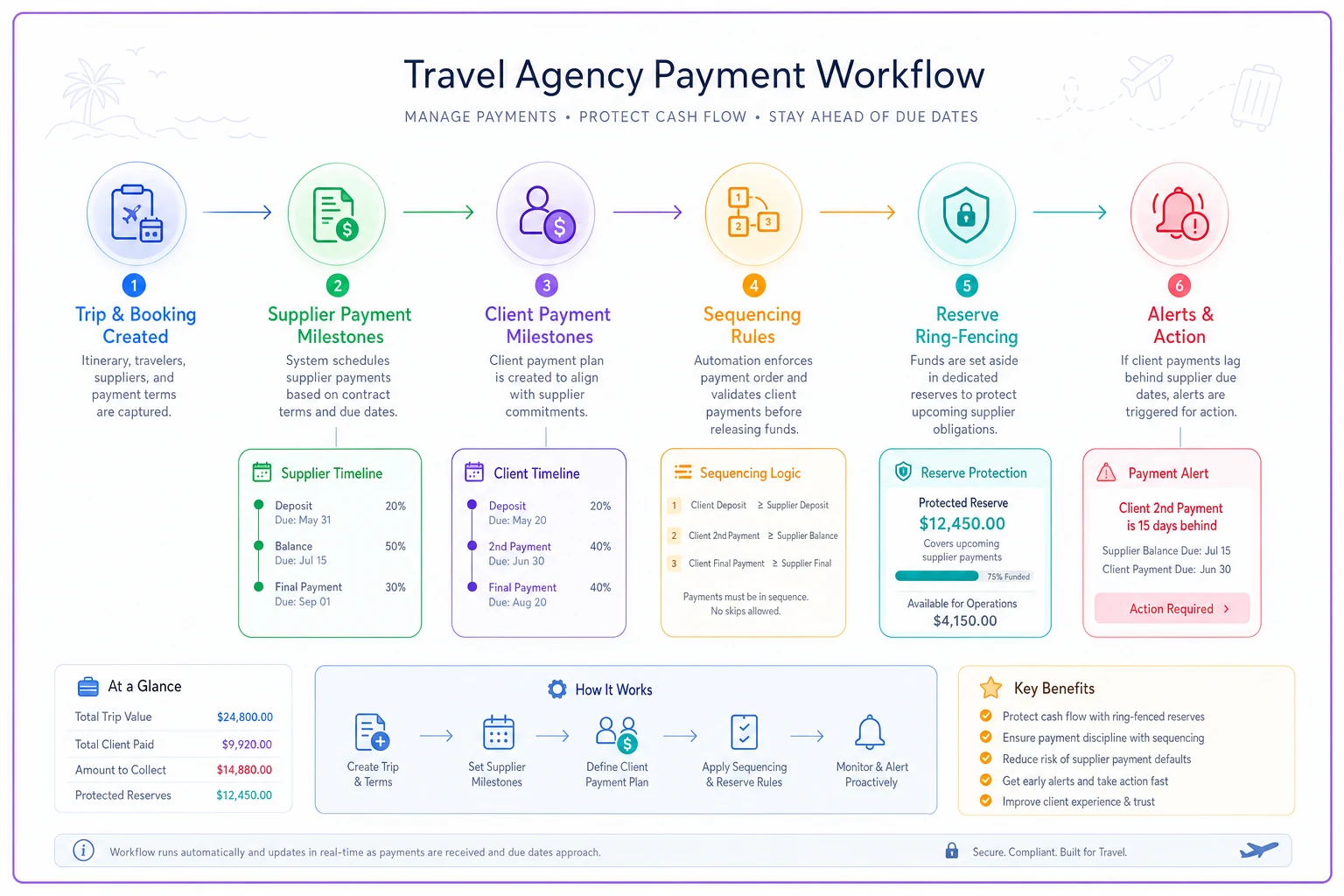
The point isn't automation for its own sake. It's that a good platform turns your cash policy from something you remember into something the operation enforces — which matters a lot once bookings scale past what one person can hold in their head.
Bringing it together
Predictable working capital isn't about earning more per trip. It's about deciding, in advance, how every dollar behaves — whether you're holding it in trust or you've truly earned it, whether you're on the hook as principal or just passing it through as agent, and whether your client money reliably arrives before your supplier money has to leave.
Set the reserve and defend it. Sequence deposits backwards from supplier calendars. Earn and use supplier credit deliberately. Buffer your FX on anything long-dated and foreign. Do those four things consistently and the lumpy months stop feeling like emergencies — because the money was never a mystery to begin with, it was just moving in an order you finally control.
Set the reserve and defend it. Sequence deposits backwards from supplier calendars. Earn and use supplier credit deliberately. Buffer your FX on anything long-dated and foreign. Do those four things consistently and the lumpy months stop feeling like emergencies — because the money was never a mystery to begin with, it was just moving in an order you finally control.
Ready to elevate your travel agency workflow?
Join 1,200+ travel agencies using Travexly to save time, improve client satisfaction, and boost operational efficiency.