



Most travel agencies lose somewhere between 3-8% of annual revenue to poorly structured payment schedules. Not because clients skip payments, but because the agency absorbs costs they shouldn't when trips change, cancel partially, or need modifications.
The real problem isn't collecting money. It's knowing which money to keep when things go sideways.
The pattern across agencies — from adventure tour operators to luxury group coordinators — is pretty consistent: agencies with trip-specific payment models retain significantly more margin during cancellations than those using generic deposit structures. The difference comes down to understanding risk timing, not just payment timing.
Why generic 30/60/90 schedules fail travel agencies
Standard payment schedules work great for products. Travel isn't a product.
When you book a group trip to Peru for next July, your financial exposure changes weekly. Hotels want deposits. Airlines change prices. Local operators need confirmation. Your risk profile at booking looks nothing like your risk profile three months out.
Yet most agencies use the same payment schedule for a weekend wine tour and a three-week African safari. Same deposit percentage. Same final payment window. Same refund structure.
This creates two operational failures that directly hit margins.
First, you're collecting payments based on calendar math instead of vendor requirements. A European river cruise might need 50% vendor deposits at 120 days out, while a domestic corporate retreat needs nothing until 30 days. Using the same schedule means you're either floating vendor payments (killing cashflow) or holding excess client funds (creating refund liability).
Second, generic schedules ignore cancellation penalty timelines. Airlines typically allow free cancellation within 24 hours, then charge increasing penalties. Hotels might offer free cancellation until 72 hours out. Tour operators often have non-refundable deposits from day one. When your payment schedule doesn't align with these vendor policies, you eat the difference.
The hidden cost of misaligned refund policies
Here's a scenario that plays out regularly in travel agencies:
Eliminate booking chaos and streamline operations.
Travexly helps you manage, confirm, and track travel bookings effortlessly.
- Unified booking management
- Automated client communications
- Team scheduling & itinerary tracking
No credit card required
A client books a $15,000 group trip with standard terms — 20% deposit, 40% at 90 days, final payment at 30 days. They cancel at 45 days out after paying $9,000 total.
Your actual vendor penalties at 45 days: $7,200 (airline change fees, hotel deposits, tour operator minimums). Your standard refund policy says they get 50% back at this stage. You refund $4,500.
You just absorbed $2,700 in unnecessary losses because your refund structure didn't match your actual vendor exposure.
Scale that across 30-40 cancellations per year and agencies are losing somewhere in the range of $80,000-$120,000 annually in preventable margin erosion. Not from bad clients or unexpected cancellations, but from payment structures that don't reflect operational reality.
Building risk-aligned payment models
Effective travel agency deposit schedules start with categorizing trips by financial exposure patterns, not destination or price.
| Category | Notes |
|---|---|
| Category A: Low-risk domestic trips | These typically involve refundable hotels, flexible transport, minimal vendor deposits. Your exposure stays low until final payment. |
| Category B: International group travel | Higher vendor deposits, stricter cancellation policies, currency exposure. |
| Category C: High-touch custom itineraries | Complex logistics, multiple vendors, significant pre-trip coordination. |
Category A: Low-risk domestic trips
Payment structure:
-
15% non-refundable planning deposit at booking
-
35% at 60 days (when you typically secure group rates)
-
50% at 21 days (aligning with most hotel final payment requirements)
Refund structure:
-
Cancellation before 60 days
retain planning deposit only
-
60-21 days
retain deposit plus actual vendor penalties
-
Inside 21 days
no refunds unless vendors provide credits
Category B: International group travel
Payment structure:
-
25% deposit at booking (covers your immediate vendor deposits)
-
35% at 120 days (when international rates lock)
-
25% at 60 days (covers increasing vendor exposure)
-
15% at 30 days (final balance)
Refund structure:
-
Before 120 days
retain $500 per person or actual costs, whichever is higher
-
120-60 days
retain all vendor penalties plus 15% coordination fee
-
60-30 days
retain 75% minimum
-
Inside 30 days
no refunds
Category C: High-touch custom itineraries
Payment structure:
-
30% planning and deposit at booking
-
30% at commitment point (when you book non-refundables)
-
40% at 45 days
Refund structure:
-
Before commitment point
retain planning fee ($1,500-3,000 typically)
-
After commitment
actual vendor penalties plus 20% handling
-
Inside 45 days
case-by-case based on recovery potential
Each model aligns payment collection with actual risk exposure, not arbitrary timelines. That's the whole point.
Legal deposit language that actually holds up
Generic terms like "non-refundable deposit" create more problems than they solve. Courts often side with consumers when language seems punitive rather than compensatory.
Use specific operational language instead:
Weak language: "All deposits are non-refundable"
Strong language: "Initial deposit covers non-recoverable planning costs including: vendor research and vetting, itinerary development, preliminary reservations, and administrative coordination. These services are rendered upon booking regardless of trip completion."
For payment schedules, explicitly tie each payment to operational milestones:
Weak: "Second payment due 90 days before departure"
Strong: "Second payment of 35% due at vendor commitment deadline (typically 90-120 days before departure). This payment directly covers: supplier deposits, rate locks, allocation securing, and continued trip coordination. Payment timeline may adjust based on vendor requirements."
Key legal protections to include:
Vendor pass-through clause: "Client acknowledges that refunds are limited to amounts recoverable from vendors. Agency will make reasonable efforts to recover funds but cannot guarantee refunds beyond vendor policies."
Actual cost recovery: "In case of cancellation, client is responsible for all non-recoverable costs incurred on their behalf, including but not limited to: deposits, penalties, change fees, and administrative costs associated with cancellation processing."
Schedule modification rights: "Agency reserves the right to accelerate payment schedule if vendor requirements change or if earlier payment secures significant cost savings for client."
Real refund calculation examples
Knowing exactly how to calculate refunds removes emotion from cancellations and protects both sides.
Example 1: Partial group cancellation
Scenario: 20-person corporate retreat to Napa Valley. Total trip value: $45,000. Four people cancel 35 days out.
Original payment received:
-
Deposit (20%)
$9,000
-
60-day payment (40%)
$18,000
-
Total collected
$27,000
Vendor impact of 4-person cancellation:
-
Hotel room release penalty
$800
-
Winery tour minimum lost
$400
-
Transportation still required (bus minimum)
$0
-
Restaurant minimums still met
$0
-
Total vendor impact
$1,200
Refund calculation:
-
Portion attributable to 4 people
$9,000 (20% of total)
-
Less vendor penalties
-$1,200
-
Less coordination fee (15%)
-$1,350
-
Refundable amount
$6,450
Agency retains: $2,550 (covers actual costs plus handling)
Example 2: Complete individual cancellation
Scenario: European river cruise for two. Total value: $12,000. Cancellation at 75 days.
Payments received:
-
Deposit
$3,000
-
120-day payment
$3,600
-
Total collected
$6,600
Vendor policies at 75 days:
-
Cruise line penalty
50% of cruise fare ($4,500)
-
Pre/post hotel
fully refundable (-$0)
-
Transfers
$200 cancellation fee
-
Flights
$600 change fees (holding as credit)
-
Total vendor penalties
$4,700
Refund calculation:
-
Total collected
$6,600
-
Less vendor penalties
-$4,700
-
Less admin fee (documented)
-$350
-
Refundable amount
$1,550
Note provided to client: Includes line-item breakdown of each vendor penalty with confirmation numbers.
Example 3: Force majeure partial refund
Scenario: Safari trip for family of four. Total value: $28,000. Destination closes borders 40 days out.
Payments received:
-
Fully paid
$28,000
Vendor recovery achieved:
-
Lodge
Full credit for future use (24-month validity)
-
Internal flights
80% credit ($2,400 of $3,000)
-
International flights
Full refund minus fees ($8,200 of $9,000)
-
Park fees
Non-refundable ($2,000)
-
Guides/transfers
Full refund ($3,000)
Client options offered:
-
Future travel credit $26,000 valid 24 months
-
Cash refund $13,400 immediate, $10,600 upon vendor refund receipt (estimate 8-12 weeks)
-
Hybrid $8,000 cash now, $16,000 credit for future
Most clients choose option 3, which preserves agency cashflow while giving immediate relief.
Software systems that enforce payment compliance
Manual payment tracking starts breaking down somewhere around 15-20 active bookings. That's when agencies start missing collection dates, calculating refunds wrong, or losing track of vendor penalty deadlines.
The operational difference between agencies that maintain margins and those that don't usually comes down to systematic enforcement of payment schedules — not aggressive collections, just consistent application of the risk-based models they've built.
Modern travel operations platforms handle this through automated workflows. When you input a booking, the system assigns the appropriate payment schedule based on trip type, then monitors vendor penalty timelines and adjusts refund calculations automatically as dates approach.
The workflow below outlines how a booking is assigned a payment schedule and monitored against vendor penalty timelines.
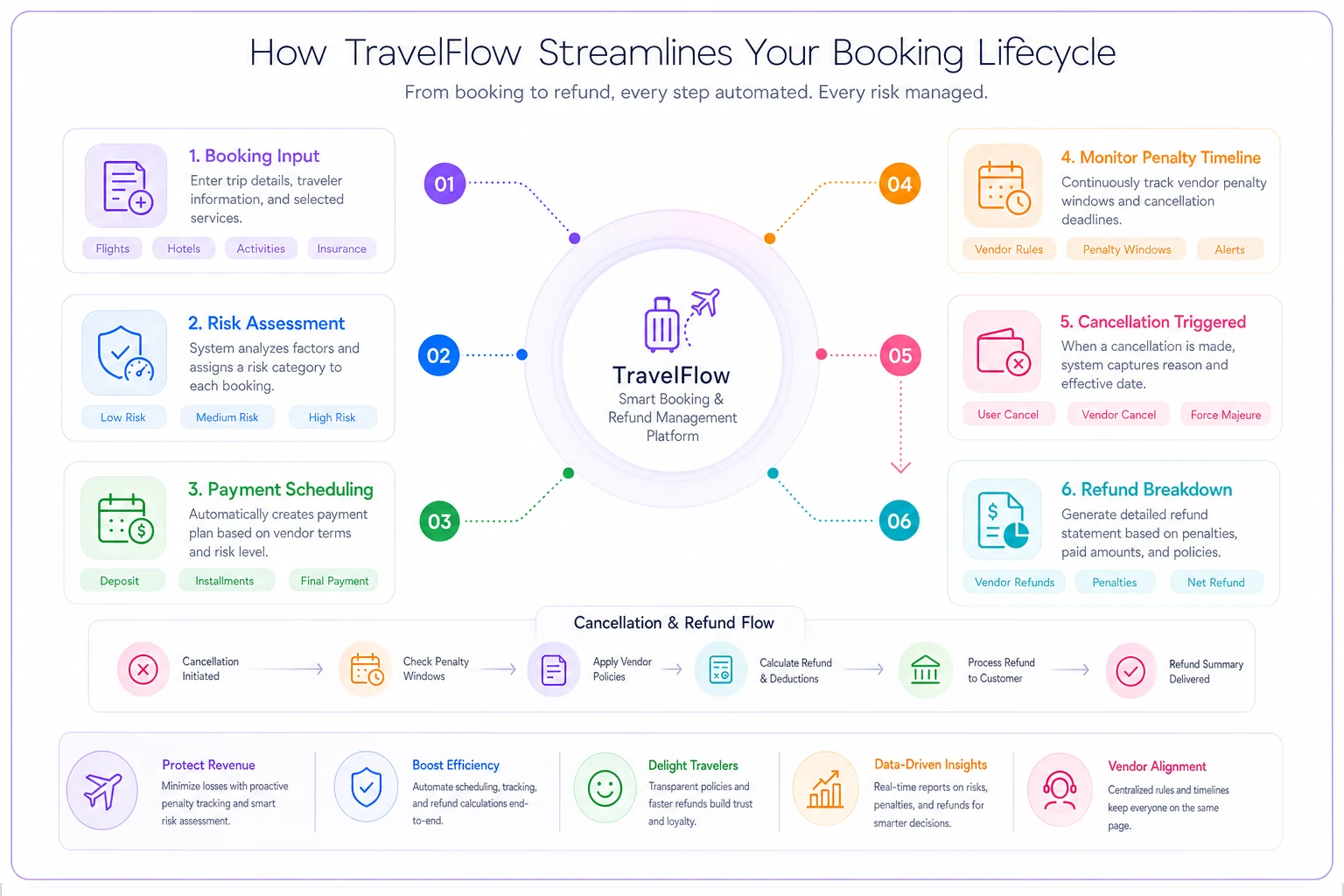
More importantly, these systems create transparency. Clients can see exactly why their payment is due when it's due. They understand what portion goes to vendors versus agency fees. When cancellations happen, the system generates detailed breakdowns showing actual vendor penalties, not arbitrary retention amounts.
That transparency alone tends to reduce payment disputes significantly. Clients still cancel, but they rarely argue about refunds when they can see documented vendor penalties. The agency protects margins while maintaining client trust.
Implementing risk-based schedules without overwhelming operations
Switching from generic to risk-based payment schedules sounds complex, but the rollout is manageable if you phase it right.
Start with new bookings only. Don't try to retrofit existing trips. Create three basic risk categories as outlined above and assign each new booking to one. Keep your old system running for existing bookings to avoid confusion.
Train your team on one critical distinction: payments are tied to vendor requirements, not calendar dates. Every payment request should include a brief explanation — something like: "This payment is due now because we need to lock in your group rate with the hotel before prices increase."
You need four data points per booking:
-
Risk category (A, B, or C)
-
Vendor penalty dates
-
Actual vendor deposits paid
-
Running exposure total
Start with new bookings only; don't try to retrofit existing trips.
Review and adjust after 90 days. You'll see patterns. Maybe Category B needs a fourth payment tier. Maybe domestic trips need subdivision into refundable versus non-refundable hotel categories. The goal isn't a perfect system on day one — it's alignment between your financial exposure and client payments.
Most agencies see margin improvement within the first quarter. Not from charging more, but from stopping the bleeding during cancellations and modifications.
Protecting margins while maintaining client relationships
The goal isn't to keep every dollar when trips cancel. It's to make sure your agency isn't subsidizing vendor penalties or absorbing costs that clients should rightfully cover.
Clear, risk-based payment schedules do that while actually improving client relationships. Clients appreciate transparency. They understand that their African safari requires different payment timing than a weekend in Vegas. They see you're not arbitrarily holding their money — you're managing real vendor requirements.
When cancellations happen, you're having operational conversations instead of emotional ones. The discussion is about vendor policies and actual costs, not agency policies and perceived fairness.
That shift — from generic to specific, from arbitrary to operational — changes how both your team and your clients view payments entirely. Agencies that build payment systems around operational reality, not accounting convenience, consistently retain more margin. They collect based on exposure, refund based on actual costs, and maintain margins by aligning their financial model with their operational model.
That alignment, more than any single policy or schedule, is what separates travel agencies that build sustainable margins from those that slowly bleed profit through misaligned payment structures.
Ready to elevate your travel agency workflow?
Join 1,200+ travel agencies using Travexly to save time, improve client satisfaction, and boost operational efficiency.