



Most agency owners don't actually decide whether they operate as principal or agent. They drift into whichever model each supplier or booking happens to push them toward, and end up with a messy hybrid — half their bookings are agent-model commission deals, the other half are packages they technically sold as principal, without the contracts, insurance, or billing setup to back it up.
That works fine until it doesn't. The moment a supplier goes bust, a client demands a refund, or your accountant asks how you're treating output VAT, the difference between principal and agent stops being academic. It changes who owes the money, who carries the risk, how cash moves through your accounts, and what your systems need to track.
This isn't a legal explainer. The distinction itself is covered well enough elsewhere. What's missing for most owners is the operational decision — a framework that connects the model choice to cashflow, process design, billing flows, and what it actually takes to migrate from one to the other without breaking your books.
Why most agencies end up with an accidental hybrid
In practice, the drift usually looks like this. You start as a pure agent — flights, hotels, supplier collects, you take commission. Clean. Then a client wants a custom package: flights from one supplier, a villa booked directly with an owner, a driver you arranged privately, a couple of excursions. You bundle it, charge one price, collect the full amount yourself, and pay each component out separately.
On that booking, you're acting as principal, whether you meant to or not. You're the one the client contracted with for the whole trip. If the villa owner cancels, that's your problem to resolve — not the client's problem with a third party.
The pattern across a lot of small and mid-sized agencies is that nobody draws the line. Bookings get processed through the same inbox, the same spreadsheet, the same card terminal, regardless of which model applies. The commercial reality — who carries liability, how money flows — ends up disconnected from how the business actually records each booking.
What breaks first is almost never the sales side. It's the back office: reconciliation, VAT treatment, and refund handling, because those systems were built assuming one model and are quietly processing both.
The two models, operationally
Forget the textbook definitions. Here's what each model actually means for how your business runs day to day.
Eliminate booking chaos and streamline operations.
Travexly helps you manage, confirm, and track travel bookings effortlessly.
- Unified booking management
- Automated client communications
- Team scheduling & itinerary tracking
No credit card required
| Dimension | Agent model | Principal model |
|---|---|---|
| Who the client contracts with | The supplier | You |
| Who collects the full payment | Often the supplier (you take commission) | You collect everything |
| Your revenue recognition | Commission only | Full trip value, cost of sale deducted |
| Cashflow timing | Commission paid in arrears, sometimes 30–90 days later | Full amount upfront, you pay suppliers later |
| Refund liability | Supplier's responsibility (mostly) | Yours, end to end |
| Supplier-failure risk | Limited | You're on the hook to the client |
| VAT treatment | Commission is the taxable supply | Often margin-scheme territory, far more complex |
| Insurance/bonding needs | Lower | Higher — you may need financial protection |
| Billing complexity | Lower | Higher — three-way flows, netting, timing gaps |
The thing that surprises people: the principal model usually improves short-term cashflow because you're sitting on the full trip value before you pay suppliers. That feels great right up until a supplier fails and you discover that cash was never really yours — it was always owed onward.
The cashflow reality nobody models properly
Under the agent model, you're frequently waiting on commission. A booking closes in March, the client travels in July, and your commission might not land until August. Lumpy and backloaded.
Under the principal model, you collect the full amount — say roughly £8k–£12k for a tailored two-week trip — months before departure. You hold that cash. You pay the villa deposit, the flight supplier, the ground handler on their own schedules. For a while, you're flush.
The trap is treating held cash as working capital. An agency running 15–20 principal bookings at any time might be sitting on a six-figure float that's entirely spoken for. If they dip into it to cover payroll during a slow month, they've created a hole that only shows when supplier invoices come due. One cancellation wave and the gap is exposed.
If you're moving toward the principal model, the deposit and payment-schedule design becomes the thing that keeps you solvent. We've written separately about how to structure deposits, payment schedules and partial refunds so margins and cash stay protected — that discipline matters far more under principal than agent, because the money passing through you is so much larger.
Your model choice should flow from a view of your working capital, not get decided booking-by-booking and leave your cashflow to sort itself out. There's a fuller treatment of turning that lumpy pattern into something predictable in the piece on predictable working capital and deposit sequencing — and the principles there assume you actually know which model each booking sits under.
The risk sits in different places
A mistake that costs agencies real money: assuming risk scales with booking value. It doesn't. It scales with model.
A £15k agent booking, where the supplier collected and carries the contract, exposes you to losing a commission. Annoying, not fatal. A £6k principal booking where a small villa owner takes your deposit and then stops responding exposes you to refunding the client the full £6k out of your own pocket while you chase someone who may not have the money.
Under the principal model, every supplier in your chain is a point of failure that lands on you. That changes how you select and monitor suppliers, how much you pay upfront, and whether you need financial protection or bonding.
The cross-border layer makes this sharper. If you're acting as principal on an international package, you're often dealing with VAT margin schemes, currency exposure on supplier payments, and invoicing across jurisdictions — a different operational burden than clipping commission on an agent sale. The detail on handling cross-border payments, VAT and invoicing becomes essential reading the moment you take on principal-model international trips, because the tax treatment alone can quietly erode the margin you thought you'd made.
When principal actually makes sense
The decision isn't "which model is better." It's "which fits this booking, this supplier relationship, and this stage of the business."
-
You're genuinely adding value by bundling. Custom itineraries, DMC-style trips, components that aren't sold as a package anywhere else. You're the product, so being the principal reflects reality.
-
Your margins justify the risk. If you're making 18–25% on a packaged trip versus 8–10% commission on components, the margin can fund the protection, insurance, and admin that principal demands.
-
You have the cash discipline to not touch client float. This is the real gate. If you can't ringfence client money, principal will eventually catch you out.
-
You want control over the client relationship and the refund experience. Being principal means a client never gets bounced to a supplier when something goes wrong — you own the resolution.
When principal is a bad idea
-
You're selling standard, resellable inventory — scheduled flights, chain hotels — where you add no bundling value. Being principal just imports risk for no reason.
-
Your back office is already behind on reconciliation. Adding margin-scheme VAT and three-way billing to a system that's struggling will break it faster.
-
You don't have the reserves to refund a full trip if one supplier fails mid-chain.
Who should not do this at all
Newer agencies without working-capital reserves, or anyone running on a shared inbox and a spreadsheet with no separation between client money and operating cash. You can grow into principal. You shouldn't start there because a booking happened to fall that way.
A worked example: the same trip, two models
Take a tailored 10-day trip. Total client price: £9,400. Component costs: flights £3,100, villa £2,800, driver £900, excursions £1,100, insurance £400 — roughly £8,300 in cost.
As agent: You book the components, suppliers collect where they can, you earn commission on the pieces that pay it — flights at nothing, villa at 12%, excursions at 10%. Realistically you're looking at around £450–£550 in commission, trickling in over a few months after travel. Minimal risk. Thin, delayed cash.
As principal: You collect the full £9,400. Gross margin around £1,100, close to 12%. You hold the client's money for months before paying suppliers, which feels like a cash boost. But you now carry: VAT margin-scheme calculation on that £1,100, full refund liability if the villa owner vanishes, FX exposure if the villa is priced in euros, and the admin of paying four suppliers on four different schedules.
The principal version makes more money and holds more cash — if nothing breaks. The agent version makes less but the risk is contained. For a one-off booking with a brand-new supplier, agent is often the smarter posture even though it earns less.
The billing flows that actually differ
Agent billing flow:
-
Supplier collects from client (or you collect and remit, less your commission).
-
You record a commission receivable — not revenue on the full amount.
-
Commission lands weeks or months later.
-
You reconcile commission received against commission expected, and chase the gaps.
The failure point: an agency books a principal-style package but records it like an agent commission deal. Revenue is understated, VAT is wrong, and reconciliation doesn't tie out because the full client payment landed but only "commission" was expected. Multiply that across dozens of bookings and your year-end becomes a forensic exercise.
Principal billing flow:
-
You invoice the client the full trip value.
-
You collect per your deposit schedule.
-
You record full value as revenue, component costs as cost of sale.
-
You pay each supplier on their own terms, creating timing gaps between money in and money out.
-
You calculate VAT — often on the margin, not the full value.
The fix isn't complicated. Tag every booking with its model at the point of sale, and route it down the correct billing path from there. Modern agency management platforms let you flag the model per booking and apply the right revenue-recognition and VAT logic automatically, so the back office isn't reverse-engineering the answer from payment patterns weeks later. That tagging discipline is worth more than any clever report, because it keeps the commercial reality and the accounting reality attached to each other.
Migration playbook: moving a booking line between models
Most owners don't flip the whole agency at once. They migrate a category — bespoke itineraries move to principal, flights and standard hotels stay agent. A sane sequence:
Start with a full audit — accidental principal bookings are common and will derail migration if left in place.
-
Audit current bookings and tag each one by its true model. Not how you billed it — how the commercial reality actually sits. You'll likely find accidental principal bookings hiding in your agent pile.
-
Decide the split deliberately. Which categories go principal, which stay agent, and write the rule down so staff aren't guessing per booking.
-
Fix the billing paths before the volume arrives. Set up separate revenue recognition, the correct VAT treatment, and a ringfenced client-money account for principal bookings.
-
Check protection and insurance. Principal usually needs financial protection or bonding. Sort this before you take the first principal deposit.
-
Rewrite client-facing terms. Under principal, your booking conditions, refund terms, and liability language all change.
-
Train the front line on the tagging rule. The whole system depends on the right flag at the point of sale. If agents get this wrong, every downstream system inherits the error.
-
Run a reconciliation test on the first batch. Take the first 10–15 principal bookings and fully reconcile them end to end before scaling. Catch the gaps while they're small.
The step most people skip is the audit in step one. They migrate forward without cleaning up the accidental-principal bookings already on their books, so they're building a clean new system on top of a messy old record.
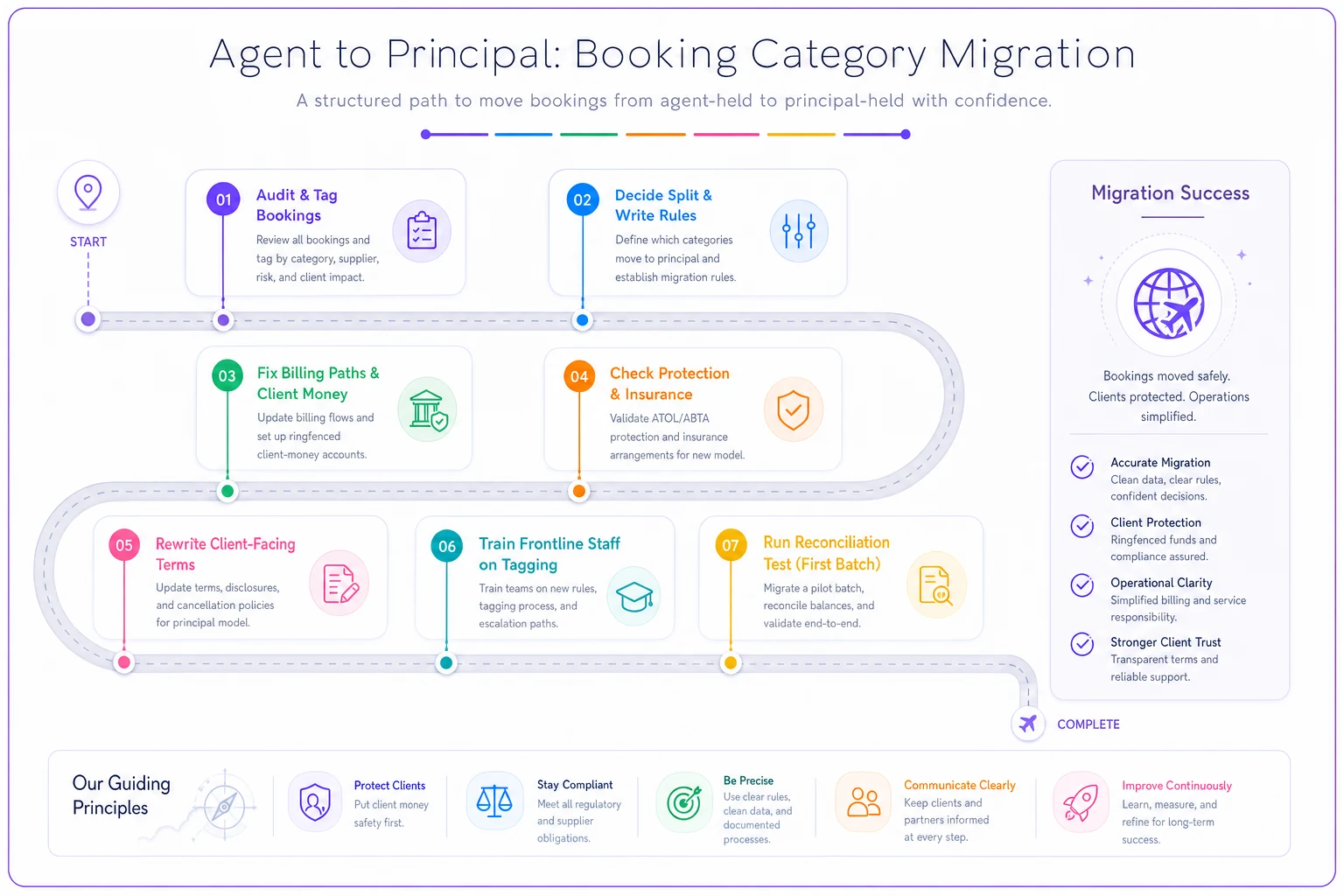
A simple visual of this migration sequence helps teams follow the steps and ensures nobody skips the initial audit.
A realistic scenario
A small UK agency, around 8 people, built its reputation on tailored trips to Southeast Asia. Almost everything was bespoke bundling — the textbook case for principal — but they'd always billed as if they were agents, recording just the "margin" as revenue and running everything through one shared process.
The problems surfaced slowly. VAT was understated because margin-scheme rules were never applied. Reconciliation took days each month because full client payments kept landing where the system only expected part of the value. And during one slow autumn, they'd leaned on held client deposits for payroll — which came home to roost when a ground supplier failed and they had to refund roughly £11k they'd already treated as theirs.
The fix wasn't dramatic. They tagged every booking by model at point of sale, moved bespoke trips onto a proper principal billing path, ringfenced client money into a separate account, and corrected their VAT treatment going forward. Within a couple of quarters, monthly reconciliation dropped from several days to a few hours, their VAT stopped being a liability waiting to be found, and they stopped confusing float with profit. Revenue on paper went up, simply because they were finally recording principal bookings at full value instead of hiding them as commission.
Nothing about the trips they sold changed. Only the decision to run each booking through the model it actually belonged to.
The real takeaway
The principal vs agent question isn't a one-time legal choice you make and forget. It's an operational setting that sits on every booking, and the damage comes from letting it stay implicit — from running two different commercial realities through one set of systems that can only handle one.
Decide the model deliberately. Tag it at the point of sale. Route cashflow, billing, VAT, and risk down the path that model requires. Keep client money separate from your own, especially under principal, where the float is large enough to feel like capital and dangerous enough to sink you if you treat it that way.
Get that right and both models can work side by side without the back office falling apart. Get it wrong and you won't find out until a supplier fails, an auditor asks a question, or a refund lands that you can't cover.
The framework above is really just one discipline repeated everywhere: make the model explicit, and build the system around it.
Ready to elevate your travel agency workflow?
Join 1,200+ travel agencies using Travexly to save time, improve client satisfaction, and boost operational efficiency.