

Walk into almost any travel agency that's been running for more than a couple years and ask to see their standard operating procedures. You'll usually get one of three answers. Either "it's all in my head," or someone pulls up a Google Drive folder with 40 documents nobody's opened since 2022, or — the most common one — a mix of both, where the written SOPs contradict what people actually do day to day.
That gap is the real issue. Writing an SOP is easy. Keeping a library of them accurate, owned, reviewed, and actually followed as your agency grows? That's the hard part, and almost nobody builds a real system around it.
So this isn't a post about how to write your first SOP. It's about the full SOP lifecycle for a travel agency — how procedures get created, reviewed, updated, measured, tied into onboarding, and eventually retired. Because a procedure that isn't governed is just a document that slowly turns into a lie.
Why scattered SOPs quietly break as you scale
When it's just you and maybe one other person, undocumented process works fine. You both know that a supplier confirmation gets forwarded to the client within an hour, that deposits go on a specific card, that certain suppliers need manual follow-up because their systems are unreliable. The knowledge lives in two heads and that's enough.
The trouble starts around the third or fourth hire, or when someone who's been there for years decides to leave. Suddenly the "obvious" way of doing things isn't obvious to anyone new, and the tribal knowledge walks out the door with whoever just handed in their notice.
Agencies don't fail at SOPs because they never wrote them. They fail because the SOPs they wrote were treated as a one-time project instead of a living system. Someone spends a full weekend documenting everything, feels great about it, and then never touches those files again. Six months later a supplier changes their booking portal, the invoicing workflow shifts, a new payment processor comes in — and the documented process is now wrong. New hires follow the wrong version, make mistakes, and everyone concludes "the SOPs don't work here." They worked fine. Nobody governed them.
If you've already built an SLA-driven operations system, you've probably felt this tension directly. SLAs only mean something if the underlying procedures behind them stay current. An SLA that says "supplier confirmations within 2 hours" is worthless if the SOP describing how to confirm points to a portal that no longer exists.
The lifecycle mindset: SOPs as a managed inventory
Think of your procedures the way you'd think of a supplier contract portfolio. Each one has an owner, a status, a next-review date, and a reason it exists. It gets created, it lives, it gets updated, and eventually it gets retired or replaced.
Eliminate booking chaos and streamline operations.
Travexly helps you manage, confirm, and track travel bookings effortlessly.
- Unified booking management
- Automated client communications
- Team scheduling & itinerary tracking
No credit card required
The five stages worth mapping for any agency:
-
Draft — someone documents a process, ideally the person who actually does it, not a manager guessing from the sidelines.
-
Active — the SOP is approved, in use, and considered the source of truth.
-
Under review — flagged for a scheduled or triggered review.
-
Revised — updated version replaces the old one, with a changelog entry.
-
Retired — no longer relevant; archived, not deleted, so you keep the history.
The biggest mistake here is skipping the "retired" stage. Old SOPs don't die — they just sit in the folder next to the current ones, and someone eventually follows the dead one. Archiving with a clear "RETIRED — see [new doc]" banner solves more confusion than almost anything else.
There's a natural flow to how procedures move through these stages, and it helps to think of it as a loop rather than a straight line. A retired SOP often prompts a new draft. A triggered review creates a revised version. Onboarding reveals gaps that cycle back into drafts. That loop, if maintained, is what keeps the library alive.
Here's a simple view of that loop.
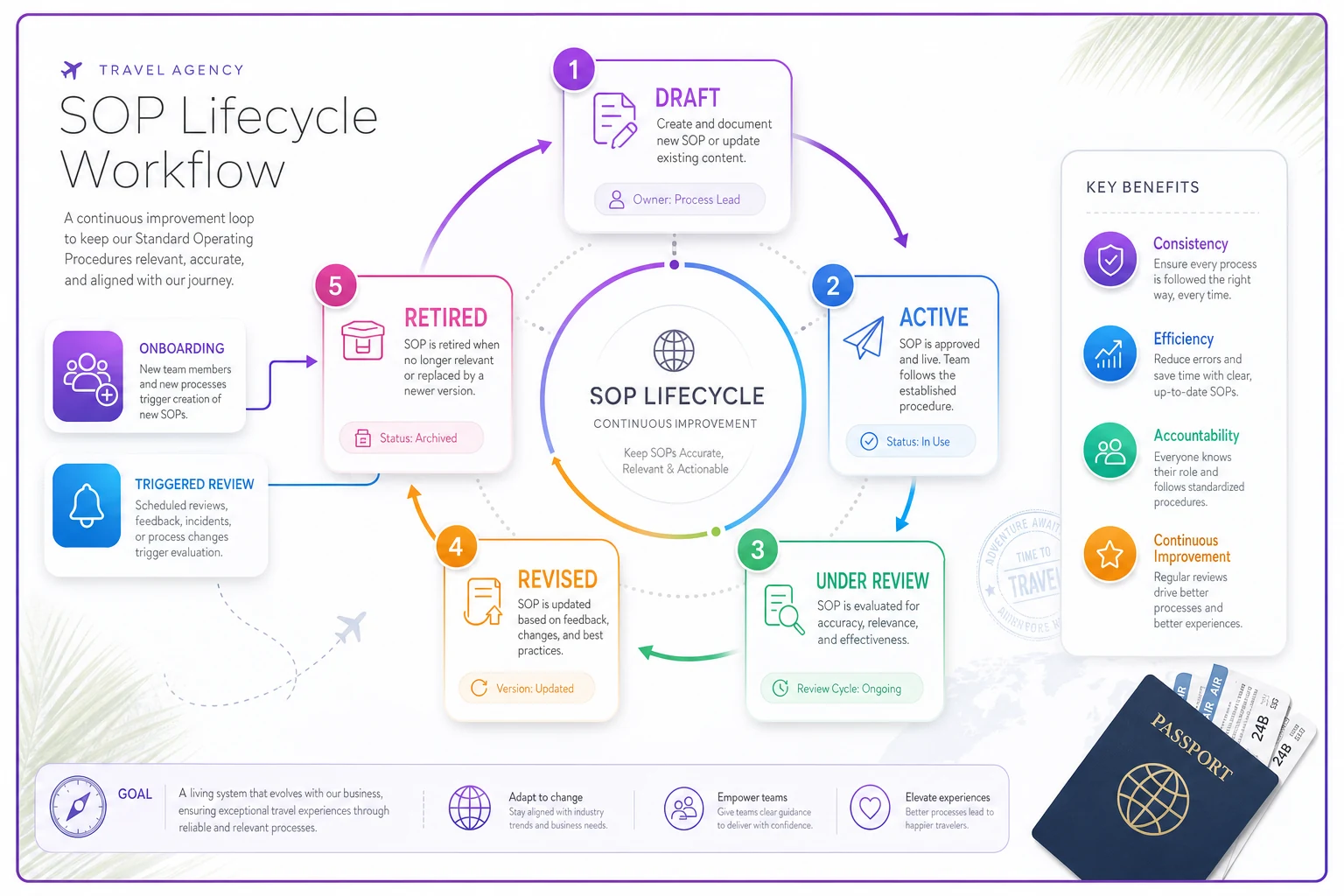
A retired SOP often prompts a new draft, and scheduled or triggered reviews feed changes back into active procedures.
What a governable SOP template actually looks like
A lot of SOP templates are bloated. Ten fields of metadata, three approval signatures, a formatting standard nobody follows. For a small-to-mid travel agency, you want the lightest template that still supports governance. If it's too heavy, people won't keep it updated — and an un-updated SOP is the whole problem.
A lean structure that holds up:
-
Title & ID — something searchable, e.g.
OPS-014 Supplier Failure Handling -
Owner — one named person, not a department
-
Last reviewed / Next review — two dates, always visible at the top
-
Trigger — when does this procedure kick in?
-
Steps — numbered, action-oriented, no vague verbs like "handle" or "manage"
-
Escalation — who to contact when the steps don't cover the situation
-
Linked SOPs — related procedures (handoff, invoicing, etc.)
-
Changelog — 2–3 lines per revision, dated
The "trigger" and "escalation" fields are the ones people consistently leave out, and they're exactly the fields that matter under pressure. A frontline agent dealing with a stranded client at 9pm doesn't need a philosophy of customer service — they need to know the exact trigger condition and who to call when step 4 doesn't work. Everything else is secondary.
Three travel-specific SOPs worth governing carefully
Generic SOP advice falls apart in travel because so much of the work is time-sensitive and involves third parties you don't control. Three procedures that break the most:
1. The client handoff SOP
Handoffs are where details die. A booking passes from a sales agent to an operations coordinator, or from one agent to another covering a shift, and something — a dietary requirement, a promised upgrade, a payment arrangement — silently doesn't make the jump.
A governed handoff SOP defines exactly what must be transferred: confirmed vs. pending items, outstanding payments, client preferences, and any verbal promises made during the sale. The verbal-promises part is the one everyone forgets, and it's the one that generates the angriest emails later. If a salesperson told a client "I'll see what I can do about a room with a view," that needs to travel with the file, even if the answer ends up being no.
For group work this gets exponentially harder because you're coordinating multiple travelers and often a group leader. If you've set up a proper group-booking SOP that keeps leaders informed and payments on schedule, your handoff procedure should link directly to it rather than duplicating the logic.
2. The supplier failure SOP
This is the one most agencies have entirely in their heads, which is a genuine problem given how often it fires. A hotel overbooks. A DMC goes quiet. An airline schedule change cascades through a whole itinerary. A supplier's payment portal is down on the day a deposit is due.
| Failure type | Time sensitivity | First action | Escalate if... |
|---|---|---|---|
| Overbooking / no availability | High (client traveling soon) | Contact supplier + source alternative in parallel | No resolution within 2 hrs |
| Supplier non-response | Medium | Second contact via alternate channel | No reply within 1 business day |
| Payment portal / invoicing failure | Medium–high (deposit deadline) | Document attempt, use fallback payment path | Deadline within 24 hrs |
| Quality complaint mid-trip | High | Direct supplier line + client reassurance | Not resolved within 4 hrs |
The value here isn't the table itself — it's that the decision is pre-made. Under stress, people either freeze or improvise wildly. A governed SOP removes the improvisation and gives everyone the same first move.
3. The invoicing SOP
Invoicing sits at the intersection of client trust and your own margin, which makes it a terrible place for undocumented process. The failure points are predictable: an invoice goes out with the wrong currency, a supplier cost gets entered against the wrong booking, a partial payment isn't logged so the balance reminder never fires, or commission is calculated before a refund adjusts the base.
A governed invoicing SOP nails down the sequence: when the invoice is generated relative to the booking, what gets reconciled against the supplier confirmation before it's sent, how partial payments are recorded, and who signs off on anything non-standard. The reconciliation-before-send step prevents the most expensive errors, because a wrong invoice that reaches a client costs you credibility on top of money.
Review cadence: scheduled *and* triggered
Most agencies that attempt review cadence pick a calendar interval — "we'll review all SOPs annually" — and then either don't, or review the wrong ones. Annual review is fine for stable procedures. It's useless for anything tied to a supplier or a system that changes on its own schedule.
Run two tracks:
Scheduled reviews, based on how volatile the process is:
-
High-volatility (supplier integrations, payment/invoicing flows)
every 3 months
-
Medium (handoffs, client comms)
every 6 months
-
Low (internal admin, filing conventions)
every 12 months
Triggered reviews, fired by events regardless of the calendar:
-
A supplier changes their booking or payment portal
-
A new payment processor or system is introduced
-
The same mistake happens twice
-
A regulatory or documentation change hits (visa rules, cross-border invoicing)
-
A key person leaves or a new role is created
The triggered track is what separates a governed library from a static one. The calendar review catches the boring stuff. The triggered review catches the stuff that would've actually hurt you. Two data points of the same mistake is a pattern — that's when you stop treating it as a one-off and open the SOP.
The ownership matrix (and why "everyone" means "no one")
Every SOP needs exactly one owner. Not a team, not a department — a named human who is responsible for keeping it accurate. The moment ownership is shared, it evaporates.
| Role | Responsibility |
|---|---|
| Owner | Keeps the SOP accurate, initiates reviews, approves changes |
| Contributor | Does the work daily; flags when reality diverges from the doc |
| Approver | Signs off on changes (often the owner's manager for high-risk SOPs) |
| Consumer | Follows the SOP; responsible for using the current version |
The contributor role is underrated. The person doing the invoicing every day knows before anyone else when the process has drifted. If they have a clear, low-friction way to flag "hey, this step is wrong now," your library stays alive. If flagging is a hassle, they just quietly do it their own way and the SOP rots. That drift is invisible until it causes a real mistake.
Measuring compliance without turning it into surveillance
SOP compliance measurement goes wrong fast when it feels like people are being policed. The point isn't to catch employees — it's to catch SOPs that don't work. If everyone's ignoring a procedure, the procedure is usually the problem.
A few KPIs that actually tell you something:
-
SOP freshness — % of active SOPs reviewed within their cadence window. Below roughly 80% and your library is quietly decaying.
-
Trigger response rate — how often a triggered review actually happened after its trigger event. This is where governance lives or dies.
-
Repeat-error rate — same operational mistake occurring more than once per quarter. Points you straight at a broken or missing SOP.
-
Onboarding-to-competence time — how long a new hire takes to work independently. A well-maintained library shortens this noticeably.
-
SOP coverage of incidents — when something goes wrong, was there an SOP for it? If a chunk of incidents fall outside any documented procedure, you've found your next drafts.
Don't measure all of these from day one. Freshness and repeat-error rate alone will tell you most of what you need for the first few months. The rest you can add once you've got the basics running without much friction.
Tying SOPs into onboarding
Most agencies miss this connection: your SOP library is your onboarding curriculum. If it isn't, you're maintaining two versions of "how we do things" and they'll drift apart.
A new hire's ramp should be a guided path through the relevant SOPs in the order they'll need them — handoffs before supplier failure, invoicing basics before edge cases. When onboarding pulls directly from the live library, two good things happen: new people learn the current process rather than a training deck that's a year stale, and the act of onboarding surfaces gaps, because a confused new hire asking "but what happens if...?" is your best SOP auditor.
If you're actively growing headcount, this ties into the broader question of scaling without service quality slipping — worth thinking through alongside a proper roadmap to scale a travel agency without losing service quality. SOP governance is one of the few levers that genuinely lets you add people without adding chaos.
Retirement: the stage everyone skips
An SOP should be retired when the process it describes no longer exists, has been fully absorbed into another procedure, or has been replaced by a system that handles it automatically. The criteria:
-
The trigger for the procedure can no longer occur (e.g. a supplier you no longer work with)
-
The steps have been merged into another SOP
-
A tool now handles it and the manual steps are obsolete
-
It's been "under review" for more than two cycles with no one able to justify keeping it
Retire, don't delete. Move it to an archive with a banner explaining why and pointing to whatever replaced it. The history matters — six months later someone will ask "didn't we used to do X?" and you'll want the record.
Agencies that never retire end up with a library so cluttered that people stop trusting it. Trust is the whole point. A library of 25 accurate, current SOPs beats a library of 90 where half are questionable, every time.
A real scenario
A mid-sized leisure agency — around 10 staff, doing roughly 300–350 bookings a month across a mix of FIT and small groups — had the classic setup: a Drive folder with about 60 documents, no owners, no review dates, and staff who mostly worked from memory.
Their recurring pain was invoicing and supplier-failure errors. They were seeing a handful of invoicing mistakes a month — wrong balances, mis-logged partial payments — and each one cost time and a bit of client goodwill. When a supplier went dark, resolution depended entirely on whichever senior person happened to be around that day.
They didn't rewrite everything. They started by identifying the 15 or so SOPs that actually mattered, assigned a single owner to each, added the two-date header and a trigger field, and set the volatile ones — invoicing, supplier failure, handoffs — to a quarterly review. They tracked just two things: freshness and repeat-error rate.
Over the following few months, repeat invoicing errors dropped to roughly one or two a month. More tellingly, when a DMC went unresponsive during peak season, a mid-level coordinator handled it start to finish without escalating, because the procedure told her exactly what to do. New-hire ramp time shortened noticeably too, since training just meant walking through the current library. The total document count actually went down, because retiring the dead ones made the live ones trustworthy again.
When this level of governance makes sense — and when it doesn't
When it makes sense: you have four or more people, you're hiring, you rely on suppliers whose systems change regularly, or you've had the same mistake come back more than once. If any of those are true, ungoverned SOPs are already costing you quietly.
When it's overkill: if you're a solo agent or a tight two-person shop with stable suppliers, a full lifecycle with review cadences and ownership matrices is probably more machinery than you need. Document your handful of critical procedures, keep them current, and skip the ceremony until you actually feel the strain.
Who should avoid doing this all at once: anyone tempted to spend a month documenting all 60 SOPs before launching governance. That's how you end up with a beautiful, complete library that immediately starts rotting because you exhausted yourself building it. Start with the 10–15 that hurt most, govern those well, and expand from there.
Where a system helps
Keeping all of this in a shared drive is possible but painful, because the drive can't enforce anything — it won't remind an owner that a review is due, won't flag an SOP that's drifted past its cadence, won't tie a procedure to the actual booking or supplier it governs.
An operational platform that keeps procedures, owners, review dates, and the actual work in one place earns its keep here. When the invoicing SOP lives next to the actual invoices, and the supplier-failure procedure surfaces the moment a supplier issue is logged, the library stops being a separate thing people have to remember to check. It becomes part of the workflow. AI-powered operational software can automate the governance reminders, flag overdue reviews, and surface the right procedure at the right moment — without relying on anyone to manually chase it. Governance you have to remember to do manually is governance that eventually stops happening.
Wrapping up
The agencies that scale cleanly aren't the ones with the most SOPs. They're the ones whose SOPs stay true — owned, reviewed on a cadence that matches how fast each process changes, measured lightly enough that the numbers tell you where the real problems are, and retired without guilt when they've outlived their purpose.
Start small. Pick the procedures that have burned you — handoffs, supplier failures, invoicing are the usual suspects — give each a single owner and two dates at the top, and set a review rhythm. A living library of fifteen procedures will do more for your operation than a dead library of sixty ever could.
Ready to elevate your travel agency workflow?
Join 1,200+ travel agencies using Travexly to save time, improve client satisfaction, and boost operational efficiency.