



Most travel agencies start the same way. A booking comes in, you handle it. Another booking, slightly different process. Fast forward eighteen months and you've got seven agents following nine different workflows, nobody knows what documentation is required when, and you're spending Sunday nights untangling amendments that should've taken twenty minutes.
I spent last month going through booking workflows across around forty travel agencies. The pattern was consistent: agencies handling more than fifteen bookings a month hit an operational wall where their ad-hoc processes completely fall apart. Not because the team isn't capable, but because nobody ever defined what "complete booking documentation" actually means, or who owns it when a client wants to change their departure date four days before travel.
The difference between agencies that scale past $2M in revenue and those that plateau around $800k usually isn't marketing budget or destination expertise. It's whether they've built a booking operations system their team can actually follow — with clear handoffs, defined service levels, and amendment protocols that don't require the owner's involvement every single time.
Why booking chaos multiplies as you grow
Small agencies survive on flexibility. When you're handling eight bookings a month, remembering that the Johnsons always want aisle seats and Mrs. Chen needs vegetarian meals feels like good service. But this breaks down hard around the twenty-booking mark.
The math is brutal. Each booking touches roughly twelve to fifteen operational checkpoints: initial inquiry, availability check, quote preparation, client approval, deposit collection, supplier confirmation, documentation gathering, visa requirements, final payment, pre-trip briefing, day-of coordination, and post-trip follow-up. That's 300 touchpoints monthly at twenty bookings. Miss just 3% of those and you've got nine operational failures every month. Nine angry clients. Nine fire drills eating into your margins.
What kills profitability isn't the missed touchpoint itself — it's the scramble afterward. A forgotten hotel confirmation leads to a panicked call at 11 PM, three hours of back-and-forth with suppliers, expedited rebooking fees, and usually some kind of client compensation. One agent told me she spent fourteen hours fixing a problem that proper booking documentation would've prevented entirely. Her effective hourly rate on that booking? Negative twelve dollars.
The real damage happens when agents start creating their own shadow processes to avoid these failures. One keeps a personal spreadsheet of booking statuses. Another has a notebook system for amendments. A third uses sticky notes on her monitor for urgent items. Now you've got three parallel tracking systems, none of them talking to each other, and when someone's out sick, their bookings fall into a black hole.
The three booking categories that need different operational flows
Not all bookings are equal, yet most agencies treat them identically. This is where operational inefficiency really compounds.
Eliminate booking chaos and streamline operations.
Travexly helps you manage, confirm, and track travel bookings effortlessly.
- Unified booking management
- Automated client communications
- Team scheduling & itinerary tracking
No credit card required
Simple bookings — single destination, standard hotels, no visa complications — should flow through your system in under 90 minutes of total work time. These represent roughly 40% of bookings but often eat up 60% of operational time because they get tangled in the same complex processes designed for multi-country itineraries.
Complex bookings — multiple countries, mixed transportation, activity coordination — legitimately need more touchpoints. These should trigger a different workflow with mandatory checkpoint reviews at booking confirmation, 30 days out, 14 days out, and 48 hours before departure. The problem is when simple bookings get forced through this same gauntlet.
Group bookings need their own universe entirely. Different deposit schedules, rooming list deadlines, dietary requirement matrices, payment collection workflows. I've seen agencies lose $18,000 on a single group booking because they treated it like twenty individual bookings rather than one coordinated operation with its own SLA requirements.
Here's what this looks like operationally:
| Booking Type | Initial Setup Time | Checkpoint Reviews | Amendment Process | Documentation Required |
|---|---|---|---|---|
| Simple | 90 minutes | 2 (confirmation, pre-departure) | Single approval, same-day processing | 5 documents |
| Complex | 4-6 hours | 5 (confirmation, visa check, 30-day, 14-day, 48-hour) | Manager review, 48-hour processing | 12-15 documents |
| Group | 8-12 hours | 8+ (includes roster deadlines, payment milestones) | Committee approval, 72-hour processing | 20+ documents |
The agencies that thrive have completely separate operational tracks for each category. Simple bookings run through streamlined templates and automated confirmations. Complex bookings trigger project management protocols. Group bookings activate specialized workflows with their own SLA commitments.
Building acceptance checklists that actually prevent problems
Generic checklists don't work. Agents click through twenty-item lists without actually verifying anything because half the items don't apply to their booking. Your Europe river cruise doesn't need malaria medication reminders. Your Bali yoga retreat doesn't need ski insurance verification.
Dynamic checklists that adjust based on booking parameters catch significantly more issues than static ones. Here's the framework that actually works:
Start with destination-specific requirements. Morocco bookings trigger passport expiration checks (must be valid six months beyond travel). Cuba bookings activate insurance verification protocols. Multi-country European itineraries launch Schengen visa requirement checks.
Layer in supplier-specific validations. Certain cruise lines require passport information 75 days before departure. Some safari lodges need dietary restrictions 30 days out. These aren't suggestions — miss these deadlines and you're eating cancellation fees or scrambling for alternatives.
Add client-specific flags. Previous booking history should automatically populate preferences and requirements. If Mr. Thompson needed a CPAP machine on his last three trips, that should be flagged at booking, not discovered at check-in. One missed medical equipment arrangement cost an agency a $4,500 emergency courier fee and nearly tanked a $30,000 booking.
The acceptance checklist needs teeth. Not just "verify passport" but "passport expiration date entered: _, verified against [specific country] requirements, minimum 6 months remaining: YES/NO, copies uploaded to booking file: YES/NO, client notified of requirements: YES/NO."
Build checklist logic that only shows relevant items per booking type.
This level of detail feels excessive until you're explaining to a client why they can't board their flight. Then it feels essential.
Amendment workflows that don't destroy your margins
Booking amendments are where most travel agencies hemorrhage money. The client wants to extend their stay by two nights. Sounds simple. Except it triggers hotel rebooking, flight changes, transfer adjustments, activity rescheduling, travel insurance updates, and potentially visa modifications. What should be a $200 upsell becomes six hours of operational chaos.
Agencies that maintain margins through amendments run strict escalation protocols. Level 1 amendments — date changes beyond 60 days, single hotel swaps, activity additions — get processed by any qualified agent within 24 hours. Level 2 amendments — flight changes, multi-property adjustments, date changes within 30 days — require senior agent approval and 48-hour processing. Level 3 amendments — complete itinerary overhauls, group booking modifications, changes within 14 days — trigger management review and 72-hour minimum processing.
More importantly, they've defined what's billable. Amendment fees aren't just about covering your time — they're about setting operational boundaries. Agencies that charge properly for amendments (typically $75-150 for Level 1, $150-300 for Level 2, $300+ for Level 3) tend to see far fewer amendment requests. Clients suddenly discover they can live with their original dates when changes aren't free.
The workflow itself needs to be bulletproof:
-
Amendment request logged with timestamp and specific changes requested
-
Feasibility check with suppliers (availability, repricing, penalty fees)
-
Cost calculation including agency time, supplier fees, and amendment margin
-
Client approval with written confirmation of new total and amendment fee
-
Supplier rebooking with confirmation numbers logged
-
Documentation updates across all systems
-
Client notification with updated documents
-
Internal handoff notes for any team member who might field questions
Here's a quick visual reference of how an amendment moves through your team.
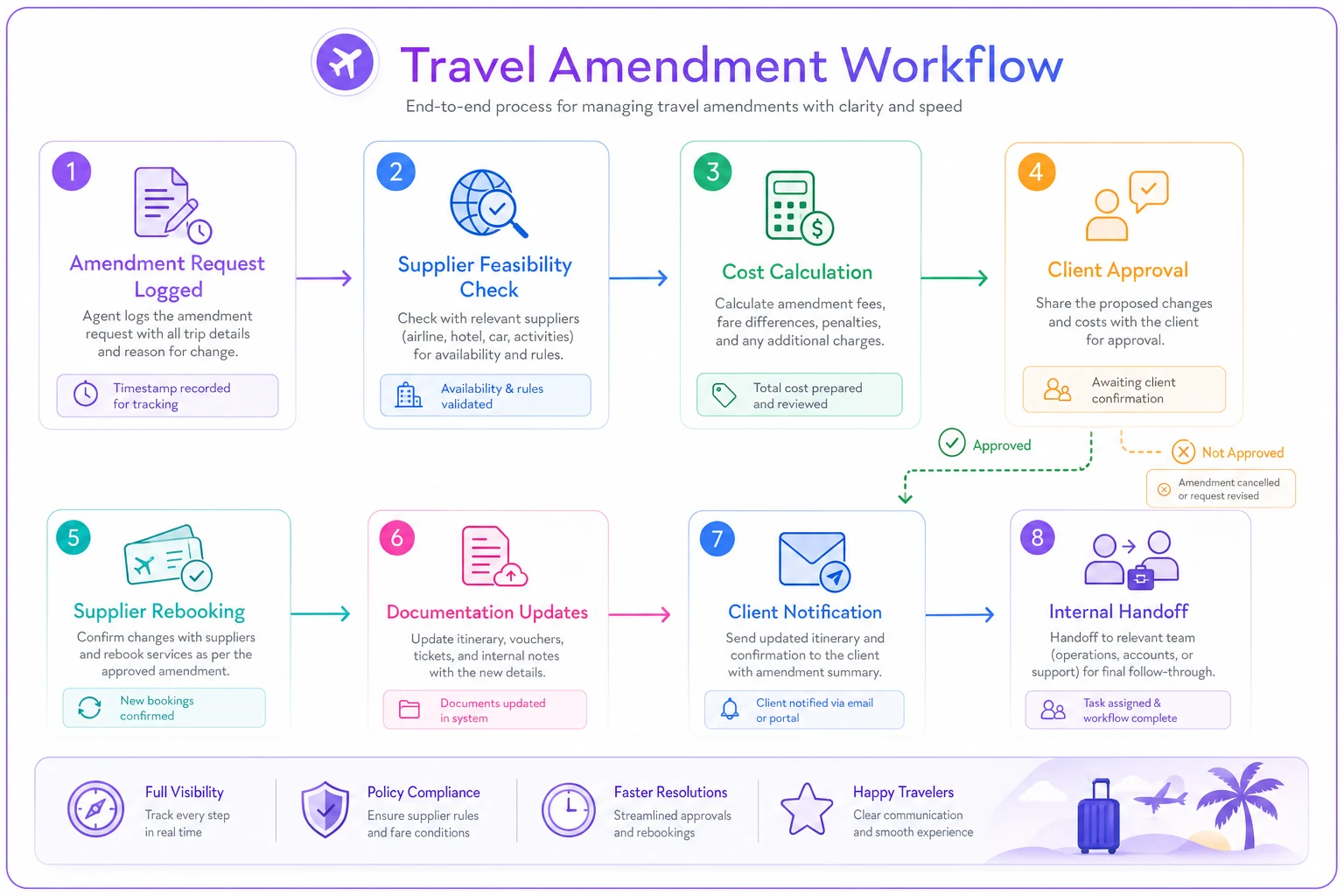
Skip step 4 and you'll eat the cost difference when the client claims they didn't approve the increase. Skip step 7 and you'll get panicked calls from the airport. Skip step 8 and the next agent to touch this booking starts from scratch.
Service level agreements that clients understand and teams can deliver
SLAs in travel aren't really about email response times. They're about setting realistic expectations for complex operational processes that clients don't fully understand.
Your SLA should spell out exactly what happens at each stage:
Initial inquiry to first response: 4 business hours for form submissions, 24 hours for email inquiries. Not "we'll get back to you soon" — specific, measurable commitments.
Quote delivery timelines: Simple bookings within 2 business days, complex itineraries within 5 business days, group bookings within 7 business days. This reflects the real time needed to verify availability, calculate accurate pricing, and build a proper proposal.
Booking confirmation: 48 hours from deposit receipt for simple bookings, 72 hours for complex, 5 business days for groups. This includes supplier confirmations, not just internal processing.
Documentation delivery: Final documents delivered 14 days before departure for domestic, 21 days for international, 30 days for complex multi-country or group bookings.
Amendment processing: As outlined above, with clear timelines based on complexity and timing.
What most agencies miss: SLAs need escape clauses for client-caused delays. If the client takes eight days to provide passport information, that's eight days added to your processing timeline. If they request amendments outside business hours, the clock starts the next business day. Without these boundaries, you're committing to timelines that are impossible to keep.
The SLA also needs to define what's NOT included in standard service. Weekend booking support, emergency rebooking, same-day amendment processing — these are premium services with premium pricing. One agency added roughly $180,000 in annual revenue just by properly charging for outside-SLA services they'd been giving away for free.
Templates that enforce consistency without killing creativity
Templates fail when they're either too rigid — agents abandon them — or too loose — might as well not exist. The sweet spot is modular templates with mandatory sections and flexible components.
Your booking confirmation template needs ironclad sections: booking reference, traveler names as they appear on passports, flight details with record locators, accommodation confirmations with addresses and phone numbers, transfer arrangements with pickup times, and payment summary with outstanding balances. These aren't negotiable.
Within those sections, though, agents need room to work. A honeymoon booking gets different messaging than a corporate retreat. A repeat client doesn't need the same educational content as a first-timer. The template structure ensures nothing gets missed while allowing the kind of personalization clients expect from boutique agencies.
Pre-departure templates are where operational efficiency really compounds. Instead of agents writing custom emails about visa requirements, currency, weather, and packing suggestions, they're pulling from tested, accurate modules. The visa module for Vietnam is always current. The weather guidance for Patagonia in March is always accurate. The currency overview for Iceland includes actually useful information about card acceptance, not generic "bring some cash" advice.
Document audit trails matter more than most people think. When a client claims they never received their flight change notification, you need proof. Templates should automatically log: sent date/time, recipient email, open tracking, attachment verification, and any delivery failures. This isn't paranoia — it's protection against the small percentage of bookings that go sideways and end up in disputes.
The compound effect of systematized booking operations
Training new agents drops from six weeks to two. They're not learning someone's personal system or decoding a notebook. They're following documented workflows with clear handoffs and defined outcomes. One agency cut training costs by around $14,000 annually just through faster onboarding.
Error rates drop significantly. When every booking follows the same operational flow, mistakes become systematic and fixable rather than random and mysterious. You stop having those "how did we miss this?" moments because the system either catches it, or you can trace exactly where the breakdown occurred.
Capacity increases without proportional headcount growth. Agents handling bookings through systematic workflows process meaningfully more bookings than those using ad-hoc methods — not because they're working faster, but because they're not wasting time on redundant checks, hunting for information, or fixing preventable problems.
Client satisfaction actually improves despite less ad-hoc flexibility. Clients value consistency and reliability over random acts of exceptional service. They'd rather know exactly when their documents will arrive than maybe get them early but possibly get them late.
And your agency becomes sellable. Nobody buys a business dependent on the owner's memory and three employees' personal systems. They buy documented operations that continue functioning regardless of who's running them. The valuation difference between an agency with documented operations versus one without? Typically 2-3x on equivalent revenue.
When to trigger operational audits
Don't wait for catastrophic failure to evaluate your booking operations workflows. Set specific triggers for operational review.
Volume triggers: Every time monthly bookings increase by 25%, audit your workflows. What worked at 20 bookings breaks at 25. The audit isn't about fixing problems — it's about preventing them.
Error triggers: Two similar errors in a month means systematic failure, not individual mistakes. If two bookings have visa issues, your visa workflow needs examination. If two clients complain about document timing, your SLA needs adjustment.
Time triggers: Quarterly reviews at minimum, even when everything seems smooth. Suppliers change requirements, regulations shift, and small inefficiencies compound into major bottlenecks before you notice them.
Team triggers: Every new hire, departure, or role change should prompt an operational review. New people expose weaknesses in documentation. Departures reveal undocumented knowledge. Role changes create handoff gaps that only show up under pressure.
Measuring what matters in booking operations
Tracking bookings and revenue tells you what happened. Operational metrics tell you what's about to happen.
First-time-right rate: What percentage of bookings complete without amendments, corrections, or fire drills? Strong agencies hit around 85%. Average ones hover around 60%. Below 60% and you're hemorrhaging margin on rework.
Touch time per booking: How many actual work minutes go into a booking from inquiry to completion — not calendar time, but hands-on-keyboard time. Simple bookings over 120 minutes suggest process problems. Complex bookings over 8 hours suggest scope creep or inefficient workflows.
Amendment frequency: Not all amendments are bad — they can increase revenue. But amendments within 30 days of departure typically indicate poor initial planning or communication. More than 15% suggests something systematic is broken in your booking process.
SLA adherence: Not just whether you meet your SLAs, but by how much. If you're consistently beating 48-hour turnaround in 24 hours, your SLA is wrong and you're setting unsustainable expectations. Consistently missing means you're eroding trust.
Escalation rate: What percentage of bookings require senior agent or management involvement? Below 10% might mean junior agents need more autonomy. Above 25% suggests either training gaps or process problems.
Documentation accuracy: Spot-audit ten bookings monthly. How many have every required document properly filed? Missing documentation is a leading indicator of future problems. Below 90% accuracy and you're sitting on a time bomb.
Moving forward with systematic booking operations
The path from chaotic to systematic isn't mysterious. It's methodical execution of boring but essential operational improvements.
Start with categorization. Every booking gets classified as simple, complex, or group before any work begins. This triggers the appropriate workflow and sets realistic timelines.
Document your current actual processes, not your ideal ones. What really happens when a booking comes in? Who actually touches it? Where does it actually stall? Build your system from reality, not theory.
Create your first checklist for your most common booking type. Not comprehensive — focused. Test it for two weeks, refine it, then expand. Don't try to systematize everything simultaneously.
Define clear amendment levels and pricing. Communicate it to clients upfront. The first time you charge for an amendment will feel uncomfortable. By the tenth time it feels normal. By the hundredth you'll wonder why you ever did it for free.
Build your SLA based on current realistic performance plus a 20% buffer. Under-promise while you iron out workflows. You can always tighten SLAs later — loosening them erodes trust.
Pick one operational metric and track it manually for a month. First-time-right rate is usually the easiest starting point. Just the act of tracking it typically improves it as awareness changes behavior.
The agencies thriving right now aren't the ones with the best destinations or the biggest marketing budgets. They're the ones that turned booking operations from artisan craft into scalable system. They process more bookings with less drama, maintaining margins while others race to the bottom.
Your booking operations system doesn't need to be perfect. It needs to exist, be documented, and be consistently applied. Every booking that follows the system instead of creating its own path saves time and prevents a potential crisis.
At 30 bookings monthly, systematic operations could recover over 150 hours of operational time annually and eliminate hundreds of preventable failure points. That's real capacity — and real margin — added back to your business.
The choice isn't complicated: keep fighting daily fires with heroic individual effort, or build boring but bulletproof systems that prevent fires entirely. The first feels more dynamic. The second builds actual business value.
Ready to elevate your travel agency workflow?
Join 1,200+ travel agencies using Travexly to save time, improve client satisfaction, and boost operational efficiency.