


Group bookings generate solid revenue for travel agencies—until they don't. The profit from a 30-person corporate retreat evaporates when payment schedules slip, tasks fall through the cracks, and the group leader finds out about problems from their own travelers instead of from you.
Most agencies handle group bookings through some mix of spreadsheets, email threads, and memory. It works until you're juggling eight groups at once, each with different payment schedules, rooming lists that keep changing, and leaders who expect updates you forgot to send.
The difference between profitable group bookings and operational nightmares isn't about working harder. It's about having a process that runs the same way every time, regardless of who's handling it or how messy the group gets.
Why group bookings quietly destroy margins
Group bookings look great on paper. You see a $45,000 booking for a destination wedding—25 rooms, multiple excursions, solid commission rates. Six months later you're doing the math on what you actually made after coordinator overtime, rush fees from missed deadlines, and commission clawbacks from canceled rooms.
The problem starts early. Someone takes the inquiry, creates a quote, collects a deposit—and then things get murky. Who handles final payments? When does the rooming list go in? Who's updating the group leader when something changes?
I've seen this exact scenario play out at a mid-sized agency in Florida that handled a 40-person corporate incentive trip. The sales agent who booked it went on maternity leave at the 90-day mark. The operations coordinator assumed accounting had the final payment timeline. Accounting thought operations was managing vendor communication. Nobody was wrong, exactly—there just wasn't a clear handoff process. They missed a vendor deadline by four days, paid a $1,200 rush fee, and the group leader found out because the hotel called her directly to confirm. That relationship didn't survive the trip.
Payment collection alone is a mess without structure. A group of 20 travelers means 20 different payment schedules, reminders at different times, and stragglers every single time. Miss a final payment deadline with a vendor and you're either fronting the money yourself or scrambling to collect while the group leader wonders why their trip still isn't confirmed.
The coordination burden compounds with every handoff. Sales books the group, operations handles manifests, accounting chases payments, customer service fields whatever the leader throws at them. Every transition is another opportunity for information to disappear.
The milestone timeline that actually works
Successful group management starts with a milestone timeline that maps every critical deadline from deposit to departure. Not some generic template—a timeline built around your actual vendor requirements, payment processing windows, and team capacity.
Eliminate booking chaos and streamline operations.
Travexly helps you manage, confirm, and track travel bookings effortlessly.
- Unified booking management
- Automated client communications
- Team scheduling & itinerary tracking
No credit card required
Start with the deadlines that will cost you money if missed:
Initial deposit deadline (Booking + 7 days)
-
Group leader deposit collected
-
Individual traveler deposits tracked
-
Vendor deposit submitted
-
Commission protection documented
Rooming list deadline (90 days out)
-
Name collection from all travelers
-
Special requests documented
-
Room type confirmations secured
-
Vendor submission completed
Final payment deadline (45 days out)
-
All traveler payments collected
-
Vendor final payment submitted
-
Commission calculations verified
-
Cancellation penalties activated
Documentation deadline (30 days out)
-
Travel documents distributed
-
Visa/passport verification completed
-
Insurance confirmations sent
-
Emergency contact lists finalized
Pre-departure deadline (7 days out)
-
Final manifests submitted
-
Leader briefing completed
-
On-trip contact protocols confirmed
-
Contingency plans documented
Between these major milestones you need micro-deadlines that keep things moving. Payment reminder at 60 days. Rooming list follow-up at 100 days. Document check at 45 days. Each milestone triggers specific tasks for specific people so nobody has to guess who does what.
The timeline gets more useful when you customize it by group type. Corporate groups need different touchpoints than destination weddings. Student groups require documentation timelines that account for permission slips and medical forms. Multi-generational family reunions need earlier deadlines for accessibility requests—something that catches agencies off guard the first time they handle one.
Customize milestone touchpoints by group type early so vendor requirements and client expectations align.
Here's a simple visual to keep the milestone workflow clear.
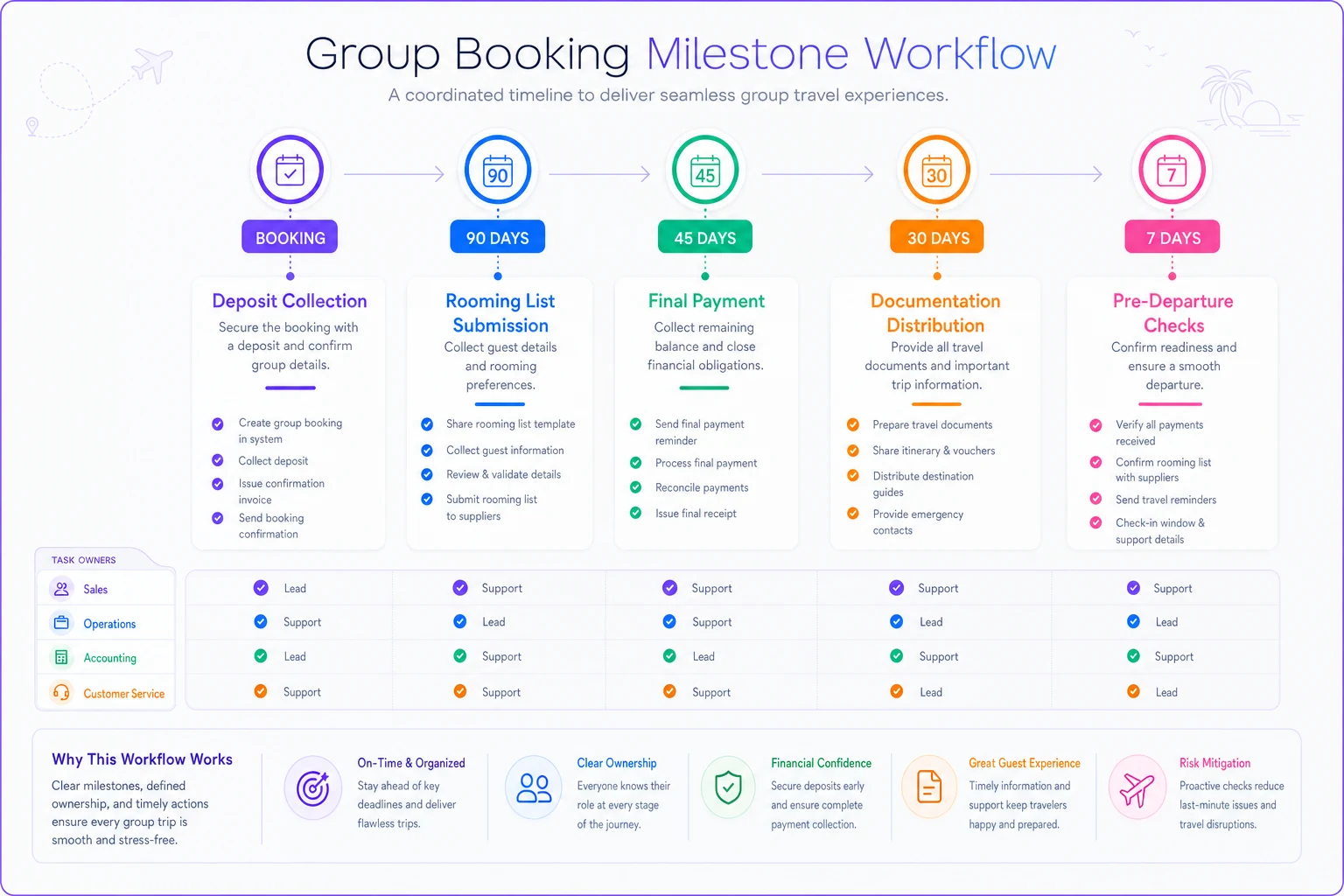
This shows the flow from deposit to departure and which team owns each milestone.
Role-based task lists that eliminate confusion
Generic task lists create more problems than they solve. When everyone is theoretically responsible for everything, nothing actually gets owned. Your SOP needs task lists that clearly define who owns what at each milestone.
Sales Agent Tasks:
-
Initial quote creation with all cost components
-
Deposit collection and receipt generation
-
Contract execution with terms documentation
-
Handoff package creation with all group details
-
Commission tracking setup and verification
Operations Coordinator Tasks:
-
Vendor relationship management throughout booking
-
Rooming list compilation and submission
-
Special request coordination and confirmation
-
Manifest preparation and accuracy verification
-
Change management and rebooking coordination
Accounting Tasks:
-
Payment schedule creation and monitoring
-
Individual traveler payment tracking
-
Vendor payment processing and confirmation
-
Commission reconciliation and protection
-
Refund and cancellation processing
Customer Service Tasks:
-
Traveler question routing and response
-
Document distribution and confirmation
-
Pre-departure communication management
-
Leader update scheduling and execution
-
Emergency contact maintenance
Specificity matters here more than most people realize. Not just "collect payments" but "collect payments and update the group tracking sheet with amount, date, and method within 24 hours of receipt." That level of detail eliminates the assumptions that quietly kill group bookings.
Task ownership also needs to account for coverage gaps. When your operations coordinator is out during a critical milestone, who picks up their tasks? Build backup assignments into the SOP now rather than figuring it out in the moment.
Payment schedule templates that prevent cash flow problems
Payment management makes or breaks group profitability. You need templates that work across different group types while protecting your agency from financial exposure.
Corporate Group Payment Structure:
-
25% initial deposit from company
-
50% at 60 days out
-
25% at 30 days out
-
Individual traveler changes billed separately
-
Cancellations handled through master account
Wedding Group Payment Structure:
-
$200 per room deposit at booking
-
Progressive payments over 6 months
-
Final payment 45 days out
-
Individual couple billing
-
Contingency fund for last-minute additions
Student Group Payment Structure:
-
Initial deposit per student
-
Monthly payment plans available
-
Fundraising credits tracked separately
-
Final payment 60 days out (earlier than standard)
-
Scholarship allocations documented
Templates need to specify not just when payments are due but how they're collected, where they're recorded, and what happens when they're late. Build in buffer time between when you collect from travelers and when you pay vendors—at least five business days to handle processing delays and failed payments.
| Group Type | Payment Details |
|---|---|
| Corporate | 25% initial deposit from company 50% at 60 days out 25% at 30 days out Individual traveler changes billed separately Cancellations handled through master account |
| Wedding | $200 per room deposit at booking Progressive payments over 6 months Final payment 45 days out Individual couple billing Contingency fund for last-minute additions |
| Student | Initial deposit per student Monthly payment plans available Fundraising credits tracked separately Final payment 60 days out (earlier than standard) Scholarship allocations documented |
Also spell out your late payment process explicitly. First reminder on the due date. Second at +3 days with a late fee warning. Final notice at +7 days with cancellation language. Escalation to the group leader at +10 days. Clear consequences, consistently applied.
One thing worth tracking over time: if corporate groups consistently pay late, adjust your collection schedule to account for it. If wedding groups keep adding travelers after final payment, build a contingency process so you're not improvising every single time.
Leader briefing checklists for professional communication
Group leaders judge your professionalism by how well you keep them informed. They don't care about your internal processes—they care about knowing their trip is under control. A solid briefing checklist makes that communication consistent at every stage.
Booking Confirmation Briefing:
-
Total group cost breakdown
-
Payment schedule with all dates
-
Key milestone timeline
-
Cancellation and change policies
-
Primary contact for questions
60-Day Briefing:
-
Payment status by traveler
-
Rooming list confirmations
-
Special requests status
-
Required documentation checklist
-
Upcoming milestone reminders
30-Day Briefing:
-
Final traveler manifest
-
Room assignment list
-
Activity confirmations
-
Emergency procedures
-
Day-of-departure logistics
7-Day Briefing:
-
Final logistics review
-
Contact information for trip
-
Weather and destination updates
-
Last-minute reminders
-
Problem escalation process
Each briefing should take under 15 minutes but cover everything the leader needs. Use a standard format they'll recognize—same sections, same order, same level of detail. Leaders appreciate consistency when they're managing group dynamics on their end.
Capture communication preferences at booking. Some leaders want weekly updates throughout planning. Others only want to hear at major milestones. Some prefer calls, others want everything in writing. Document it and build those preferences into your task lists.
What actually happens when this runs properly
When a real group booking SOP is in place and actually being followed, the improvements compound quickly. Payment collection that used to eat 15 to 20 hours of follow-up now happens through scheduled reminders. Rooming lists that caused last-minute panic get submitted weeks early. Leaders who used to call constantly start trusting your process.
One agency I worked with closely—handling somewhere around $2.5 to $3 million in annual group bookings—cut their operational time per group by roughly a third after implementing structured SOPs. Not by cutting staff, but just through efficiency. Tasks that took hours took minutes. The expensive mistakes, mostly rush fees and last-minute corrections, largely stopped. That number isn't from a published report—it's from their own before-and-after tracking across about 18 months of groups.
Your team also carries more groups when they're not firefighting constantly. They catch problems during milestone reviews instead of discovering them in crisis mode. New hires don't need months of shadowing either—they follow the documented process from day one and know exactly what's expected.
Technology amplification without dependency
The right operational software turns a solid SOP into a consistently executed one. AI-powered platforms can monitor approaching milestones, automatically trigger task assignments, and flag when payments fall behind schedule—handling the tracking and reminders so your team can stay focused on relationships and problem-solving.
Payment collection improves when automated reminders go out on schedule every time without someone having to remember. When a traveler's payment fails, the system flags it immediately for both the traveler and your accounting team, so the gap doesn't quietly affect a vendor deadline.
Task management stops being mental overhead. Each team member sees their specific tasks per group, when they're due, and what information they need. Handoffs happen cleanly because the system keeps a complete group history that anyone can access.
That said—the SOP comes first, technology second. You can run a solid group booking operation with paper checklists if your processes are tight. Technology amplifies good processes. It cannot fix broken ones.
Making the SOP actually stick
Creating the SOP is the straightforward part. Getting your team to use it consistently is where most agencies fall short. Start with one group type, get it working well, then expand. Don't try to overhaul everything at once.
Pick your most chaotic group type first. If wedding groups consistently create problems, build that SOP first. Document every step, create the templates, set the milestones. Run a few groups through the new process, collect feedback, refine it. Then move to the next group type.
Measure compliance, not just outcomes. Track whether milestone reviews happen on time. Monitor whether payment reminders go out when they should. Check whether leader briefings include everything required. You're building habits, not just writing procedures.
Experienced agents sometimes resist SOPs because they feel restrictive—like their expertise is being boxed in. The better framing is that the SOP handles routine coordination so they can focus on what they're actually good at: building client relationships and solving problems that don't fit neatly into any checklist. It frees them up rather than tying them down.
Review and refine quarterly. Vendor requirements change. Payment processing evolves. Client expectations shift. The SOP should improve with real experience, not sit as a static document nobody reads after the first month.
Conclusion
Group bookings don't have to be the thing that burns out your team and quietly eats your margins. With a properly structured SOP—milestone timelines, role-based task lists, payment templates, leader briefing checklists—you turn the chaos into something predictable and profitable.
The agencies that handle group bookings well aren't necessarily running the most experienced staff or the most sophisticated systems. They're running consistent, documented processes that ensure every group—whether it's 10 corporate executives or 200 wedding guests—gets the same professional handling from deposit to departure.
Build the SOP once, refine it based on what actually happens, and your group bookings stop being your biggest headache and start being your most reliable revenue stream.
Ready to elevate your travel agency workflow?
Join 1,200+ travel agencies using Travexly to save time, improve client satisfaction, and boost operational efficiency.