


Most travel agencies hit a breaking point somewhere between their eighth and fifteenth employee. The owner who used to handle complex group bookings personally now spends Tuesday mornings mediating between two agents who booked conflicting hotel blocks. The senior agent who knew every supplier's quirks is now training junior staff who miss commission deadlines because nobody documented the Carnival Cruise payment timeline. Operations that ran smoothly at five people turn into a mess of Slack messages, forgotten handoffs, and quality issues at twelve.
The pattern shows up differently across agencies, but the core problem is pretty consistent: scaling without a framework means building on quicksand. You hire when things feel overwhelming, automate random tasks when someone complains loudly enough, and write SOPs after mistakes already cost you money. By month nine, you've got three booking systems that don't talk to each other, agents following different processes, and a training program that amounts to "shadow Sarah for two weeks."
What actually works is treating growth the way you'd plan a complex multi-destination group trip. Map the journey month by month, figure out which pieces need human expertise versus systematic handling, and build the infrastructure before you desperately need it. Agencies that scale well don't just add headcount—they create repeatable systems where each new hire multiplies capacity instead of adding complexity.
Quarter 1: Foundation mapping and role clarity
The first three months determine whether your scaling efforts create leverage or expensive chaos. Before posting job listings or buying new software, you need real clarity on what work actually happens inside your agency and who should be doing it.
Start by tracking every task for two weeks. Not broad categories like "customer service" but the actual work: responding to quote requests, chasing supplier confirmations, updating booking spreadsheets, calculating commission splits, handling payment processing, building itineraries. Most agencies discover they're spending somewhere around 40% of their time on work that shouldn't exist—duplicate data entry, manual follow-ups that software could handle, or fixing mistakes caused by unclear processes.
Once you see the real breakdown, write role scorecards for every position. Not job descriptions full of vague responsibilities—specific, measurable outputs. A booking coordinator scorecard might say: processes 15-20 new booking requests weekly with 48-hour initial response time, maintains 95% accuracy on supplier confirmation details, escalates complex bookings within 24 hours. These scorecards become your hiring filters and your performance benchmarks.
The hire-versus-automate decision needs actual data, not gut feelings. List every repetitive task eating more than two hours weekly. For each one, calculate the real cost of human handling versus automation. Payment reminders consuming eight hours weekly at $25/hour runs you about $10,400 annually. A basic automation platform handling the same task might cost $200 monthly. But factor in flexibility too—automated payment reminders work fine until you need exceptions for VIP clients or complicated group bookings.
Build your tech foundation now, while you can still think clearly. Pick one core booking platform, one communication system, one document storage solution. Three different booking systems because "each one has features we like" creates exponential complexity as you grow. Better to have 80% functionality that works together than 100% features requiring manual bridges between them.
Quarter 2: Systems documentation and first strategic hire
Months four through six are about turning tribal knowledge into teachable systems. Every process that only exists in someone's head becomes a bottleneck at scale. But don't build 200-page manuals nobody reads—build living documentation people actually use.
Eliminate booking chaos and streamline operations.
Travexly helps you manage, confirm, and track travel bookings effortlessly.
- Unified booking management
- Automated client communications
- Team scheduling & itinerary tracking
No credit card required
The most effective approach has three levels. Quick reference cards for daily tasks, one page max. Detailed SOPs for complex processes with screenshots and decision trees. Video walkthroughs for genuinely nuanced situations. Your commission calculation SOP might have a one-pager showing standard percentages, a detailed doc covering edge cases and override approvals, plus a screen recording walking through actual calculations in your booking system.
Your first strategic hire sets the precedent for everything that follows. Most agencies default to hiring another agent when the owner feels overwhelmed, but that rarely fixes the actual problem. Look at where operational bottlenecks genuinely hurt growth. If quote requests pile up because nobody has time for initial research, hire an operations coordinator who handles preliminary supplier checks and quote prep. If payment reconciliation eats everyone's time, bring in someone who owns that entire workflow.
The onboarding curriculum for this first hire becomes your template for everyone after. Week one: systems access and basic workflows. Week two: client interaction protocols and supplier relationships. Week three: complex scenarios and exception handling. Week four: shadowing and supervised work. More importantly, document what confused them, what took longer than expected, what they figured out that wasn't written anywhere. Their experience improves the process for the next hire.
This quarter also reveals which tasks genuinely need human judgment versus systematic handling. Responding to "Can you check if these dates work?" doesn't require an experienced agent. But recognizing when a client's request suggests they'd actually be happier with a completely different destination—that needs a person. Map these distinctions carefully, because they drive your automation investments.
Quarter 3: Operational expansion and quality controls
By month seven, you're ready for faster growth, but only if the infrastructure actually exists. This quarter typically means adding two or three people and meaningful automation, which either multiplies capacity or creates operational chaos depending on your preparation.
The hire-versus-automate analysis gets more nuanced here. You're not just comparing direct costs but looking at scalability curves. A junior agent costs around $3,500 monthly and handles roughly 40 bookings. Two junior agents cost $7,000 and handle 80. An AI-assisted booking platform might run $500 monthly and handle initial processing for 200 bookings, leaving agents free for high-touch service and complex arrangements. The math isn't just about salaries—it's about where human expertise actually adds value versus where consistent, systematic processing matters more.
Role scorecards need updating based on real performance data. That coordinator processing 15-20 requests weekly? Maybe they're consistently hitting 25 with your new systems, or struggling to maintain quality above 18. Adjust the scorecards based on what sustainable performance actually looks like, not theoretical capacity.
Quality controls become critical once you can't personally review every booking. Build systematic checkpoints: automated alerts for bookings missing supplier confirmations after 72 hours, peer review for bookings above $10,000, weekly spot-checks of five random bookings per agent. But don't create bureaucracy for its own sake—each control should prevent a specific problem you've actually experienced, not a hypothetical one.
This quarter usually exposes coordination gaps. The person who booked flights doesn't know ground transportation changed. The agent handling the cruise doesn't realize the client booked pre-cruise hotels through someone else. You need systematic handoff protocols and a single source of truth for every booking. Every file needs one owner, even when multiple people contribute. Every client needs one primary relationship manager, even when specialists handle components.
Quarter 4: Scalability refinement and preparation for the next year
The final quarter is about turning growth experiments into sustainable operations. You've learned what works, what breaks, and where human talent beats automation. Now you optimize and prepare for the next level.
Performance data from quarters two and three shows which roles need full-time people versus fractional help. Maybe your social media coordinator works perfectly at 20 hours weekly, or your supplier relationship manager handles everything in three days. Build flexible capacity models instead of defaulting to full-time positions for everything. Three part-time specialists often outperform two generalists, especially in travel where depth of expertise matters.
Your tech stack needs honest evaluation. The booking platform that seemed fine with five agents might struggle with twelve. The communication system that worked for simple bookings can't handle complex group coordination. But don't replace everything at once—identify the one or two systems genuinely constraining growth and plan careful migrations. Switching booking platforms during peak season because "the new one has better reporting" is how agencies lose clients and staff simultaneously.
Create advancement paths before people start leaving. The star operations coordinator who's been delivering for six months needs to see growth opportunities beyond "maybe senior coordinator someday." Build skill development tracks: supplier specialization, complex group handling, technology implementation, team leadership. Not everyone moves up hierarchically, but everyone needs to see forward movement of some kind.
The onboarding curriculum gets its major revision after nine months of hiring experience. That four-week program might compress to three weeks for experienced hires or stretch to six for career-changers. Build modular training components that adjust to experience level. Commission calculation might be day-two material for someone with agency experience but week-three content for someone coming from hospitality.
Making the hire-versus-automate decision
The framework that actually works looks at five factors, not just cost:
Consistency requirements: Payment processing needs near-perfect accuracy—well-suited for automation. Client preference insights need human intuition and relationship building.
Volume patterns: Steady daily tasks suit automation. Sporadic complex problems need human flexibility.
Exception frequency: If more than 20% of cases need special handling, humans adapt better than rigid automation.
Client impact: Anything directly affecting client experience deserves careful thought. Automated booking confirmations work great. Automated "sorry your trip got cancelled" messages damage relationships.
Growth trajectory: Will this task 5x in volume or complexity? Automation scales linearly; human capacity hits walls.
Build automation with simple override flags for VIP clients so exceptions are easy to handle without manual workarounds.
A practical way to see how these decisions play out across the year:
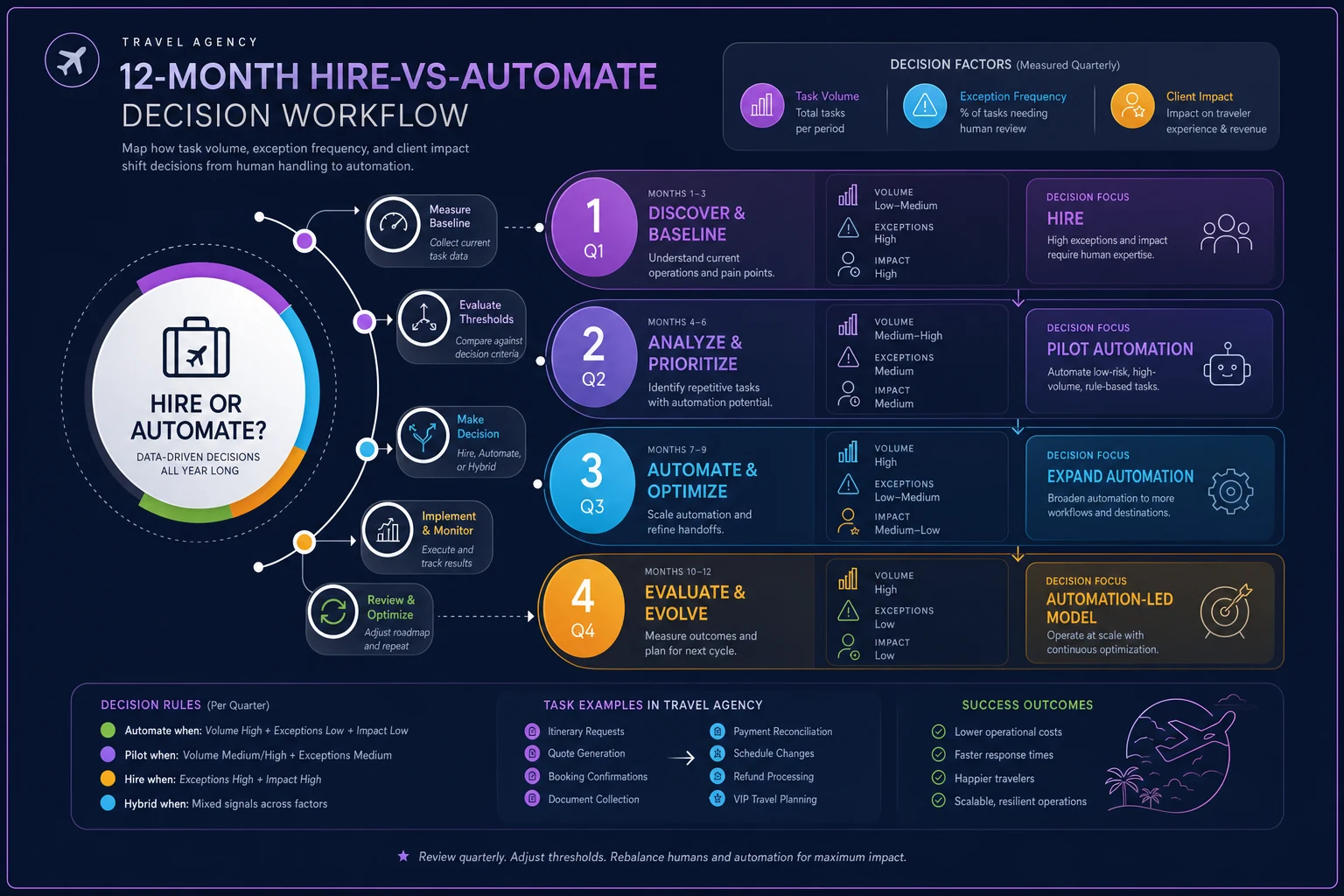
The graph above illustrates something worth sitting with: early on, almost everything feels like it needs a person. By quarter three, you start seeing which tasks are just eating human hours unnecessarily. That shift in thinking is what separates agencies that scale cleanly from ones that keep piling on headcount.
Building your tech selection criteria
Stop evaluating software based on feature lists. A platform with 200 features where you actually use 15 creates more problems than it solves. Evaluate based on operational fit instead:
| Criteria | What to Actually Test |
|---|---|
| Integration depth | Does it genuinely sync with existing systems, or just claim compatibility? |
| Workflow alignment | Does it match how your agency operates, or force you into its structure? |
| Growth capacity | Can it handle 10x current volume without major changes? |
| Team adoption likelihood | Will your team actually use it daily? |
| Vendor stability | Will this company exist in 18 months? |
The evaluation process should include real workflow testing, not demos. Run five actual bookings through the platform. Have three different team members attempt common tasks. Test how it handles your weirdest edge case from last year. Software demos show perfect scenarios—you need to test messy reality.
Creating sustainable onboarding curriculum
New hire productivity determines scaling success more than hiring velocity. An agent productive by week six versus week twelve changes your entire growth math. Most agencies confuse information dumping with actual onboarding.
-
Week 1 — Foundations Systems access, communication protocols, basic booking workflow, company culture. Keep it simple—overwhelming people with everything at once helps nobody.
-
Week 2 — Skill building Supplier relationships, quoting process, client communication standards, basic problem resolution. Practice with real but low-stakes work.
-
Week 3 — Complexity introduction Special request handling, group booking basics, commission structures, quality standards. Shadow experienced agents on challenging situations.
-
Week 4 — Supervised practice Handle real bookings with oversight, manage client communications with review, process actual payments with verification. Make mistakes in controlled conditions.
-
Weeks 5-6 — Gradual independence Own simple bookings completely, contribute to complex ones, flag uncertainties for guidance. Build confidence through progressive autonomy.
The curriculum means nothing without feedback loops. Weekly check-ins during month one, bi-weekly during month two, monthly after that. Track what repeatedly confuses people and fix the training, not just the individual.
Measuring what matters during scaling
Traditional metrics miss what actually drives sustainable growth. Booking volume and revenue matter, but operational health determines whether you're building something solid or burning toward a breakdown.
Time to productivity: How long before new hires contribute meaningfully? If agents take four months to handle standard bookings independently, your hiring plan needs adjustment.
Error rates by complexity: Patterns matter more than isolated mistakes. High error rates on simple tasks suggest training gaps. High error rates on complex tasks might mean you need specialization.
Handoff success rate: What percentage of multi-person bookings complete without coordination failures? This predicts scalability better than individual performance metrics.
System adoption scores: Sophisticated software means nothing if the team works around it. Track actual usage versus theoretical capability.
Client satisfaction by agent tenure: Some variance between new and experienced agents is expected. Massive gaps suggest onboarding problems.
Monthly operational reviews should examine trends, not just snapshots. Increasing error rates might signal overload even when volume looks manageable. Declining system usage can signal platform problems before they become expensive.
Common scaling pitfalls that destroy agencies
Three mistakes kill more scaling efforts than anything else.
First, hiring for today's problems instead of next quarter's needs. When bookings pile up, agencies panic-hire anyone with basic experience. Three months later, that reactive hire can't handle the complex corporate groups you're now pursuing. Hire for where you're going, not where you're stuck.
Second, automating without understanding workflows. Agencies buy expensive platforms then force their operations into rigid structures. Six months later, everyone uses workarounds that destroy the efficiency gains they were chasing. Map your processes first, then find technology that supports them.
Third, scaling uniformly instead of strategically. Not every part of your business should grow at the same pace. Leisure travel might scale beautifully while corporate accounts need boutique attention. Build growth plans that match operational reality, not arbitrary targets.
The path forward
Scaling successfully requires disciplined execution of unsexy work. Creating role scorecards isn't exciting. Documenting processes feels tedious. Building systematic onboarding seems like overhead. But this foundation is what determines whether adding people multiplies or divides your capacity.
| Quarter | Focus |
|---|---|
| Month 1-3 | Map current operations, create role scorecards, build hire-versus-automate matrix, establish tech foundation |
| Month 4-6 | Document core processes, make first strategic hire, develop onboarding curriculum, identify automation priorities |
| Month 7-9 | Expand team strategically, implement quality controls, refine coordination systems, optimize role definitions |
| Month 10-12 | Evaluate and adjust tech stack, create advancement paths, revise training programs, establish operational metrics |
Agencies that actually succeed at scale don't just add resources—they build systems where each addition amplifies what's already there. Your tenth employee should make your first nine more effective, not create complexity that slows everyone down.
Growth without a framework creates expensive chaos. Systematic scaling that balances human expertise with operational automation builds agencies that work beyond the founder's personal capacity. The roadmap is straightforward. The harder question is whether you follow it before growth forces painful corrections, or after.
Ready to elevate your travel agency workflow?
Join 1,200+ travel agencies using Travexly to save time, improve client satisfaction, and boost operational efficiency.