


Most agencies think of customer success in three separate buckets: getting the client set up, handling problems during the trip, and (maybe) selling them again later. Each bucket usually lives with a different person, in a different tool, with different rules — or no rules at all. That works fine when you're running 40 trips a year and the owner personally touches every one.
Then you hit a hundred concurrent travelers across six time zones, and the whole thing quietly falls apart. Not with a bang. With a slow accumulation of dropped balls: the client who texted your agent's personal WhatsApp at 2am and got no answer, the upsell that never happened because nobody flagged the anniversary, the escalation that sat in an inbox for eight hours because "someone" was supposed to be watching.
A customer success travel agency operating model isn't a nicer way to be friendly. It's the connective tissue between onboarding, in-trip care, and expansion — so that quality doesn't depend on which agent happened to be online. Below is how these pieces actually link, where they break, and what a system that holds together at scale looks like.
The three phases aren't separate — they're one continuous handoff
The core mistake is treating onboarding, in-trip, and expansion as a relay race where each runner drops the baton and walks off. In reality, the quality of your in-trip care is largely decided during onboarding. And your expansion revenue is largely decided by what happened during the trip.
Think about the information flow:
-
Onboarding captures the client's preferences, risk tolerance, deal-breakers, and how they want to be contacted.
-
In-trip care depends entirely on that data being available to whoever's on shift when something goes wrong.
-
Expansion depends on the in-trip experience being documented well enough that you know what to pitch, and when.
When onboarding is thin, in-trip agents are flying blind. When in-trip care isn't logged, the expansion conversation starts from zero. Each weak handoff compounds into the next phase.
A solid onboarding process feeds everything downstream. If you haven't tightened your intake yet, the single highest-leverage move is a structured questionnaire — the kind that cuts discovery calls in half by feeding straight into your itineraries. That same intake data is what your in-trip agent pulls up at 3am when a client's connection gets cancelled in Istanbul.
Where onboarding quietly sabotages in-trip care
Agencies usually collect the wrong onboarding data. They gather what's needed to build the itinerary — dates, budget, party size — and stop there. They don't capture what's needed to rescue the trip when things go sideways.
Eliminate booking chaos and streamline operations.
Travexly helps you manage, confirm, and track travel bookings effortlessly.
- Unified booking management
- Automated client communications
- Team scheduling & itinerary tracking
No credit card required
What's actually missing:
-
Contact escalation preferences. Does the client want to be called or texted? Who's the backup contact if they're unreachable — mid-flight, in a spa, off-grid?
-
Risk profile. Are they the type who wants to be informed of every minor change, or only contacted when action is required? Getting this wrong creates either panic or resentment.
-
Decision authority. On a group booking, who can approve a $600 rebooking without a committee call?
-
Medical, mobility, or dietary non-negotiables that turn a "minor" hotel swap into a crisis.
A typical example: a couple books an anniversary trip, and the onboarding form never flags it as an anniversary. Mid-trip, the hotel bumps their room. The agent, not knowing the significance, resolves it with a standard equivalent room. Technically fine. Emotionally, a disaster. That's a lost referral and a dead expansion opportunity — all because a checkbox wasn't on the intake form.
The fix isn't more forms. It's designing onboarding backwards from your in-trip failure modes. List the ten most common things that go wrong mid-trip. Then ask: what would I need to know in advance to handle each one gracefully? Put those questions in the intake.
In-trip SLA and backstop rules: the part everyone under-builds
Most agencies operate on vibes here. "We take care of our clients" is not an SLA. An SLA is a promise with a clock on it, plus a defined fallback for when the primary person can't respond.
Two pieces people consistently conflate:
-
SLA = the response time you promise and staff toward.
-
Backstop rule = what automatically happens when the SLA is about to be breached.
Without the backstop, your SLA is just a hope. The agent's phone dies, they're on a flight, they're asleep — and the promise breaks silently.
| Situation | Response SLA | Primary owner | Backstop if unmet |
|---|---|---|---|
| General question (non-urgent) | Within 4 hours (business hours) | Assigned agent | Rolls to shared queue after 4h |
| Change/amendment request | Within 2 hours | Assigned agent | On-call agent after 2h |
| Active disruption (cancelled flight, no-show pickup) | Within 30 minutes, 24/7 | On-call duty agent | Senior/owner paged after 30 min |
| Safety or medical | Immediate | Any available agent | Owner + emergency protocol |
The 24/7 tier is where small agencies flinch. You don't need a night-shift team of five. You need a rotating on-call phone and one rule: any active disruption gets a human acknowledgment within 30 minutes, even if the fix comes later. Clients forgive a delayed solution far more readily than they forgive silence.
Automate backstop triggers so SLA breaches immediately notify the next owner.
The backstop column is the actual innovation here. Every SLA row must answer: "and if that person doesn't respond, then what?" If any row is blank, that's your next 2am failure.
Escalation paths: who gets pulled in, and when
Escalation is where the in-trip system either scales or collapses. The failure mode is predictable: junior agents either escalate everything — drowning seniors and slowing response — or escalate nothing, making expensive judgment calls they're not equipped for.
The cure is a written trigger list, not a culture of "use your best judgment." Best judgment doesn't scale because judgment varies wildly between a six-month agent and a six-year one.
-
Spend threshold. Any resolution over $X requires senior sign-off. Below it, the agent acts.
-
Emotional threshold. A client who's used the words "furious," "refund," or "never again" gets escalated regardless of dollar amount.
-
Time threshold. Anything unresolved past the SLA window auto-escalates — the clock does it, not a person's memory.
-
Category triggers. Safety, legal, medical, and media-adjacent situations skip the ladder entirely and go straight to the owner.
If you don't have this on a single page yet, start there — a one-page escalation protocol that spells out exactly when junior agents must loop in seniors removes the guesswork that causes both over- and under-escalation. Post it somewhere the on-call agent can actually see it while the phone is ringing.
One thing worth noting: the problem is rarely that agents don't know to escalate. It's that they don't know to whom, right now, at 11pm on a Sunday. An escalation path without a live, current on-call name attached to it is decoration. Keep a rotating on-call schedule visible and current, or the whole ladder becomes theoretical.
The measurement layer that ties it all together
You can't professionalize what you don't measure, and most agencies measure the wrong things during in-trip care. They track NPS after the fact — useful, but too late to fix anything mid-trip.
The metrics that actually run the operation:
-
First-response time on active disruptions (not resolution time — response time). This is your early warning system.
-
SLA breach rate by tier. If your 30-minute disruption tier breaches 15% of the time, your on-call coverage has a hole.
-
Escalation accuracy. What percentage of escalations were appropriate vs. over-escalations? Trends here tell you where training is needed.
-
In-trip issue rate per booking type. Certain suppliers or itinerary structures generate disproportionate mid-trip chaos. This number tells you where.
-
Silent-failure catches. How many issues did the client not report but you caught proactively? This is the hardest to track and the most valuable.
Response-time metrics are leading indicators; satisfaction scores are lagging ones. If you only watch the lagging ones, you find out about problems from the review, not from the dashboard.
Expansion: the handoff nobody staffs properly
The trip goes well, the client comes home happy — and then nothing. No follow-up, no next-trip conversation, no upsell. The success of the trip evaporates because expansion was never a defined step in the operating model.
The problem is timing and ownership. The in-trip agent knows exactly what the client loved and hated, but they're not the one who handles expansion. The person who does handle expansion doesn't have that context. So the handoff either doesn't happen or happens too late, after the emotional peak has already faded.
Two rules fix most of this:
-
Capture the expansion signal during the trip, not after. When a client says "we have to come back here" or "next time we'd love the wine region," that gets logged as an expansion trigger immediately, tied to their record.
-
Time the follow-up to the emotional window. The post-trip window is short. This is exactly why turning post-trip reviews into revenue with proper timing and upsell triggers works — the review request and the expansion pitch ride the same wave of goodwill, if you catch it before it cools.
A typical miss: client returns in April glowing about their trip, mentions offhand they're thinking about a big trip for their 25th anniversary "in a couple years." Nobody logs it. Two years later they book through a competitor because your agency never followed up. That's a $12k–$18k trip lost to a missing checkbox and a missing follow-up rule.
What breaks specifically at scale
Everything above works informally at low volume. The owner remembers every client, personally handles escalations, and mentally tracks who's due for a follow-up. The system is the owner's brain.
Then volume climbs and the cracks show in a predictable order:
-
First to break
after-hours coverage.
The 2am disruption that used to be rare is now weekly, and one person can't hold the on-call phone forever. -
Second
escalation clarity.
New hires don't have the owner's instincts, so they either escalate everything or freeze. -
Third
information handoff.
With more agents, the client's context stops living in one head and starts scattering across inboxes, notes apps, and memory. -
Fourth
expansion follow-through.
As volume grows, the informal "I'll remember to follow up" completely stops working, and expansion revenue flattens even as trip volume rises.
These break in this order because they're each dependent on the owner's personal bandwidth, and after-hours is where that bandwidth runs out first.
Here's a simple workflow view of the shared operating system and how the pieces connect.
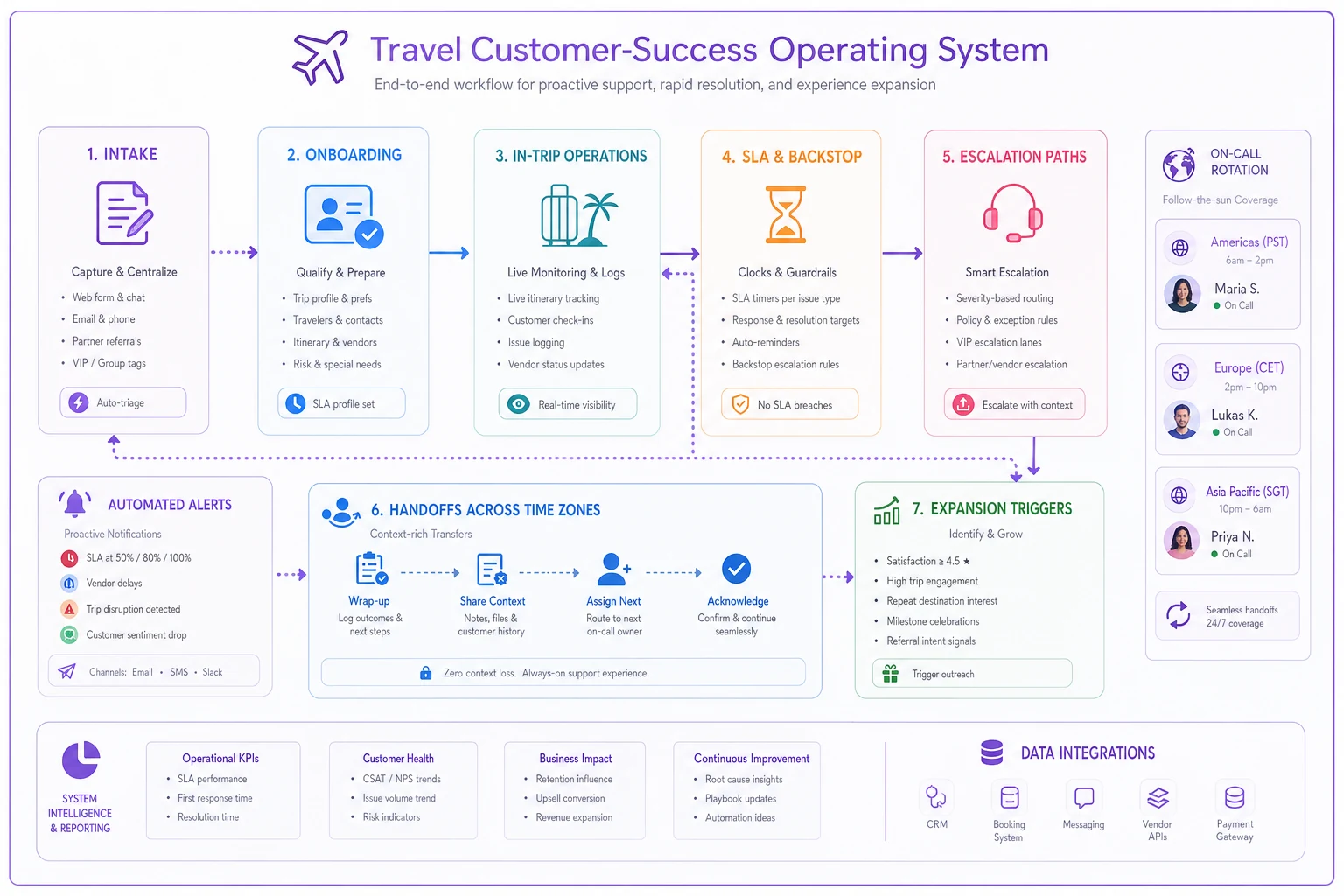
This is the point where a shared operating system — one place where onboarding data, in-trip logs, SLA clocks, escalation paths, and expansion triggers all live together — stops being a nice-to-have. When an SLA clock is automated, a breach fires an alert to the on-call agent whether or not anyone remembers to check. When the client's full context lives in one record, any agent on shift can pick up the thread. The tooling doesn't replace judgment; it makes sure the judgment happens on time and with the right information in front of it.
When this level of structure makes sense — and when it doesn't
Not every agency needs a full tiered SLA-and-backstop model.
When it makes sense:
-
You're running enough concurrent trips that no single person can track them all.
-
You have more than two agents handling in-trip care, so consistency matters.
-
Your trips involve real disruption risk — international, multi-supplier, high-value.
When it's overkill:
-
You're a solo operator doing 30–50 domestic trips a year with a simple structure. Formalizing SLAs into tiers just adds paperwork you'll have to maintain.
-
Your clients are low-touch corporate bookings where the "care" is mostly transactional.
One type of agency that should not rush this: anyone still figuring out their onboarding basics. Build the intake layer first. A sophisticated escalation protocol sitting on top of thin onboarding data is a fast car with no fuel — it looks impressive and goes nowhere when it matters.
A real scenario
A boutique agency doing high-end European itineraries — roughly 180 to 220 trips a year, four agents — was fielding all in-trip communication through individual agents' phones and emails. No shared on-call, no SLA definition, no escalation triggers.
The breaking point was a summer where two agents were traveling simultaneously and a client's disruption sat unanswered for most of a day. The client posted about it publicly. The owner realized the "we take great care of clients" promise had no infrastructure behind it.
-
Redesigned onboarding to capture escalation preferences and risk profile.
-
Set up a rotating on-call phone with a 30-minute acknowledgment rule for active disruptions.
-
Put a one-page escalation trigger sheet in front of every agent.
-
Started logging expansion signals during trips instead of trying to reconstruct them afterward.
The results weren't dramatic overnight, but they were real. After-hours response times went from "whenever someone saw it" to consistently under 30 minutes. Escalations to the owner dropped by roughly a third because agents finally had clear thresholds. And expansion revenue noticeably picked up over the following year — mostly because the signals were finally being captured and acted on rather than evaporating the moment the client landed home.
The takeaway
Onboarding, in-trip care, and expansion aren't three departments. They're one continuous flow of information and responsibility, and the quality of each phase is set by the phase before it. The agencies that professionalize in-trip care at scale aren't the ones with the friendliest agents — they're the ones who built SLAs with real backstops, escalation paths with live owners attached, and measurement that catches problems before the review does.
Start where you're weakest. If your onboarding is thin, fix the intake. If your after-hours coverage is a single overworked phone, build the on-call rotation and the backstop behind it. If your expansion revenue is flat despite growing trip volume, the leak is almost certainly in the handoff, not the demand. Fix the handoffs, and the rest of the system holds together as you grow.
Ready to elevate your travel agency workflow?
Join 1,200+ travel agencies using Travexly to save time, improve client satisfaction, and boost operational efficiency.