


Your agents are spending close to 45 minutes on every discovery call asking the same questions. Half those prospects ghost you after hearing the price. The other half need three follow-up emails to clarify budget preferences you could've just asked upfront.
And after all of that, your agents are still manually piecing together itineraries from scratch — copying the same destination descriptions and activity blurbs they've used dozens of times. A well-structured travel agency onboarding questionnaire changes this entire dynamic.
The Actual Cost of How Most Agencies Handle Discovery
Most travel agencies treat discovery calls as relationship-building. And for luxury bookings, that reasoning holds. But when you're fielding 40-something inquiries a month, those calls quietly add up to around 30 hours of agent time just gathering basic trip information.
Here's how the cycle typically goes: a prospect fills out your contact form with "interested in Europe trip" and their email. Your agent schedules a call. The first 15 minutes cover dates, destination, group size. Another 10 on budget and accommodation preferences. Then activity interests, dietary restrictions, mobility considerations. By minute 35, they're finally getting somewhere — and the prospect has to jump off for another meeting.
The agent takes scattered notes. An hour later, they're building an initial proposal and hunting through folders for the Tuscany villa description they wrote eight months ago. Three days later, the prospect asks if the quote works for 12 people instead of 10. The whole thing starts over.
This pattern shows up constantly across mid-sized leisure agencies, and the average agent is burning somewhere around 10 to 12 hours a week just on discovery and initial proposal creation. That's basically a part-time job's worth of repetitive information gathering, week after week.
Building Questionnaires People Actually Finish
The difference between a questionnaire prospects complete versus one they bail on comes down to structure and a little bit of psychology. Too many fields upfront and they leave. Too few and you're back to the hour-long calls.
Eliminate booking chaos and streamline operations.
Travexly helps you manage, confirm, and track travel bookings effortlessly.
- Unified booking management
- Automated client communications
- Team scheduling & itinerary tracking
No credit card required
Start with commitment-building questions. Ask about their dream destination first, not their budget. Get them imagining the trip before you ask for effort. Once someone types "walking through Santorini at sunset" into your form, they're emotionally invested in finishing it.
Here's the field progression that tends to work:
-
Section 1
The Dream (2-3 questions)
- Where are you dreaming of going? - What's the occasion? (anniversary, family reunion, etc.) - Roughly when? (month/year is fine) -
Section 2
The Group (3-4 questions)
- How many travelers? - Any kids? What ages? - Anyone with mobility considerations? - Dietary restrictions we should know about? -
Section 3
The Experience (4-5 questions)
- Accommodation style preference (luxury hotel, boutique, vacation rental) - Must-have experiences (specific sites, activities) - Travel pace (packed schedule vs. lots of downtime) - Previous favorite trips — this one tells you more about real preferences than almost anything else -
Section 4
The Investment (2 questions)
- Budget range per person - What's included in that budget expectation?
Start with the dream question first — it builds emotional investment before you ask for effort.
Budget comes last deliberately. By then, they've spent five minutes imagining their trip. They're far more willing to share real numbers.
Branching Logic That Mimics Conversation
Static forms feel like paperwork. Dynamic questionnaires feel like a conversation. The difference is branching logic that adapts based on what someone selects.
Someone picks "Family with kids"? Show fields for ages and kid-friendly activity preferences. Someone flags themselves as a wine enthusiast? Display questions about tasting preferences and vineyard styles. Business class flights? Ask about airline alliance preferences and lounge access priorities.
Two things happen when you do this well. First, the questionnaire stays relevant — nobody wants to answer questions about kids' clubs when they're planning a honeymoon. Second, it signals expertise. When your form asks educated follow-ups about specific interests, prospects trust that you understand their niche before they've spoken to anyone.
One adventure travel agency uses branching that gets quite specific on fitness and experience level. Select "interested in hiking" and the form asks about typical hike duration, altitude experience, and whether they own their own gear. Those details let agents suggest appropriate trek difficulty levels without the awkward "so... can you actually hike 15 miles?" conversation on a call. It sounds like a small thing. It isn't.
The technical setup isn't complicated. Most form builders offer conditional logic. The real work is mapping branches before you build anything. Start with your five most common trip types, identify what unique information each one needs, build those paths first, then layer in edge cases as you encounter them.
Templates That Populate from Questionnaire Responses
This is where questionnaires start earning real operational leverage. Every response should feed directly into proposal templates, cutting out hours of manual customization.
Set up your templates with merge fields that pull from questionnaire data:
``
Dear [First Name],

I'm excited to plan your [Occasion] trip to [Destination] for [Number of Travelers] travelers this [Travel Month/Year].

Based on your interest in [Selected Activities] and preference for [Accommodation Style], I've crafted an itinerary that balances [Travel Pace Preference] with authentic local experiences.
``
-
Family with kids under 10? Include your pre-written paragraph about adjoining rooms and early dinner reservations
-
Wine enthusiast? Insert your curated list of boutique wineries off the tourist track
-
First-time visitors? Add your orientation day recommendations
-
Celebrating an anniversary? Include romantic dinner venue suggestions
One agency built template libraries for their top 20 destinations. Each destination has modular content blocks: overview, seasonal highlights, accommodation tiers, activity categories, dining scenes. Based on questionnaire responses, their system assembles personalized proposals in a fraction of the time it used to take.
The math isn't complicated. If agents previously spent 90 minutes per proposal and that drops to around 20 minutes, you're saving over an hour per inquiry. Across 40 inquiries a month, that's a meaningful chunk of agent time redirected toward actually selling and servicing clients rather than copying and pasting.
Dynamic Pricing Based on Selections
Static pricing sheets lead to endless back-and-forth. Dynamic pricing that adjusts based on questionnaire selections sets realistic expectations from the start.
Build pricing logic that accounts for:
-
Seasonal variations (high/shoulder/low season based on travel dates)
-
Group size economies (per-person costs that decrease with larger groups)
-
Accommodation tiers (budget/moderate/luxury multipliers)
-
Included experiences (base package vs. added activities)
For example: someone indicates May travel to Greece, luxury preferences, and interest in private tours. Your system calculates May as shoulder season, applies luxury accommodation multipliers, adds the per-day cost for private guiding. The initial quote they receive already reflects those factors.
This doesn't mean rigid pricing — you're still customizing final proposals. But when prospects see a realistic range immediately, you eliminate the sticker shock that kills deals after days of back-and-forth.
A practical setup: create pricing matrices for your top destinations. Base accommodation costs by tier, typical activity costs by category, seasonal adjustment factors. Your questionnaire feeds these matrices, generating estimated ranges that show up in automated follow-up emails before anyone's had to manually calculate a thing.
| Pricing Factor | What It Does |
|---|---|
| Seasonal variation | Adjusts for high, shoulder, or low season travel dates |
| Group size | Applies per-person discounts as group size increases |
| Accommodation tier | Multipliers for budget, moderate, or luxury preferences |
| Add-on experiences | Layers activity and tour costs onto the base package |
The technical approach reduces surprises and improves the quality of first-touch quotes.
Integration Steps That Actually Work
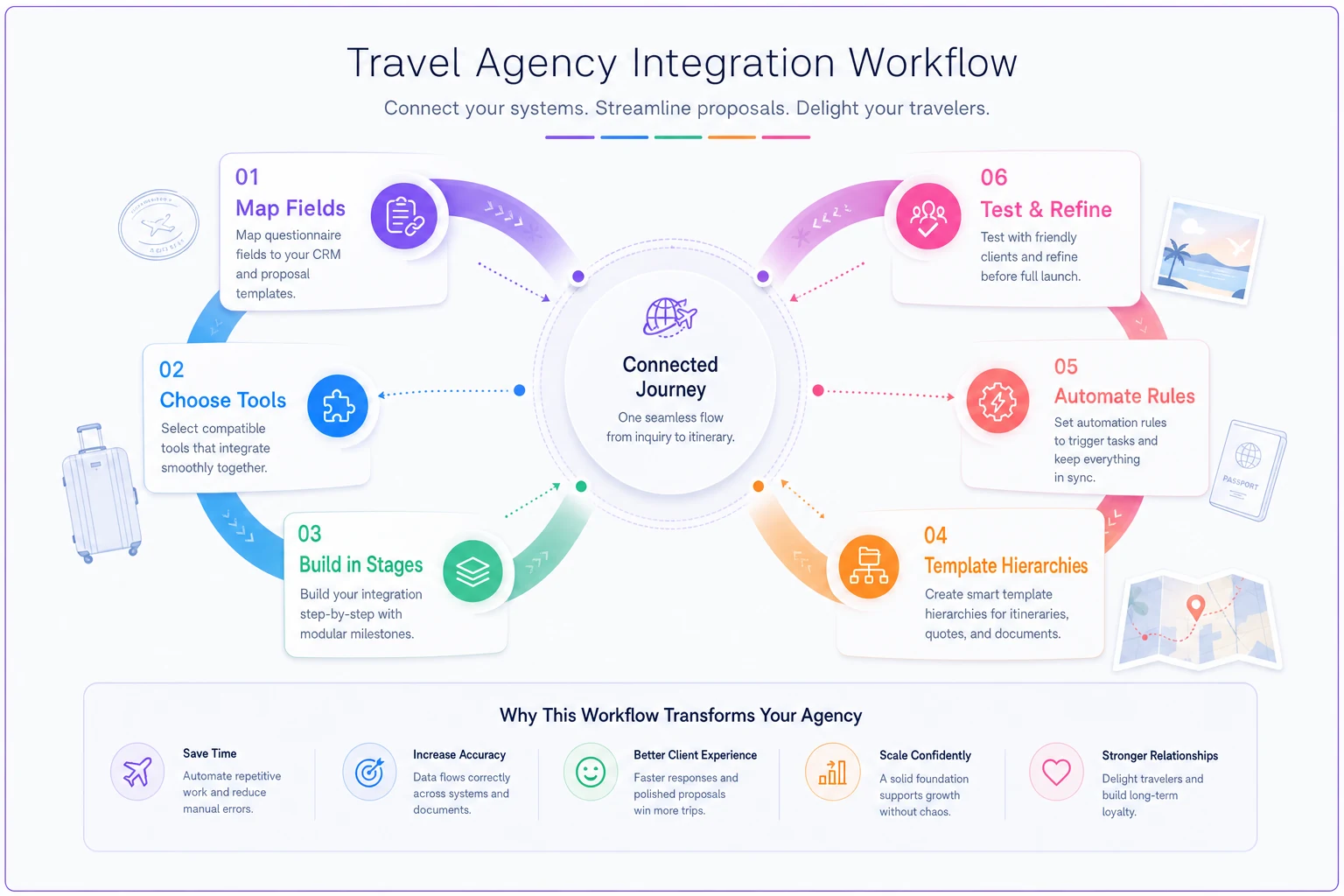
The technical integration between questionnaire and templates doesn't require developer skills, but it does require planning. Here's the practical sequence:
-
Map your data flow — List every questionnaire field and where it needs to appear: CRM, proposals, emails, pricing sheets. This becomes your integration blueprint.
-
Choose compatible tools — Your form builder, CRM, and document system need to talk to each other. Native integrations beat complex workarounds. Typeform to HubSpot to PandaDoc is simpler than juggling three different automation platforms.
-
Build the questionnaire in stages — Start with 10 essential fields. Test the integration completely. Then add branching and conditional fields. This staged approach prevents debugging nightmares.
-
Create template hierarchies — Main template → Destination variants → Preference modifications. Building modular templates takes time upfront but pays off exponentially.
-
Set up automation rules — Questionnaire completed → Create CRM contact → Generate initial proposal → Send personalized follow-up email → Task for agent follow-up if no response within 48 hours.
-
Test with friendly clients — Before going live, have a handful of trusted clients complete the questionnaire. Watch for confusion points, technical glitches, and missing personalization.
Here's a simple visual of the integration workflow.
Getting the sequence right matters more than the tools you pick. Agencies that try to build everything at once usually end up with a half-working system nobody trusts.
Common Mistakes That Kill Conversion
Asking for too much commitment upfront. Requiring a phone number on page one? Expect abandonment. Start with email only, request phone numbers after they've invested time answering preferences.
Using generic, corporate language. "Please indicate your accommodation preferences" vs. "Where do you love waking up on vacation?" The second version gets responses.
Hiding the questionnaire behind barriers. Making people create accounts or verify emails before accessing your questionnaire adds friction. Let them start immediately, capture contact info midway through.
Forgetting mobile optimization. A significant portion of travel research happens on phones. If your questionnaire requires horizontal scrolling or tiny checkboxes, you're losing prospects before they even start.
No progress indicators. People abandon when they can't see the end. Show "Step 2 of 4" or a progress bar. Even better, show estimated completion time: "About 3 minutes left."
Ignoring partial completions. Someone filled out 80% and disappeared? That's still valuable data. Set up automation to capture partial responses and trigger follow-up.
One agency found their completion rate dropped sharply at the "previous travel experience" field. They changed it from an open text box to multiple choice with an "other" option. Completion rates recovered almost immediately, and they still got the insight they needed. Small change, real impact.
Measuring What Actually Matters
Track these metrics to optimize your questionnaire performance:
| Metric | Target | What It Tells You |
|---|---|---|
| Completion rate | 65%+ | Low rate = too long or uncomfortable questions too early |
| Time to completion | 4–7 minutes | Longer risks abandonment, shorter may not capture enough detail |
| Field abandonment points | Varies | Where people stop reveals friction in your form |
| Discovery call reduction | 50% within 2 months | Core efficiency signal |
| Proposal acceptance rate | Trending up | Better-matched proposals close at higher rates |
| Sales cycle length | Days from contact to deposit | Efficient questionnaires typically shave several days off |
If your completion rate stays below 60% after adjustments, the questionnaire probably isn't the problem — your traffic quality or offer clarity might be. Worth checking both before rebuilding the whole form.
When Questionnaires Aren't the Answer
Ultra-luxury bookings ($25K+ per person). These clients expect white-glove service from the first touchpoint. The questionnaire can supplement but shouldn't replace the initial conversation.
Complex multi-generational trips. When you're coordinating 15-plus people with varying preferences, a conversation uncovers family dynamics a form never would.
Corporate incentive travel. Company culture and unspoken political dynamics require verbal exploration.
Nervous first-time travelers. Some clients need reassurance that only a real conversation provides. Use questionnaires for follow-up details after you've built some trust.
The point is recognizing which prospects benefit from which approach. Your questionnaire can include a "I'd prefer to discuss this by phone" option that routes those leads differently — and that's perfectly fine.
Building Operational Leverage Over Time
The real power comes from treating your questionnaire as an operational system, not just a form. Every completed questionnaire feeds your template library, making future proposals faster. Common preferences become pre-built packages. Unusual requests become new template modules. Over time, you're building an institutional knowledge base that makes your agency progressively more efficient.
One agency handling around 400 bookings annually calculated that their questionnaire system saves somewhere in the range of 80 to 100 hours monthly in discovery and proposal time. That's close to adding another team member without the overhead. But honestly, the bigger impact was consistency — junior agents could produce proposals matching senior agent quality because the templates captured knowledge that used to live only in people's heads. That institutional knowledge problem is underrated. It kills agencies when experienced people leave.
The questionnaire also functions as a training tool. New agents can review completed questionnaires to understand client psychology, preference patterns, and how stated interests translate to actual bookings. Instead of shadowing calls for weeks, they study real client inputs alongside the successful itineraries that followed.
How AI-Powered Operational Software Fits In
Modern AI-powered operational platforms can analyze questionnaire responses to surface things agents might otherwise miss. Natural language processing can read sentiment in open-text responses — enthusiasm about beaches combined with hesitation about crowds, for instance, points toward remote coastal destinations over popular resort areas rather than the obvious choices.
Pattern recognition also surfaces connections that are easy to overlook when you're handling volume. A system might notice that clients who mention "photography" also book sunrise tours at a high rate and automatically flag those additions in proposals. Or it identifies that families with teens selecting "adventure activities" tend to report higher satisfaction with moderate rather than extreme options — useful context that usually takes an experienced agent years to internalize.
The automation also handles necessary but tedious follow-ups. If someone selects dietary restrictions, the system generates supplier communication templates highlighting those needs. International travel selections trigger visa requirement emails based on nationality. Travel insurance preferences generate appropriate coverage recommendations.
The critical point is this: AI-powered software assists, it doesn't replace agent expertise. The system suggests. Agents decide. It handles the repetitive coordination so agents can focus on relationship building and complex problem-solving — the things that actually differentiate a real travel agency from a booking engine.
The Compound Effect
Six months after implementing a solid questionnaire system, agencies typically see a cascade of operational improvements. Sales cycles shrink because prospects get immediate, relevant proposals instead of waiting days for post-call customization. Agents handle more inquiries because they're not stuck in repetitive discovery calls. Conversion rates improve because proposals actually match what people said they wanted.
The less obvious benefit is team morale. Agents stop feeling like they're cycling through the same questions every week. They become consultants having meaningful conversations about trip enhancement, not basic logistics gathering. Junior agents feel capable producing professional proposals from day one. Senior agents get to focus on complex bookings that genuinely require their experience.
One agency owner put it plainly: "We went from feeling perpetually behind to actually having capacity for proactive client outreach. The questionnaire didn't just save time — it gave us our agency back."
A travel agency onboarding questionnaire isn't just an efficiency tool. It's a systematic approach to understanding client needs, delivering consistent work, and creating operational leverage that compounds over time. Each questionnaire completed makes your agency a little smarter and a little faster. In an environment where clients increasingly expect immediate, personalized responses, that compounds into a real competitive advantage. The agencies winning right now aren't the ones working harder — they're the ones building systems that turn repetitive tasks into automated workflows, freeing their people to do what people actually do best: create travel experiences worth remembering.
Ready to elevate your travel agency workflow?
Join 1,200+ travel agencies using Travexly to save time, improve client satisfaction, and boost operational efficiency.