


Most travel agencies send satisfaction surveys three days after clients return home. By then, half of them have 800+ unread work emails, the trip feels like a distant memory, and that perfect moment to capture feedback—and additional revenue—has completely vanished.
The real opportunity isn't just getting reviews. It's using that post-trip emotional high to generate upsells while memories are fresh and clients are still mentally in travel mode.
The broken post-trip sequence most agencies follow
What typically happens: client returns Sunday. You send a generic "How was your trip?" email Wednesday. Maybe 20% respond. Of those, you get surface-level feedback like "Loved it!" Then you manually forward positive reviews to marketing, negative ones to operations, and nobody really tracks what happens next.
Meanwhile, that same client who just spent $12,000 on their Italy trip would have booked their anniversary getaway right then if you'd asked at the right moment with the right offer.
The standard approach leaves real revenue on the table because agencies treat post-trip communication as a checkbox rather than a sales opportunity. You're missing the psychological window where clients are most receptive to booking again—usually 24 to 72 hours after returning, when they're still in vacation mode but starting to feel the contrast with regular life.
Mapping satisfaction triggers to specific upsell opportunities
The smarter agencies don't just ask "How was everything?" They create targeted trigger points throughout the trip experience that naturally connect to specific upsells.
Eliminate booking chaos and streamline operations.
Travexly helps you manage, confirm, and track travel bookings effortlessly.
- Unified booking management
- Automated client communications
- Team scheduling & itinerary tracking
No credit card required
Instead of one big survey, they send micro-feedback requests tied to individual trip elements. Client just finished a Tuscany wine tour? That's the moment to ask about the experience—and if they rate it 4+ stars, immediately offer spots on next year's harvest season tour at early-bird pricing.
This works because you're catching people in the exact moment they're thinking "I wish this could last longer." One agency in Denver increased their rebooking rate from 22% to 41% just by adjusting timing.
The key is matching the upsell to what they actually rated highly. If someone loved their boutique hotel in Paris, don't pitch a cruise. Offer your collection of similar properties in Lyon or Bordeaux. Relevance drives conversion.
The 48-hour golden window (and why most agencies miss it)
The data is pretty consistent across agencies: response rates crater after 72 hours post-return. Day 1 sits around 47% open rate. Day 3 drops to 31%. By day 7 you're looking at 12%. Day 14, you might as well be sending into the void.
What's less obvious—the type of response changes too. Early responders give detailed, actionable feedback and are roughly 3x more likely to book again within 90 days. Late responders give generic star ratings and almost never engage with upsell offers.
One agency tested sending their first touchpoint while clients were still at the airport heading home. Simple message: "Before the memories fade—what was the absolute highlight of your trip?" The responses were surprisingly detailed and emotional. Then when they followed up 24 hours later with "We have three spots left on a similar experience next spring," their conversion hit 18%.
This isn't about being pushy. Clients are already sad the trip is ending. Giving them something to look forward to actually feels helpful.
Building your trigger sequence
Start by mapping every major touchpoint in a typical client journey:
-
Pre-trip planning calls
-
Arrival day
-
First tour or activity
-
Mid-trip check-in
-
Special experiences (private tours, upgrades)
-
Departure day
-
Return home
Now assign satisfaction triggers to each point. The crucial part—don't ask about everything. Pick three or four moments that matter most and that naturally connect to future bookings.
For example, after a multi-generational family trip to Costa Rica:
-
Day 2
"How was the welcome experience at the resort?" (If positive → offer family villa upgrades for next time)
-
Day 5
"Quick check—how did the kids enjoy the zip-lining?" (If positive → pitch adventure packages)
-
Day 8 (return)
"What one thing would you do differently?" (Use response to personalize next trip proposal)
Each trigger should take under 30 seconds to complete.
One question, maybe two. Star ratings or simple multiple choice. Save the detailed feedback request for clients who engage with multiple triggers—they're your superfans anyway.
Here's a visual of the trigger-based workflow.
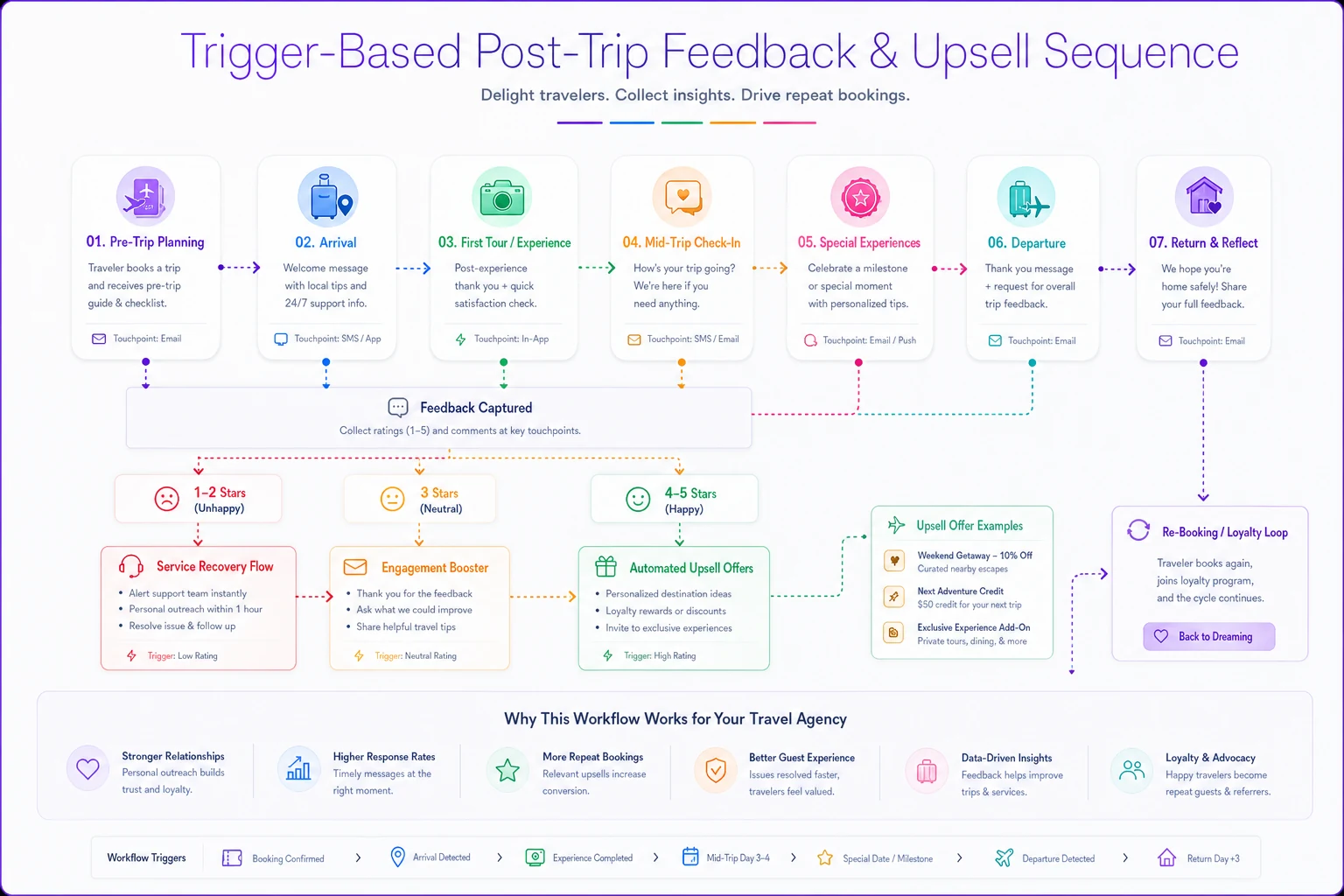
Start small: pick the moments that naturally map to a relevant upsell and automate those first.
Templates that actually convert
Generic templates kill conversion. "Dear [NAME], we hope you enjoyed your recent trip to [DESTINATION]" screams mass email. Instead, reference specific moments from their actual itinerary.
Here's a sequence that consistently performs:
Trigger 1 (24 hours post-return): Subject: "Still dreaming about those Santorini sunsets?" "Welcome home! We know re-entry is rough after 10 days in Greece. While the memories are fresh—what exceeded your expectations? Hit reply with just one thing that surprised you. P.S. - Marina from the cooking class sent photos from your session. Want us to forward them?"
Trigger 2 (48 hours, if they responded): Subject: "Re: Santorini sunsets" "Love that the private catamaran was the highlight! Captain Dmitri actually runs a 5-day sailing program through the Cyclades every September. Only takes 6 couples. Since you loved the sunset cruise, thought you might want first dibs on next year's dates? Here's what it includes..."
Trigger 3 (72 hours, if no response to Trigger 1): Subject: "Quick favor—10 seconds" "How was the Hotel Mystique? [5-star rating system] If you could change one thing about your Greece trip, what would it be? [text field] That's it! Thanks for helping us improve."
Each template assumes specific knowledge about their trip. This isn't really possible if you're managing everything in spreadsheets, but with proper tracking, you can reference actual experiences, people they met, and specific moments from their itinerary.
Conversion benchmarks and tracking what matters
Most agencies track overall review response rates and stop there. That's like measuring restaurant success by counting how many people walked through the door. The metrics that actually matter:
-
Initial trigger response
35–45% (good), 45–55% (excellent)
-
Second touchpoint engagement
60–70% of initial responders
-
Upsell consideration
25–35% of engaged responders
-
Actual booking
8–12% of total contacted, 20–30% of those who considered
The hidden metric almost nobody tracks? Time to next booking. Clients who engage with post-trip triggers book their next trip roughly 73 days sooner on average than those who don't. Over a client lifetime, that acceleration compounds into serious revenue.
Track response sentiment too. One agency found their best predictor of rebooking wasn't the star rating—it was whether clients mentioned specific staff members by name. Those personal connections drove significantly higher lifetime value.
The tech stack that makes this possible
Manual tracking kills this entire system. You need triggers firing automatically based on return dates, responses routing to the right people, and upsell offers generating from actual trip data.
Most agencies try cobbling together email marketing tools with spreadsheets and wonder why nothing connects properly. The friction means even well-designed trigger sequences fall apart because someone forgets to send Tuesday's batch or nobody updates the template with actual trip details.
Three things need to work together:
-
Automated scheduling based on trip return dates
-
Dynamic template population from booking data
-
Response routing with upsell trigger rules
This is where AI-powered operational software genuinely changes things. Instead of manually tracking return dates and sending individual emails, automation handles the entire sequence—it knows when clients return, what they booked, which experiences they upgraded, and when to fire each touchpoint.
It also learns from patterns. When the system notices clients who book cooking classes in Italy often book wine tours in France, it starts adjusting upsell recommendations accordingly. No manual analysis required.
Common mistakes that tank post-trip upsell conversion
Asking for too much too soon. The first touchpoint isn't the time for a 20-question survey. You want engagement, not homework.
Generic offers to everyone. Your luxury safari client doesn't want to hear about budget backpacking trips. Segmentation isn't optional.
Waiting for perfect timing. Some agencies delay triggers until they have bandwidth to handle responses. By then, the window has closed. Better to send something imperfect at the right time than something polished two weeks late.
Not closing the loop. When clients provide feedback, acknowledge it specifically. "Thanks for letting us know about the delay at the Colosseum—we've already spoken with our ground operator about adjusting the morning schedule for future groups."
Forgetting the human element. Templates handle logistics, but personal touches drive connection. When appropriate, have the actual travel advisor add something personal to the sequence. "P.S. - Can't wait to hear about the proposal at Piazzale Michelangelo! -Sarah"
When clients complain in reviews
Negative feedback isn't failure—it's actually useful. The worst thing you can do is defend or deflect. When someone rates their hotel 2 stars, don't send an upsell. Send this: "That's not the experience we wanted for you. Can we jump on a quick call to make this right?" Then actually make it right. Partial refund, future trip credit, whatever makes sense.
The strategic part: track every complaint by supplier, destination, and trip type. When three clients mention the same tour operator in Bali, that's actionable intelligence. Fix the root cause, then circle back to affected clients: "Remember that issue with the Bali transfers? We've switched partners. Here's 15% off if you want to give the destination another shot."
Clients who experience a problem that gets resolved well often show higher lifetime value than those who never had an issue at all. Recovery builds trust in a way that a smooth trip sometimes doesn't.
The compound effect of post-trip optimization
Small improvements in post-trip process create outsized revenue growth. Increase response rate from 20% to 35%? That's not just 15% more reviews—it's 15% more upsell opportunities, 15% more referral captures, 15% more operational intelligence feeding back into your product.
One agency in Atlanta implemented this kind of system and watched their numbers shift significantly over 18 months:
| Metric | Before | After |
|---|---|---|
| Review response rate | 19% | 43% |
| Average rebooking window | 8 months | 4.5 months |
| Revenue per client | $4,200 | $6,100 |
| Annual revenue from post-trip upsells | $38k | $247k |
They didn't change their destinations, suppliers, or pricing. They just got better at reaching clients in that golden window when memories were fresh.
Making this work in your agency
Start small. Pick your next 10 returning clients and run this sequence manually. Test different trigger points, refine your templates based on actual responses, figure out which upsells land.
Document everything: response rates by day, which questions actually get answered, what upsells convert. That becomes your baseline.
Once you've proven the model manually, that's when operational software starts making sense. Automation can monitor return dates, fire triggers at optimal times, populate templates with trip specifics, route responses to the right team members, and track every metric that matters. But you need to know what works first—otherwise you're just automating a broken process faster.
The agencies winning at post-trip upsells don't have better destinations or bigger marketing budgets. They understand that the easiest sale is to someone who just had an amazing experience and wants more. Meet them in that moment with the right message, and revenue follows.
Most agencies treat trip-end as the finish line. The smart ones know it's actually the starting line for the next booking.
The path forward
Your clients want to book again. They're practically looking for reasons to escape back into vacation mode. But if you wait two weeks to send a generic survey followed by a newsletter three months later, you've lost them to whoever reached out first with something relevant.
Start with one trigger. Test it on ten clients. Measure everything. Scale what works.
A client who just returned from an incredible trip is your hottest lead. Don't let that opportunity cool while you're busy chasing cold prospects who might book someday.
Your clients want to book again. They're practically looking for reasons to escape back into vacation mode. But if you wait two weeks to send a generic survey followed by a newsletter three months later, you've lost them to whoever reached out first with something relevant.
Start with one trigger. Test it on ten clients. Measure everything. Scale what works.
A client who just returned from an incredible trip is your hottest lead. Don't let that opportunity cool while you're busy chasing cold prospects who might book someday.
Ready to elevate your travel agency workflow?
Join 1,200+ travel agencies using Travexly to save time, improve client satisfaction, and boost operational efficiency.