



Most escalation failures don't happen because a junior agent ignored a problem. They happen because the agent genuinely didn't know it was a problem yet — or knew, but wasn't sure whether pinging a senior was overreacting. That hesitation, usually somewhere between 20 minutes and four hours, is where refunds turn into chargebacks and annoyed clients turn into one-star reviews.
The fix isn't more training or more "use your judgment." It's a single page that removes judgment from the equation entirely. When X happens, you loop in a senior within Y minutes, and here's exactly what you send them. This post walks through how to build that one page specifically for travel operations — the triggers, the timelines, and the handoff templates that actually get used instead of buried in a Notion doc nobody opens.
Why travel agencies get escalation wrong
Travel is unusually bad at escalation because the stakes spike suddenly and unpredictably. A booking sits quiet for three weeks, then a supplier cancels a hotel block 36 hours before check-in and now you've got a family of five landing in Lisbon with nowhere to sleep. The junior agent handling it has never dealt with a same-day rebook of that size and freezes.
The pattern across agencies is almost always one of three things:
-
No defined trigger. The agent waits until the client is already angry before escalating, because "the client is upset" is the only signal they've been given.
-
No timeline. They escalate eventually, but "eventually" means they tried to fix it solo for two hours first, and now the fixable window has closed.
-
A useless handoff. They finally message a senior with "Hey can you help with the Martinez booking?" — no PNR, no supplier, no deadline. The senior spends 15 minutes just reconstructing the situation.
Each of these adds delay at the exact moment delay is most expensive. In travel, the cost of a slow escalation isn't just a bad experience — it's often a hard financial number: a missed free-cancellation window, a fare that reprices, a visa appointment that can't be rebooked in time.
The three-column logic every travel escalation page needs
Forget the sprawling flowcharts. A working escalation protocol fits on one page and has exactly three columns: Trigger → Timeline → Handoff contents. Everything else is noise.
Eliminate booking chaos and streamline operations.
Travexly helps you manage, confirm, and track travel bookings effortlessly.
- Unified booking management
- Automated client communications
- Team scheduling & itinerary tracking
No credit card required
The trigger has to be observable, not interpretive. "Client seems frustrated" is interpretive — two agents will read it two different ways. "Client uses the words refund, cancel, dispute, or lawyer" is observable. Anyone can spot it. The whole point is to make escalation decisions boring and consistent, so a first-week hire escalates the same situation the same way a five-year veteran would.
Here's the core structure applied to travel operations:
| Trigger (observable) | Escalate within | Who gets it |
|---|---|---|
| Supplier cancels confirmed booking inside 72 hrs of travel | 15 minutes | Senior ops + on-call |
| Any request containing "refund," "chargeback," "dispute," "attorney" | 30 minutes | Senior agent |
| Booking value over ~$8k with any change request | 1 hour | Account lead |
| Payment fails on a booking traveling within 5 days | 30 minutes | Finance-side senior |
| Client traveling within 48 hrs, unresolved question 2+ hrs old | 1 hour | Senior agent |
| Visa/entry-document issue flagged inside 7 days of departure | Immediate | Senior + compliance owner |
| Negative review threatened publicly (social, TripAdvisor, email CC to owner) | Immediate | Owner or designated lead |
The timelines aren't uniform, and that's intentional. A supplier cancellation 72 hours out is a 15-minute alarm because rebooking inventory disappears fast. A high-value change request gets an hour because it needs care, not speed. Matching the clock to the type of decay is the part most agencies skip — they either escalate everything instantly (and seniors tune it out) or treat everything as low-priority until it blows up.
What actually goes in the handoff
This is the column agencies forget, and it's the one that saves the most time. A trigger and a timeline get the senior involved. The handoff template gets them effective in the first two minutes instead of the first twenty.
For travel specifically, a good handoff has to include everything a senior needs to act without asking a single follow-up question:
-
PNR / booking reference — the one identifier that unlocks everything else.
-
Supplier(s) involved — airline, hotel, DMC, whoever, plus any confirmation numbers.
-
Travel date and current countdown — "departs in 41 hours" reads very differently from "departs June 12."
-
What the client has already been told — so the senior doesn't contradict the junior and make it worse.
-
What's already been tried — "called supplier line twice, hold times over 20 min, no answer."
-
The specific decision needed — "Do I authorize the $340 rebook fee or wait for supplier waiver?"
-
Money at stake — deposit paid, refundable portion, potential loss.
That last one — the specific decision needed — is what separates a real handoff from a cry for help. "Can you look at this booking" forces the senior to figure out what you actually want. "I need approval to rebook at +$340 or a decision to hold for the waiver by 6pm" gets you an answer in one reply.
A realistic filled-in handoff looks like this:
> Trigger: Supplier cancellation inside 72h > PNR: KX8842 | Supplier: Riu Palace, conf #RP-99210 > Travel: Check-in in 38 hrs (Sat 3pm) > Client told: "We're on it, will update within the hour." > Tried: Called Riu res line 2x, escalated to DMC contact, awaiting callback ~30 min. > Decision needed: Approve alternate property (+$210/night, 4 nights = ~$840 over budget) or hold for DMC? > At stake: $2,100 deposit, client is a repeat (3rd trip).
A senior reading that can decide in under a minute. Compare that to the version most agencies actually get — three separate Slack messages spread over ten minutes with half the information missing.
The workflow around the page
The page itself is static. What makes it work is the routine around it.
The junior spots a trigger (or the system flags one). They don't try to solve it first — that's the behavioral shift most owners underestimate. They fill the handoff template, send it to the named person for that trigger, and keep the client warm with a holding message while the senior takes over the decision. The senior owns the resolution from that point; the junior's job becomes execution and client updates. Once resolved, a one-line note goes back into the client record so anyone picking it up later has the full thread.
The most common breakdown isn't the escalation itself — it's the ambiguity about who owns the problem after it's escalated. Juniors keep half-owning it, seniors assume the junior is still driving, and the client sits in silence. The protocol has to state, explicitly, that ownership transfers on handoff.
Use your booking platform to auto-flag triggers and pre-fill handoff fields so juniors don't have to decide whether something's big enough to escalate.
Here's a quick visual of the escalation workflow and ownership handoff.
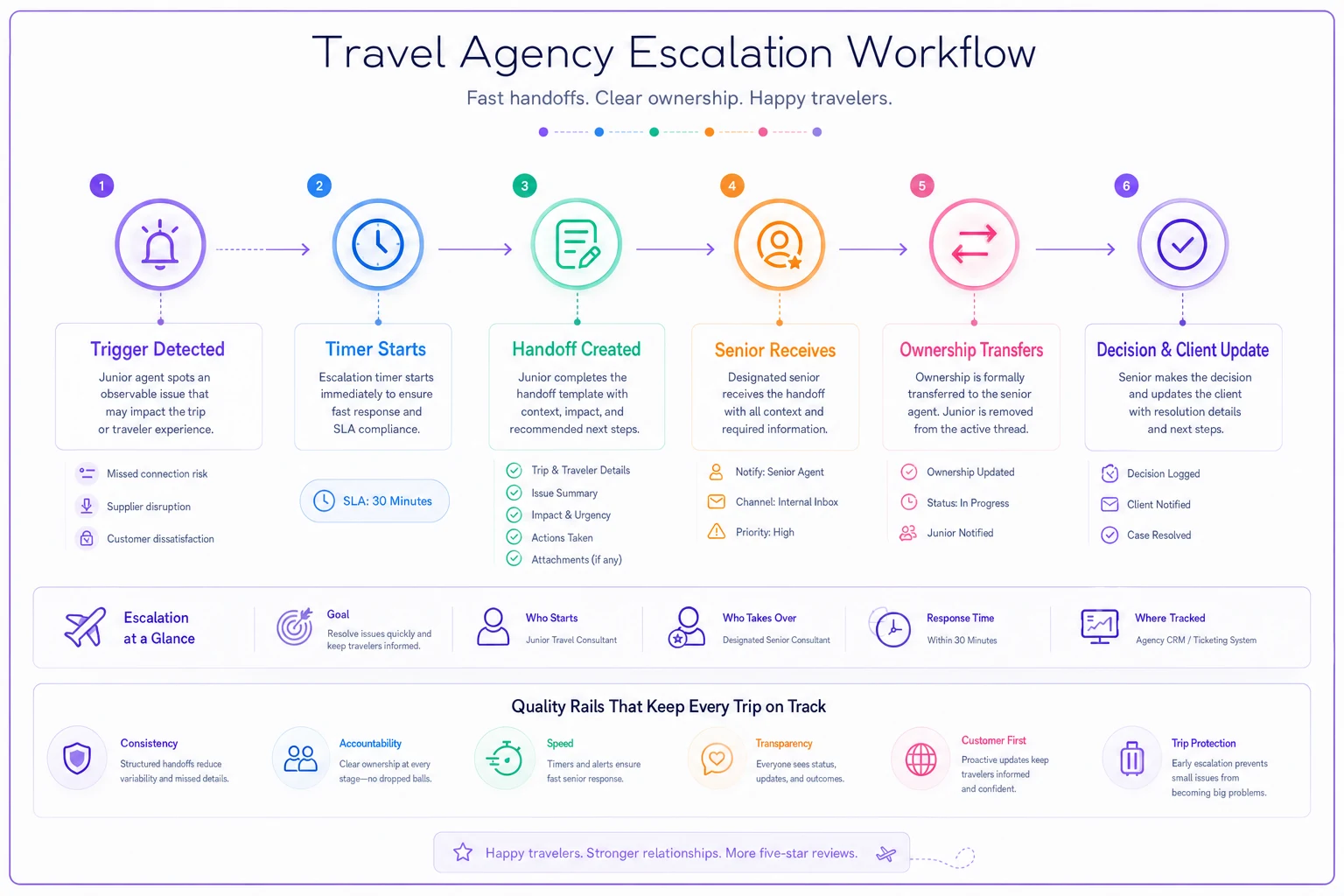
Where operational software helps here is quiet but real. A good booking or workflow platform can watch for some of these triggers automatically — payment failed, travel date inside a threshold, supplier cancellation webhook — and surface the alert before a human even notices, then pre-fill most of the handoff fields from data it already holds.
That removes the "I wasn't sure if it was a big deal" gap entirely, because the system flagged it before anyone had to decide. But the protocol works on paper first; automation just makes it faster and harder to skip.
When a hard escalation rule is a bad idea
A rigid one-page matrix is not without downsides.
When it makes sense: teams with junior agents, high booking volume, or seasonal hires who don't yet have the pattern recognition. Also any agency where a single mishandled booking can eat a full month's margin — luxury, groups, complex multi-supplier itineraries.
When it's overkill: a two-person shop where both people are seniors handling everything jointly. Adding formal escalation triggers there just creates ceremony. The protocol solves a coordination problem; if there's no coordination gap, you're adding process for its own sake.
Who should avoid over-engineering this: agencies tempted to build a 15-page matrix with sub-tiers and severity scores. Every extra tier reduces the odds anyone follows it. The strength of the one-pager is that a stressed agent can read it in ten seconds. If yours takes a minute to parse, it won't get used when it matters most.
A real scenario
A mid-sized leisure agency — around 300–350 bookings a month, four agents, two of them junior — kept getting burned by same-week supplier cancellations. Their pattern was textbook: juniors would spend an hour or two trying to fix it alone, escalate late with a vague message, and by the time a senior had the full picture the good rebooking inventory was gone. Over a busy quarter they'd eaten roughly four chargebacks, plus the softer cost of a few clients who didn't come back.
They didn't change staff or add headcount. They built the one-page matrix, set the 15-minute trigger on inside-72-hour supplier cancellations, and made the handoff template mandatory. The behavioral rule was blunt: don't try to fix it first, escalate first.
The change was pretty clear over the next quarter. Time-to-senior-involvement on urgent cases dropped from a couple of hours to under 20 minutes. Chargebacks on cancellation-related disputes went to near zero. The seniors actually complained less, oddly, because the handoffs they received were finally complete — no more reconstructing the situation from scratch. The agency estimated somewhere in the $6k–$9k range in recovered margin and avoided refunds over three months, though a meaningful chunk of that was just two repeat clients they didn't lose.
Building yours this week
You don't need a project for this. Pull your last 20–30 problem bookings, look at what they had in common, and write down the five or six triggers that show up most. Assign each a timeline and a named owner. Draft the handoff template with the seven fields above. Print it. Tape it where the juniors work, or pin it in your team channel.
Then do the one thing that actually makes it stick: tell your junior agents explicitly that escalating early is never the wrong call, and that nobody will be criticized for looping in a senior 15 minutes too soon. Most of the delay you're paying for isn't ignorance — it's fear of overreacting. Remove that fear and the protocol largely runs itself.
An escalation protocol for a travel agency isn't about control or hierarchy. It's about compressing the gap between "something's wrong" and "the right person is deciding" from hours down to minutes — because in travel, that gap is usually measured in money.
Ready to elevate your travel agency workflow?
Join 1,200+ travel agencies using Travexly to save time, improve client satisfaction, and boost operational efficiency.