

Most agencies don't have a quality problem. They have a detection problem. The errors are already happening — a wrong room category here, a mismatched passenger name there, a deposit logged against the wrong supplier — and nobody finds out until a client forwards an angry email or a supplier invoice doesn't match what you charged. By then it's not a QA issue anymore. It's a refund, an apology, and a dent in your margin.
The agencies that run clean books aren't the ones with smarter agents. They're the ones who stopped relying on agents to catch their own mistakes and built a system that samples work, categorizes failures, traces them to root cause, and feeds that learning back into their SOPs. That loop is the difference between "we check bookings sometimes" and actual booking quality assurance for a travel agency.
This article covers how that loop is structured, where it tends to break as you grow, and what each piece actually looks like in practice.
Why ad-hoc checking fails the moment you scale past a few agents
When you're two or three people, informal QA works fine. You glance over each other's bookings, you notice when something looks off, and the shared context keeps errors low. Nobody needs a sampling plan when everyone can see everything.
The trouble starts somewhere around the fifth or sixth agent, when booking volume crosses the point where no single person has eyes on the whole operation. Error rates don't climb gradually — they stay invisible until a cluster surfaces at once, usually during a busy stretch when everyone's heads-down and nobody has bandwidth to check anything.
The pattern that catches owners off guard: the types of errors change as you grow, but your QA habits don't. At small scale, mistakes are mostly typos and oversights. At larger scale, they're systemic — a misconfigured template, a supplier mapping that's been wrong for months, a new hire who learned the process slightly wrong and has been quietly repeating that error across dozens of files. Spot-checking individual bookings will never catch a systemic error, because the problem isn't in any single booking. It's in the process generating all of them.
Ad-hoc checking also can't tell you whether you're improving. If you don't record what you find in a consistent way, you have no baseline. You can't answer "are name-mismatch errors trending up or down?" because you never counted them in the first place. You're just reacting.
The five pieces of a real QA loop
A functioning QA system isn't one activity — it's five connected pieces. Skipping any one of them quietly breaks the whole thing. Most agencies have maybe two of these and wonder why nothing actually improves.
Eliminate booking chaos and streamline operations.
Travexly helps you manage, confirm, and track travel bookings effortlessly.
- Unified booking management
- Automated client communications
- Team scheduling & itinerary tracking
No credit card required
| Piece | What it does | What breaks without it |
|---|---|---|
| Sampling plan | Decides which bookings get reviewed and how often | You check randomly, miss high-risk files, waste time on safe ones |
| Error taxonomy | A fixed vocabulary for categorizing every defect | Nobody can tell if errors are trending up or down |
| Audit script | A consistent checklist auditors follow on every file | Different reviewers catch different things; results aren't comparable |
| RCA template | Traces each significant error to its underlying cause | You fix symptoms, same error returns next month |
| CI cadence tied to SOPs | Turns findings into actual process changes | You learn the same lesson over and over, change nothing |
The loop only works when it's a loop. Sampling feeds the audit. The audit classifies errors using the taxonomy. Significant or repeated errors trigger root-cause analysis. RCA findings update the SOP. The updated SOP changes what the next round of sampling checks for. Break the chain anywhere and you're back to catching problems by accident.
Sampling: stop reviewing everything, start reviewing the right things
The instinct when quality slips is to review every booking. That's a trap. Full review doesn't scale, it burns your most experienced people on low-risk work, and it creates a false sense of safety — because 100% review done by tired staff finds fewer errors than smart sampling done with real attention.
A better approach is risk-weighted sampling. Not all bookings are equally risky. There's a real difference between a simple domestic round-trip for a repeat client and a multi-leg international itinerary with three suppliers, a visa dependency, and a group deposit schedule. One of those generates expensive errors. The other almost never does.
A practical sampling structure:
-
Audit 100% of high-risk bookings. Define "high-risk" concretely — anything above a certain value threshold, multi-supplier itineraries, international bookings with documentation requirements, group bookings, and anything booked by an agent in their first 90 days.
-
Sample a fixed percentage of standard bookings — somewhere in the 10–20% range is a reasonable starting point, pulled randomly so agents can't predict which files get reviewed.
-
Over-sample new processes. Any time you launch a new supplier integration, a new destination, or a new product type, review a higher share of those bookings for the first month or two, then taper down as the error rate proves stable.
-
Pull a small random tail from the "safe" category — maybe 3–5% — because this is where silent systemic errors tend to hide.
The number that matters isn't how many files you review. It's whether your sample is representative enough to catch patterns and weighted enough to catch the expensive ones. An agency doing 800 bookings a month doesn't need to audit 800 files. It needs to audit the right 120 or so, skewed toward risk.
One thing worth flagging: don't let agents know exactly which bookings will be audited in advance. The point isn't to catch people — it's to get an honest read on your real error rate. Predictable audits produce performances, not data.
Start by defining high-risk criteria clearly — it makes sampling decisions immediate and defensible.
Here's a compact workflow view to make the sampling choices easier to communicate to the team.
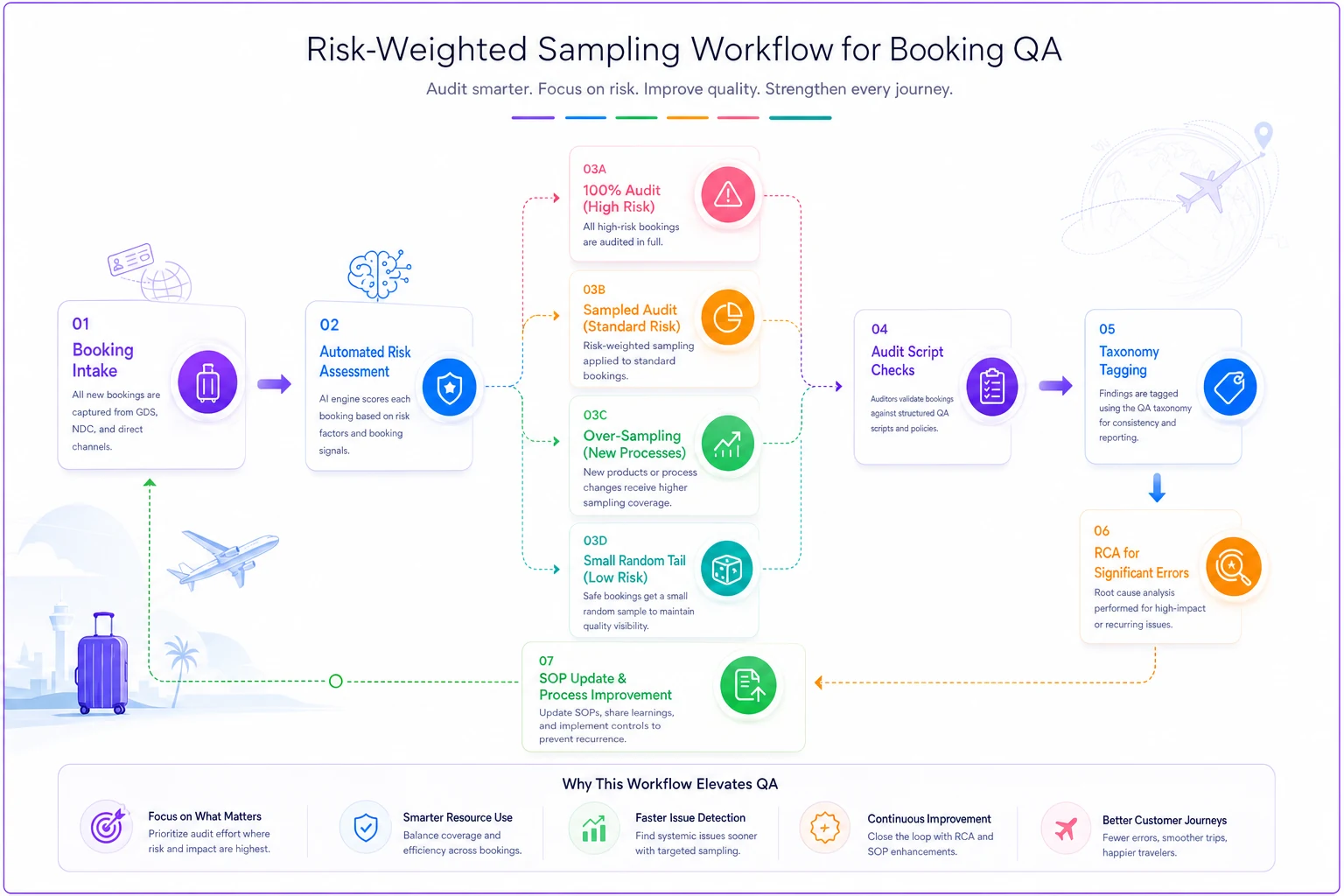
The visualization shows how sampling decisions feed directly into audit and RCA, which then update SOPs.
Error taxonomy: the piece everyone skips, and the one that makes the rest work
This is the least glamorous part and the one that separates agencies that actually improve from the ones that stay busy without getting better. If every auditor describes errors in their own words — "booking was a bit off," "client details wrong," "supplier mix-up" — you can never aggregate anything. You've got a pile of anecdotes, not data.
A taxonomy is just a fixed, short list of error categories that everyone uses the same way. Keep it tight. A sprawling 40-category taxonomy never gets used consistently. Aim for something closer to 8–12 categories that cover the vast majority of what actually goes wrong:
-
Passenger/name data — name mismatches, title errors, DOB wrong, passport details off
-
Product mismatch — wrong room category, fare class, cabin, meal plan versus what was sold
-
Date/time errors — wrong travel dates, missed connection timing, check-in/out mismatch
-
Pricing errors — wrong rate applied, missed surcharge, currency mistake
-
Commission/supplier mapping — booking logged to wrong supplier, commission rate wrong
-
Payment/deposit errors — wrong deposit amount, schedule off, payment applied to wrong file
-
Documentation gaps — missing visa, insurance, or passport-validity check
-
Communication errors — confirmation not sent, wrong info in client comms
-
Policy errors — cancellation terms wrong, refund logic misapplied
For each error you also want severity (cosmetic / recoverable / client-impacting / financial loss) and stage (where in the workflow it was introduced versus where it was caught). That last distinction is underrated. An error introduced at quote and caught at audit is a near-miss. The same error introduced at quote and caught by the client at the airport is a crisis. Tracking both tells you whether your controls are moving earlier in the process — which is the whole goal.
Commission and supplier-mapping errors deserve special attention because they rarely get caught by clients. They quietly cost you, not them. If your taxonomy surfaces a steady drip of these, it's worth reading our deeper breakdown on how to calculate splits and resolve supplier commission errors — the QA loop will tell you that they're happening, but you'll still need a separate process to fix the money.
The audit script: making reviews consistent across different people
The reason two auditors reviewing the same booking reach different conclusions is almost always that they're checking different things. A written audit script fixes that — it's a defined sequence of checks, in a fixed order, that every reviewer runs on every sampled file.
A workable audit script reads top-to-bottom through the booking in roughly the order it was built:
-
Do passenger names exactly match passport/ID as captured in the intake?
-
Does the booked product match what's on the quote and the client confirmation — room type, fare class, inclusions?
-
Are travel dates, timings, and connections internally consistent?
-
Is the price charged consistent with the quoted price and the supplier rate?
-
Is the booking logged against the correct supplier with the correct commission terms?
-
Do deposit amounts and payment schedule match policy?
-
Are all required documents flagged and tracked (visa, insurance, passport validity)?
-
Was the confirmation sent, and does it contain correct information?
The value of the fixed order is subtle but real: it mirrors the workflow, so an auditor naturally spots where in the process something went sideways, not just that it's wrong. That stage information feeds straight back into your taxonomy.
What breaks this at scale is drift. Audit scripts rot. Suppliers change their rate structures, you add a product type, a regulation shifts — and the script quietly stops covering the thing that now matters most. Treat the script as a living document that gets updated on the same cadence as your SOPs. The two should never drift apart. If your SOPs aren't organized yet, that foundation comes first — we covered building it in moving from scattered SOPs to a governed playbook library.
Root-cause analysis: fixing the process, not the booking
Most agencies stop short here. They find an error, fix that booking, and move on. The booking's fixed. The cause is still live, and it'll produce the same error next week.
RCA doesn't need to be heavy. For routine, cosmetic errors, log and correct. But any error that's client-impacting, financial, or recurring should trigger a short structured analysis. A lightweight RCA template has maybe five fields:
-
What happened — the specific defect, in taxonomy terms
-
Where it was introduced — which workflow stage
-
Why it happened — the real cause, not "agent made a mistake"
-
Why it wasn't caught earlier — the control gap
-
What change prevents recurrence — the SOP or system fix
The most important discipline is refusing to accept "human error" as a root cause. "The agent entered the wrong room category" is not a root cause — it's a restatement of the symptom. Keep asking why. Why did they enter the wrong category? Because the supplier's naming convention is ambiguous and the booking screen doesn't show the room description. That's a root cause, and it's fixable with a process change. "Be more careful" is not.
A quick example of where the why-chain leads somewhere useful:
-
Error
client charged in the wrong currency on an international package
-
Why
agent selected the supplier's default currency instead of the client's
-
Why
the booking template defaults to supplier currency with no prompt
-
Root cause
template design + missing confirmation step
-
Fix
template defaults to client billing currency and requires a one-click currency confirmation before the booking is finalized
That fix prevents every future instance, not just this one. Spot-checking catches instances. RCA eliminates classes of error — that's the whole point.
When RCA surfaces errors introduced because a junior agent didn't know when to pause and ask, that's an escalation design problem, not a training problem. A clear rule for when work has to loop in a senior prevents a whole category of these; we laid out a version of that in our one-page escalation protocol.
Continuous improvement cadence: closing the loop
The loop isn't closed until findings change your SOPs on a predictable schedule. This is where "we do QA" becomes "our QA actually makes us better."
A simple cadence that works for most small-to-mid agencies:
-
Weekly auditors run the sampling plan, log results against the taxonomy, correct booking-level issues
-
Monthly review aggregated error data — which categories are trending, which stages introduce the most defects, which agents or suppliers cluster errors. Run RCA on anything recurring or expensive. Issue SOP and audit-script updates.
-
Quarterly step back and look at the whole system. Is the error rate falling? Are errors moving earlier in the workflow (good) or later (bad)? Is the sampling plan still weighted toward where the real risk sits now? Retire checks that never catch anything; add checks for new risks.
The monthly review is where patterns emerge that a single booking never reveals. One agency found that nearly a third of their documentation-gap errors clustered on bookings taken late Friday afternoon — not because those agents were worse, but because the Friday handoff to the weekend on-call skipped a verification step. No individual booking told that story. The aggregated taxonomy data did.
When this makes sense — and when it's overkill
A full five-piece loop makes sense once you're past roughly five agents or a few hundred monthly bookings, or any time a single error can cost you four figures. International, group, and multi-supplier work pushes you toward it faster regardless of team size.
It's overkill for a solo agent or a two-person shop doing simple leisure bookings. At that scale a shared checklist and mutual review genuinely is enough, and building a formal taxonomy would be ceremony for its own sake. Start light: a simple audit checklist and a shared error log. Add the taxonomy and RCA template when you notice you're fixing the same kind of error more than once.
One thing to be clear about — don't use this to grade and punish individual agents. The moment QA becomes a performance-management tool, your error data goes dishonest. Agents hide mistakes, near-misses stop getting logged, and you lose the exact signal the whole system exists to capture. QA finds process gaps. Performance management is a separate conversation.
A real scenario
A mid-sized leisure and corporate agency — around ten agents, roughly 600 bookings a month — kept getting hit with supplier invoice mismatches and occasional client-facing errors on international files. Problems surfaced when clients or finance complained. Their rough estimate was a client-facing error on maybe 4–5% of complex bookings, plus a steady leak of small commission discrepancies nobody had quantified.
They put in a basic version of this loop over about a quarter. 100% audit on international, group, and over-threshold bookings; a 15% random sample on the rest; a nine-category taxonomy; a one-page RCA template for anything client-impacting or recurring; and a monthly review that fed SOP updates.
RCA surfaced two systemic issues fairly quickly — a supplier-mapping default that was quietly misrouting commissions, and a passport-validity check that lived in the SOP but wasn't in the booking workflow, so agents skipped it under pressure. Both got fixed at the process level, not the booking level.
Within about three months the client-facing error rate on complex files dropped under 2%, and commission discrepancies — once they were actually being counted — shrank to a fraction of where they'd started. Nothing dramatic happened in any single week. The improvement came from catching classes of error instead of instances, month after month.
Where software quietly carries the weight
None of this requires software to start — a spreadsheet taxonomy and a shared audit checklist will get a small agency surprisingly far. But two things get painful by hand as volume grows: pulling a properly risk-weighted sample, and aggregating taxonomy data cleanly enough to see monthly trends.
That's where an operational platform with workflow and QA tracking earns its place — automatically flagging high-risk bookings for mandatory review, logging errors against a fixed taxonomy as part of the normal booking flow, and surfacing the monthly trend view without anyone exporting and pivoting spreadsheets at month-end. The point isn't to replace judgment. It's to remove the friction that makes agencies abandon QA loops after a few weeks. When the loop runs with less effort, it actually keeps running — and a QA system that keeps running is the only kind that improves anything.
The takeaway
Booking quality isn't something you inspect your way into at the end. It's a loop: sample deliberately, classify consistently, trace causes honestly, and update your SOPs on a cadence.
Each piece is close to useless alone and powerful when connected. Ad-hoc checking catches the error in front of you. A real QA loop catches the kind of error — and keeps catching it earlier, cheaper, and less often, as you grow. That's the shift worth making before your volume forces it on you the hard way.
Booking quality isn't something you inspect your way into at the end. It's a loop: sample deliberately, classify consistently, trace causes honestly, and update your SOPs on a cadence.
Ready to elevate your travel agency workflow?
Join 1,200+ travel agencies using Travexly to save time, improve client satisfaction, and boost operational efficiency.