



Most travel agencies don't have a data problem. They have a data sequencing problem. They try to build dashboards before they can trust their booking records, or they chase predictive forecasting while three different staff members still record supplier costs three different ways. The analytics fall apart not because the tools are bad, but because the agency skipped a stage.
Think of it as a maturity model — a set of stages every agency passes through whether they name them or not. You can't reliably reconcile data you haven't captured cleanly. You can't build alerts on top of reconciliation that isn't happening. And you certainly can't forecast demand or margin if the underlying numbers shift depending on who typed them in. Each stage depends on the one below it holding steady.
What follows is the actual progression we see across agencies, what typically breaks at each transition, who should own the data at each stage, sample metrics that tell you whether a stage is working, and a prioritized 6–12 month backlog you can hand to whoever runs your operations.
Why the analytics maturity model matters for a travel agency specifically
Travel is unusually messy from a data standpoint. A single booking might touch a GDS, two or three supplier portals, a payment processor, a CRM, and a spreadsheet someone maintains "just to be safe." Commissions land weeks or months after the trip. Refunds and amendments rewrite the original record. FX moves between deposit and final payment.
So when an agency owner says "I want better reporting," the honest answer is usually: your reporting is only as good as the layer beneath it, and that layer is probably broken in ways you can't see yet. The analytics maturity model for a travel agency is really a map of trust — how much you can believe your own numbers as you move from raw inventory data all the way to predictions.
The four stages, plainly
Here's the progression, with what each stage is actually for:
Eliminate booking chaos and streamline operations.
Travexly helps you manage, confirm, and track travel bookings effortlessly.
- Unified booking management
- Automated client communications
- Team scheduling & itinerary tracking
No credit card required
| Stage | Core question it answers | What has to be true first | Typical failure if skipped |
|---|---|---|---|
| 1. Inventory | "What do we actually have on our books?" | Every booking, supplier cost, and payment is captured in one consistent structure | Reports that don't tie to reality |
| 2. Reconciliation | "Do our records match the money and the suppliers?" | Inventory is clean and consistent | Margins look fine on paper, cash says otherwise |
| 3. Alerts | "What needs my attention right now?" | Reconciliation runs reliably and on schedule | Alert fatigue or missed exceptions |
| 4. Predictive | "What's likely to happen, and what should we do?" | Alerts have produced a track record of trustworthy data | Confident forecasts built on sand |
Notice the dependency chain. Predictive analytics gets all the attention because it sounds impressive, but it's the last thing you should build. An agency forecasting demand off unreconciled bookings is guessing with extra steps.
Stage 1: Inventory — get everything into one honest structure
This is the least glamorous stage and the one that determines everything else. Inventory means every booking, every supplier line item, every payment and refund exists in one place, recorded the same way each time.
The classic pattern: a mid-sized agency with three agents, each maintaining their own view of a booking. One tracks net cost, one tracks gross, one tracks "what the client paid me" and figures out the rest later. When the owner pulls a monthly revenue number, it's a reconstruction, not a record. Duplicate client entries make it worse — the same traveler shows up three times because nobody agreed on how to spell or match records. If that sounds familiar, the data governance playbook for stopping duplicate customers and broken bookings is the prerequisite work before any of this maturity model applies.
What "done" looks like at this stage:
-
Every booking has a unique ID that everyone uses
-
Supplier costs, client payments, and commissions each have a defined field — no cramming three numbers into one cell
-
Refunds and amendments update the original record instead of creating orphan rows
-
One agreed source of truth per data type (bookings live here, payments live there)
Data-owner rule for Stage 1: whoever creates the booking owns its accuracy at entry. Not the bookkeeper three weeks later. Accuracy at the point of entry is cheaper than reconstruction after the fact, every single time.
Sample metrics to watch:
-
% of bookings with complete required fields (aim for 95%+ before moving on)
-
Duplicate client rate (should be trending toward near-zero)
-
Number of "manual correction" edits per week (a proxy for how messy entry is)
If those three numbers aren't stable, you are not ready for Stage 2. Full stop.
Stage 2: Reconciliation — make the records match the money
Once inventory is clean, reconciliation asks a harder question: does what we recorded actually match what the bank shows and what suppliers say they owe us?
This is where a lot of hidden margin lives. A typical example: an agency books roughly 300 trips a month, records everything neatly, and believes its net margin is around 14%. But when supplier commissions actually settle, a chunk arrives short — a wrong split here, a missed override there, a refund that clawed back commission nobody flagged. The recorded margin and the realized margin drift apart by two or three points. On even modest volume, that's real money leaking every month.
Reconciliation is the discipline of comparing three things regularly:
-
What you recorded (from Stage 1)
-
What the payment processor / bank shows
-
What suppliers actually paid or invoiced
Where those three disagree, you have an exception. The goal isn't zero exceptions — that's unrealistic in travel. The goal is that exceptions get found and resolved on a schedule instead of discovered by accident at year-end.
Data-owner rule for Stage 2: reconciliation ownership belongs to a finance or ops role, not the agent who made the booking. You want independence here. The person checking the money should not be the person who recorded it.
Sample metrics:
-
% of bookings reconciled within X days of trip completion
-
Recorded margin vs. realized margin gap (this is the number that should keep owners up at night)
-
Average days to resolve a supplier commission discrepancy
-
Value of unreconciled items sitting open right now
If your supplier feeds are unreliable — dropping fields, timing out, sending stale prices — reconciliation will feel like bailing a leaky boat. Fixing the plumbing first is worth it, and the integration-architecture blueprint for stopping supplier-feed failures covers that groundwork.
Stage 3: Alerts — stop reading reports, start getting told
This is the shift most agencies underrate. Stages 1 and 2 are about building trustworthy data. Stage 3 is about not having to stare at that data all day.
Once reconciliation runs reliably, you know what "normal" looks like. Which means you can define what abnormal looks like and get pinged when it happens. Alerts turn a passive dashboard nobody opens into an active system that reaches out.
Good alerts in a travel context tend to cluster around exceptions and thresholds:
-
A booking's final payment date passed without payment received
-
A supplier commission came in more than X% below expected
-
A deposit is due in 48 hours and hasn't been collected
-
Margin on a booking dropped below your floor after an amendment
-
An unreconciled item has been open longer than your SLA allows
The mistake here is obvious once you've lived it: too many alerts is the same as no alerts. If staff get 40 pings a day, they mute the channel by Wednesday. Alerting maturity means tuning — starting with the three or four exceptions that actually cost money, and only expanding once those get acted on consistently. Your core KPIs and the thresholds that should trigger action are the natural place to draw those first alert boundaries.
Start by alerting on the three or four exceptions that historically recovered money before widening coverage.
Data-owner rule for Stage 3: every alert needs a named owner and a response action. An alert with no owner is just noise. If a "margin below floor" alert fires and nobody's job is to look at it, delete the alert.
Sample metrics:
-
Alert response rate (% of alerts acted on within their SLA)
-
False-positive rate (alerts that fired but didn't matter — you want this low)
-
Average time from alert to resolution
-
Money recovered or protected because an alert fired (this justifies the whole stage)
When alerts are a bad idea
If your reconciliation isn't stable, alerts will fire constantly on data problems rather than real business problems. You'll spend your days chasing ghosts. Don't build this stage to escape Stage 2 — build it because Stage 2 is solid.
Stage 4: Predictive — forecasting you can actually bet on
Only now, with clean inventory, reliable reconciliation, and a track record of trustworthy alerts, does prediction make sense. Predictive analytics for a travel agency isn't crystal-ball stuff. It's pattern extension: using months of clean data to anticipate what's coming.
Realistic predictive use cases at agency scale:
-
Cash flow forecasting — knowing that deposits collected now imply supplier payments due in six weeks, so you can see a squeeze before it hits
-
Demand shaping — spotting which destinations or seasons are trending up early enough to negotiate supplier allocations
-
Margin risk scoring — flagging bookings that look like ones that historically lost margin to amendments or FX moves
-
Client lifetime signals — identifying which repeat travelers are drifting before they book elsewhere
Data-owner rule for Stage 4: predictions need a human owner who can override them. The person who owns a forecast owns explaining when it's wrong and adjusting the assumptions. A forecast nobody owns becomes a number people either blindly trust or completely ignore — both are dangerous.
Sample metrics:
-
Forecast accuracy (predicted vs. actual, tracked over time)
-
% of predicted cash squeezes that were acted on early
-
Margin protected on bookings flagged as high-risk
Who should NOT jump to predictive
If you're still reconstructing last month's revenue by hand, predictive is not your next project — it's a distraction. Agencies that force this stage early end up with confident-sounding forecasts that quietly embarrass them a quarter later. The stage exists to be earned.
A real scenario: what moving up two stages actually looks like
A boutique agency doing roughly 250–300 bookings a month was stuck between Stage 1 and Stage 2. Their inventory was mostly fine, but reconciliation was a once-a-year scramble their accountant did at tax time. Nobody knew the real margin month to month.
They spent about a quarter tightening reconciliation: defining owners, running a monthly three-way match between records, bank, and supplier statements, and tracking the recorded-vs-realized margin gap. What they found was uncomfortable — realized margin was running roughly 2.5 points below what they'd assumed, mostly from short-paid commissions and refund clawbacks nobody chased.
Over the following few months, they added a small set of alerts on late final payments and below-floor margins. The recovered commissions and prevented margin slips added up to something in the low four figures most months — not life-changing individually, but a steady leak sealed. More importantly, by the time they did start forecasting cash flow, the numbers feeding the forecast were ones they actually trusted.
That's the whole point of the model: each stage made the next one possible.
Your prioritized 6–12 month BI backlog
Months 1–2 (Inventory foundation):
-
Agree one source of truth per data type (bookings, payments, costs, commissions)
-
Standardize required fields and enforce them at entry
-
Kill duplicate client records and set a matching rule going forward
-
Assign the "accuracy at entry" owner
Months 3–5 (Reconciliation):
-
Build the three-way match process (records ↔ bank ↔ supplier)
-
Assign an independent reconciliation owner
-
Start tracking the recorded-vs-realized margin gap monthly
-
Set an SLA for resolving discrepancies
Months 5–8 (Alerts):
-
Pick your top 3–4 money-losing exceptions and alert on those only
-
Assign an owner and response action to each alert
-
Track response rate and false-positive rate; tune before expanding
-
Expand alert coverage only once the first set is being acted on consistently
Months 8–12 (Predictive, if earned):
-
Start with cash flow forecasting off your now-clean data
-
Add margin-risk scoring on new bookings
-
Assign a human forecast owner who can override and explain
-
Track forecast accuracy and revisit assumptions quarterly
If you get to month six and reconciliation still isn't stable, stay there. A delayed predictive stage is far better than a premature one.
A simple workflow to follow:
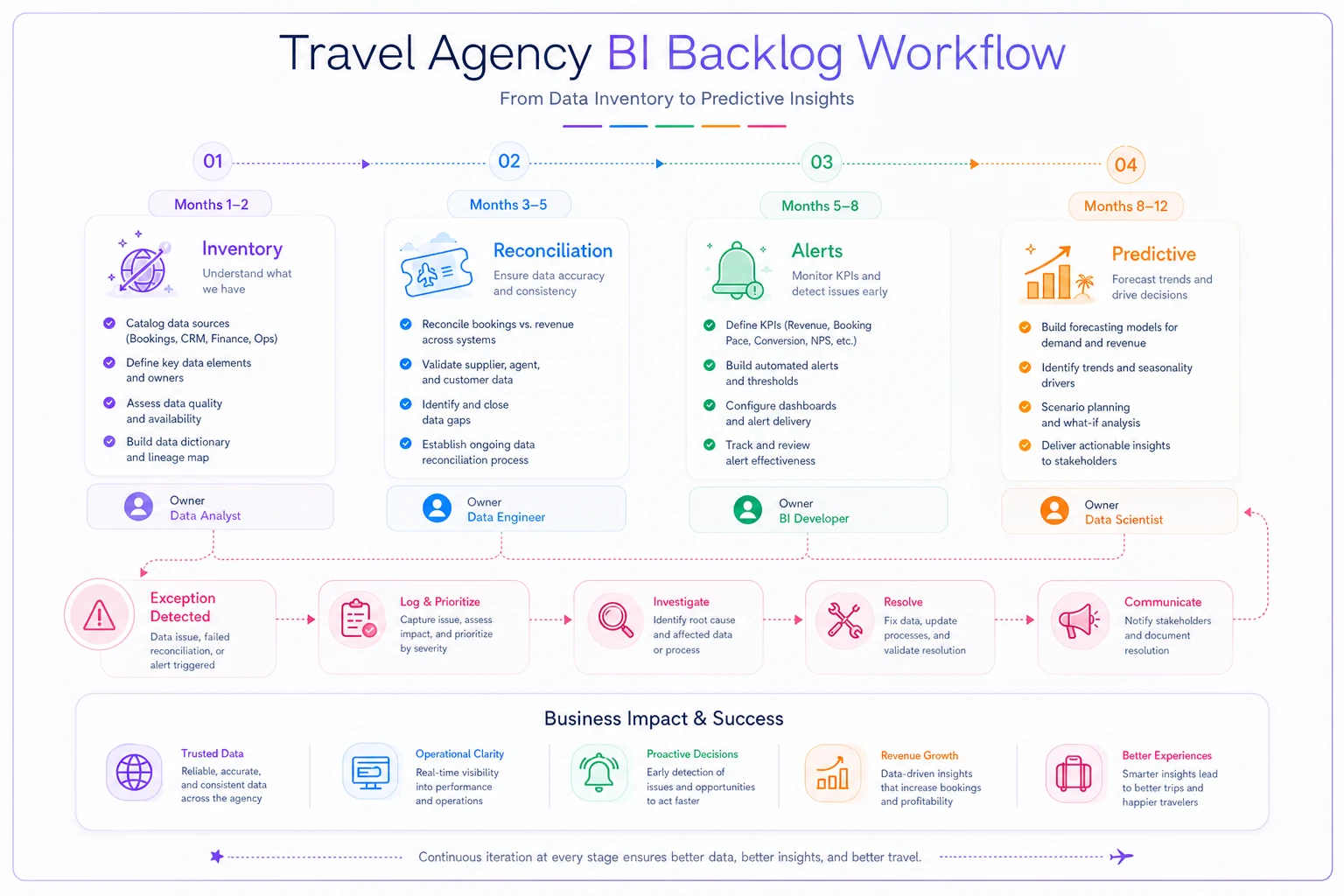
Use the sequence as a deliberate checklist and don't reshuffle to get to predictive faster.
A note on tooling
Most of this can start in spreadsheets and honestly should, at least through early Stage 2 — the discipline matters more than the software. As volume grows, though, manual reconciliation and hand-built alerts stop scaling. That's usually where an operational platform with AI-assisted reconciliation and exception flagging earns its place: matching records across sources automatically, surfacing the exceptions worth a human's time, and handling the repetitive checking so your ops person spends their hours resolving problems instead of hunting for them.
The tool doesn't replace the maturity model. It just makes the higher stages sustainable once you've earned them.
Where most agencies actually are
Most agencies live somewhere between Stage 1 and Stage 2, telling themselves they're closer to Stage 4 than they are. The dashboards look mature. The trust underneath them isn't.
The good news is the model is forgiving as long as you respect the order. Fix inventory, and reconciliation gets dramatically easier. Nail reconciliation, and alerts become obvious instead of noisy. Earn a track record of trustworthy alerts, and prediction stops being a gamble. Each stage pays for the next — which is exactly why skipping any of them costs more than it saves.
The good news is the model is forgiving as long as you respect the order. Fix inventory, and reconciliation gets dramatically easier. Nail reconciliation, and alerts become obvious instead of noisy. Earn a track record of trustworthy alerts, and prediction stops being a gamble. Each stage pays for the next — which is exactly why skipping any of them costs more than it saves.
Ready to elevate your travel agency workflow?
Join 1,200+ travel agencies using Travexly to save time, improve client satisfaction, and boost operational efficiency.