

There's a specific kind of chaos that shows up once an agency crosses a few thousand bookings a year. It doesn't announce itself. It shows up as a client emailing "why did I get two confirmation numbers?" or an agent quoting a returning customer as if they'd never traveled with you before. Or a supplier statement that references a booking your system swears doesn't exist.
Almost every time, the root cause is the same: nobody decided, in writing, what a "customer" is, what a "booking" is, and which system gets to be right when two of them disagree. That's what data governance actually means for a travel agency — not a compliance binder, but a set of decisions about record ownership, matching rules, and sync behavior that keep your data from quietly rotting as you scale.
This is a systems article. We're going to look at how customer, booking, and supplier data flow through a typical agency, where things crack under load, and how to build a canonical model plus sync policies that stop duplicates and mismatches before they reach a client's inbox.
The real shape of the problem
Most agencies don't have one system of record. They have a booking engine or GDS, a CRM, an accounting tool, maybe a separate email marketing platform, and a pile of supplier portals. Each one holds a version of the same customer and the same trip. None of them fully agree.
Here's the pattern that breaks things. A customer named Robert Mendez books a honeymoon over the phone, so an agent types his name into the CRM. Six months later he books an anniversary trip through your website, where he enters "Bob Mendez" with a different email. Your accounting system knows him as "R. Mendez" because that's how the deposit came through on his card. You now have three customers who are one person, and no system knows it.
Multiply that by every returning client, every family booking under different names, every corporate traveler whose assistant enters their details. Within a couple of years you've got a customer table where maybe 15–20% of records are duplicates or fragments. Segmentation gets useless. Loyalty tracking becomes fiction. Automated emails go out twice or address someone by the wrong name.
Bookings have the same disease, just with higher stakes. A single trip might live as a record in your CRM, a PNR in the GDS, a reservation number at the hotel, and a line item in accounting. When those four don't reconcile, you get the failure modes that agency owners actually lose sleep over: a payment applied to the wrong booking, a supplier bill that can't be matched, a cancellation that processes in one system but not another.
Start with a canonical data model, not a tool
The mistake most owners make is shopping for software before deciding what their data actually is. The tool then imposes its own model, and you spend years fighting it.
Eliminate booking chaos and streamline operations.
Travexly helps you manage, confirm, and track travel bookings effortlessly.
- Unified booking management
- Automated client communications
- Team scheduling & itinerary tracking
No credit card required
A canonical data model is just an agreed definition of your core entities and their fields — the "source of truth" version that every other system maps into. It doesn't need to be elaborate. For a travel agency, three entities carry almost all the weight: Customer, Booking, and Supplier. Everything else hangs off those.
The single most important decision inside that model is choosing a stable unique identifier for each entity — one that doesn't change and isn't reused. Email is not stable (people change them, share them, mistype them). Names definitely aren't. What you want is an internal ID your systems generate and carry everywhere, with the human-readable fields treated as attributes that can be corrected without breaking the link.
Pick an internal, non-reused ID (UUID or similar) and make integrations carry it everywhere so merges don't orphan records.
| Entity | Canonical unique key | Core fields (source of truth) | Common conflict fields |
|---|---|---|---|
| Customer | Internal customer_id | Legal name, DOB, primary email, primary phone, passport/nationality, marketing consent | Name variants, secondary emails, address |
| Booking | Internal booking_ref | Lead customerid, trip dates, status, total price, currency, supplierids, deposit/balance | Status timing, price after amendments, traveler list |
| Supplier | Internal supplier_id | Legal entity name, commission terms, currency, contract ref, contact | Rate/commission changes, portal booking IDs |
That "common conflict fields" column matters. These are the fields you know will disagree across systems. Naming them upfront tells you exactly where you need conflict-resolution rules, instead of discovering them one angry client at a time.
The owner matrix: deciding who's allowed to be right
Every field needs an owner — the system (and usually the person) that is authoritative when there's a disagreement. Without this, sync becomes a coin flip. Two systems update the same phone number, and whichever synced last wins, even if it's wrong.
An owner matrix sounds bureaucratic. It's actually the cheapest insurance you'll ever buy. A simple table that says, for each field, which system is the master and which are read-only followers.
A realistic version looks like this:
| Field | Master system | Followers (read-only) | Who can override manually |
|---|---|---|---|
| Customer contact details | CRM | Booking engine, email tool | Senior agent |
| Passport / nationality | CRM | GDS | Ops manager only |
| Booking status | Booking engine / GDS | CRM, accounting | Ops manager |
| Booking total & currency | Booking engine | CRM | Finance only |
| Payments received | Accounting | CRM | Finance only |
| Commission terms | Supplier contract record | Accounting | Contracts owner |
One thing worth internalizing: payments and pricing should almost never be mastered by the CRM. CRMs are built for relationships, not ledgers, and agents fat-finger numbers into them constantly. Let accounting or the booking engine own money, and let the CRM display it read-only. This single rule prevents a huge share of the "system says paid but we never got the money" support tickets.
Sync policies: frequency and conflict resolution
Once you know what each entity is and who owns each field, you decide how data moves between systems. Two questions drive everything: how often, and who wins when there's a conflict.
Frequency rules should match how fast the field changes and how badly a stale value hurts. Not everything needs real-time sync — forcing everything to real-time is how you overload APIs and rack up sync errors.
A sensible frequency tiering:
-
Real-time / near-real-time (webhook or under 5 min) booking status, payment posting, cancellations. Anything a client or supplier acts on immediately.
-
Hourly new customer records, contact detail changes, itinerary edits.
-
Daily batch (overnight) marketing consent flags, supplier commission updates, historical corrections.
-
On-demand bulk re-syncs after a known outage or import.
Conflict resolution needs an explicit policy, not a default. The three you'll actually use:
-
Master-wins. The owner-matrix master always overrides. Use this for money and status fields.
-
Most-recent-wins with source priority. If two non-master systems disagree, the more recent change wins — but only among sources allowed to edit that field.
-
Hold-for-review. When a conflict touches a high-risk field (passport, legal name on a ticket, total price), don't auto-resolve. Flag it and route it to a human.
Here's a quick visualization to make the flow obvious.
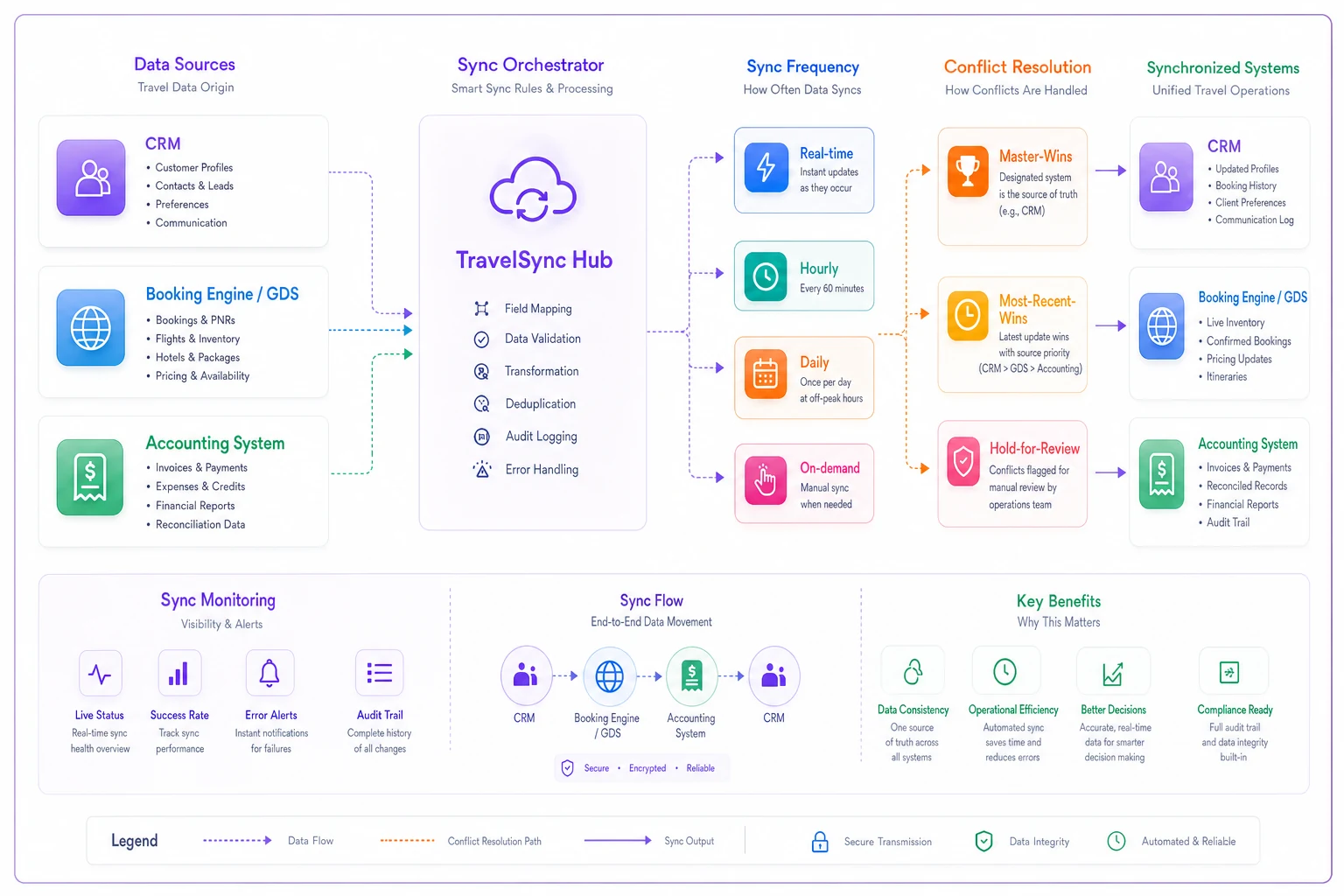
The mistake is treating conflict resolution as a purely technical setting. In real operations, the highest-value rule is knowing which conflicts should never be auto-resolved. A name mismatch on an international ticket isn't a data annoyance — it's a denied boarding. That goes into hold-for-review every time, no exceptions.
Sample field maps that prevent the classic breakages
A field map is the translation layer between a system's fields and your canonical model. Getting these explicit is what stops the "Bob vs Robert" and "two confirmation numbers" problems.
Customer field map (website form → canonical):
-
fullname→ split intofirstname+lastname, then run against existingcustomeridby fuzzy match on name + DOB + phone -
email→ normalize (lowercase, trim) → check against primary and secondary emails before creating new -
phone→ normalize to E.164 → strong match signal for dedup -
No match on normalized email/phone → create new
customer_id; partial match → hold-for-review, don't auto-merge
Booking field map (GDS/booking engine → canonical):
-
PNR/ supplier reservation number → stored as attributes ofbooking_ref, never as the primary key -
status→ mapped to a controlled vocabulary (quoted,confirmed,depositpaid,balancedue,cancelled) so three systems don't use three different words for "confirmed" -
total+currency→ always travel together; a price without its currency is a landmine on international trips -
travelerlist→ each traveler linked to acustomeridwhere possible
Supplier field map (portal / statement → canonical):
-
portal booking ID → attribute linked to your internal
booking_ref -
commission rate → validated against the contract record, not accepted blindly from the statement
The dedup logic in that customer map is where the real value sits. Match on a combination of signals, never a single field. Email alone misses shared family inboxes. Name alone merges different people. Name + DOB + normalized phone gives you a confidence score, and you only auto-merge above a high threshold. Everything in the murky middle goes to review.
Reconciliation smoke-tests you can actually run
None of this stays healthy on its own. Data drifts. Integrations silently break. Someone imports a spreadsheet at 2am. You need lightweight checks that run continuously and flag when something's wrong — the data equivalent of a smoke detector, not a full audit.
-
Duplicate-customer scan flag any two
customer_ids sharing a normalized email or phone. Should trend toward zero. -
Orphaned bookings find any booking with no valid
customer_idor no supplier link. -
Status mismatch list bookings where CRM status ≠ booking-engine status. These are your future client complaints.
-
Payment vs booking drift flag bookings where payments recorded don't reconcile with the booking total (over- and under-payments both).
-
Currency-less prices any booking with a total but no currency code.
-
Cancelled-but-active bookings marked cancelled in one system, still active in another. These generate ghost supplier bills.
-
Stale sync check any master record not synced to followers within its expected frequency window.
Run these and you'll be surprised what surfaces in the first week. The point isn't to fix everything at once — it's to make silent corruption visible so it stops compounding.
The reconciliation logic here overlaps heavily with the discipline in our pre-integration checklist for supplier APIs, which covers the test-case thinking for the sync layer itself. It also feeds directly into the financial matching we cover in automating supplier invoice reconciliation — worth reading alongside this if payment mismatches are already showing up.
A real scenario: what this looks like in numbers
A mid-sized leisure agency — around 3,000–3,500 bookings a year, five agents — went through a data cleanup because their loyalty program was misfiring and clients were getting duplicate marketing emails.
The first duplicate-customer scan flagged something like 2,400 customer records that collapsed into roughly 1,900 real people once matched on email + phone + name. Close to a fifth of their "customers" were just fragments. On the booking side, the status-mismatch check turned up about 60 bookings where the CRM said "confirmed" but the supplier had them as "on request" or cancelled — a couple of which would've become no-show disasters within weeks.
They didn't rebuild everything. They set an owner matrix (accounting owns money, GDS owns booking status, CRM owns contact info), turned on daily smoke-tests, and moved all customer creation through a dedup check with hold-for-review for partial matches.
Within about two months, new duplicate creation had basically stopped, and the mismatch report — which started at dozens of items — settled into single digits most days. The measurable win wasn't dramatic revenue growth; it was roughly a dozen fewer client-facing errors a month and an agent team that actually trusted the CRM again.
When this level of governance makes sense — and when it doesn't
When it's worth it: You're past roughly 1,000–1,500 bookings a year, you run more than two systems, or you have multiple agents entering data. At that point duplicates and mismatches are actively costing you client trust and staff time. It's also worth doing before any migration or new integration — a clean canonical model makes those projects survivable instead of catastrophic.
When it's overkill: A solo agent doing a few hundred curated trips a year, all in one CRM, probably doesn't need an owner matrix. The dedup habit and a couple of smoke-tests, yes. The full apparatus, no. Governance should be proportional to the number of systems and hands touching your data.
Who should not start here: If your bigger bleed is margin or commission tracking, fix that first — the KPIs worth tracking with action thresholds will tell you where your real leaks are. Data governance is foundational, but it's not always the most urgent fire.
The system view
The reason duplicate customers and broken bookings feel unfixable is that owners keep treating each incident as a one-off — merge these two records, correct that status, chase this payment. Every incident is a symptom of a missing decision: no canonical definition, no field owner, no conflict rule, no reconciliation check.
Make those decisions once, write them down, and enforce them at the point data enters your systems. The canonical model defines what things are. The owner matrix says who's right when systems disagree. The sync policies control how data moves. The smoke-tests catch what slips through.
Together they turn data quality from a constant firefight into a background process that mostly runs itself — which is exactly what you want when you're trying to grow the agency instead of cleaning up after it.
Together they turn data quality from a constant firefight into a background process that mostly runs itself — which is exactly what you want when you're trying to grow the agency instead of cleaning up after it.
Ready to elevate your travel agency workflow?
Join 1,200+ travel agencies using Travexly to save time, improve client satisfaction, and boost operational efficiency.