



For years, the safest thing an agency could tell a client was "assume your passport renewal will take a while." That single assumption shaped deposit timing, cancellation windows, how far out you booked international trips, and how much hand-holding your staff did on documents. It was conservative, and it protected you.
That assumption is now on shaky ground.
On August 28, 2026, the State Department published a proposed rule to expand its Online Passport Renewal program to eligible U.S. citizens living overseas — and the part most agencies are underweighting — to remove the old requirement that a passport have one year or less of remaining validity before you can renew online. The Federal Register posting for the rule lays out a public comment window through October 27, 2026, with a phased country-by-country rollout to be announced on travel.state.gov.
The rule isn't finalized. Rollout is phased. But the operational shift it points toward — shorter, more flexible renewal paths for a chunk of your client base — is the kind of change that quietly makes your current workflows wrong without anyone noticing until a booking falls apart.
Start with the failure mode, not the opportunity
Most agencies will read "faster passport renewals" and immediately think more last-minute international sales. Fine. But what'll actually hurt you first isn't a missed upsell — it's a stale rule inside your booking process silently rejecting or delaying good bookings.
-
Passport must have 6+ months validity beyond travel date
-
If renewal needed, add 8–12 weeks lead time before international departure
-
Block deposits on trips inside that window unless client confirms valid passport
That logic was correct under the old system. Under an expanded online renewal path, a client who previously "couldn't make" a trip 5 weeks out might now genuinely be able. If your process is still flagging them as high-risk or steering them toward domestic options, you're losing the booking to an OTA or another agency who updated their assumptions.
The failure is invisible because nothing errors out. The booking just doesn't happen, or your agent talks the client out of it based on outdated timelines. That's the most expensive kind of operational drift — the kind nobody logs.
What actually needs to change in your workflow
Break this into the fields, rules, and human steps that carry old assumptions. Almost every agency has these scattered across three places: the CRM, client-facing templates, and the tribal knowledge in agents' heads.
Eliminate booking chaos and streamline operations.
Travexly helps you manage, confirm, and track travel bookings effortlessly.
- Unified booking management
- Automated client communications
- Team scheduling & itinerary tracking
No credit card required
1. Passport data fields and flags. Most CRMs store passport expiry as a single date and calculate risk off it. That's not enough anymore. You want to capture:
-
Passport expiry date
-
Country of residence (drives eligibility for overseas online renewal as rollout expands)
-
Renewal method the client is likely eligible for (online vs. in-person)
-
Last verified date on the document info
The residence field matters because rollout is phased by location. A client in one country may have the online path available months before a client somewhere else. Treating all international clients the same will make you either too cautious or too aggressive depending on where they live.
2. Lead-time rules tied to trip type. Replace your single blanket lead-time rule with tiered logic:
| Client document situation | Old assumed lead time | Updated approach |
|---|---|---|
| Valid passport, 6+ months beyond travel | None | No change |
| Renewal needed, eligible for online (rollout-confirmed country) | 8–12 weeks blocked | Shorter window, verify against current State timeline |
| Renewal needed, in-person/mail only | 8–12 weeks | Keep conservative buffer |
| Eligibility unclear / new resident | 8–12 weeks | Treat as conservative until confirmed |
The point isn't the exact numbers — those will move as the phased deployment publishes real processing data. The point is that a single global lead-time rule is now a liability. You need branching.
3. Deposit and cancellation windows for international trips. If a segment of clients can now realistically book shorter-lead international travel, your deposit sequencing and cancellation windows need to accommodate that without exposing you to supplier penalties. A client booking 5 weeks out is a different risk profile than one booking 5 months out. You don't need to reinvent your refund language — you already have solid structures for that — but you do need to make sure a short-lead international booking doesn't slip through with a deposit schedule designed for long-lead trips.
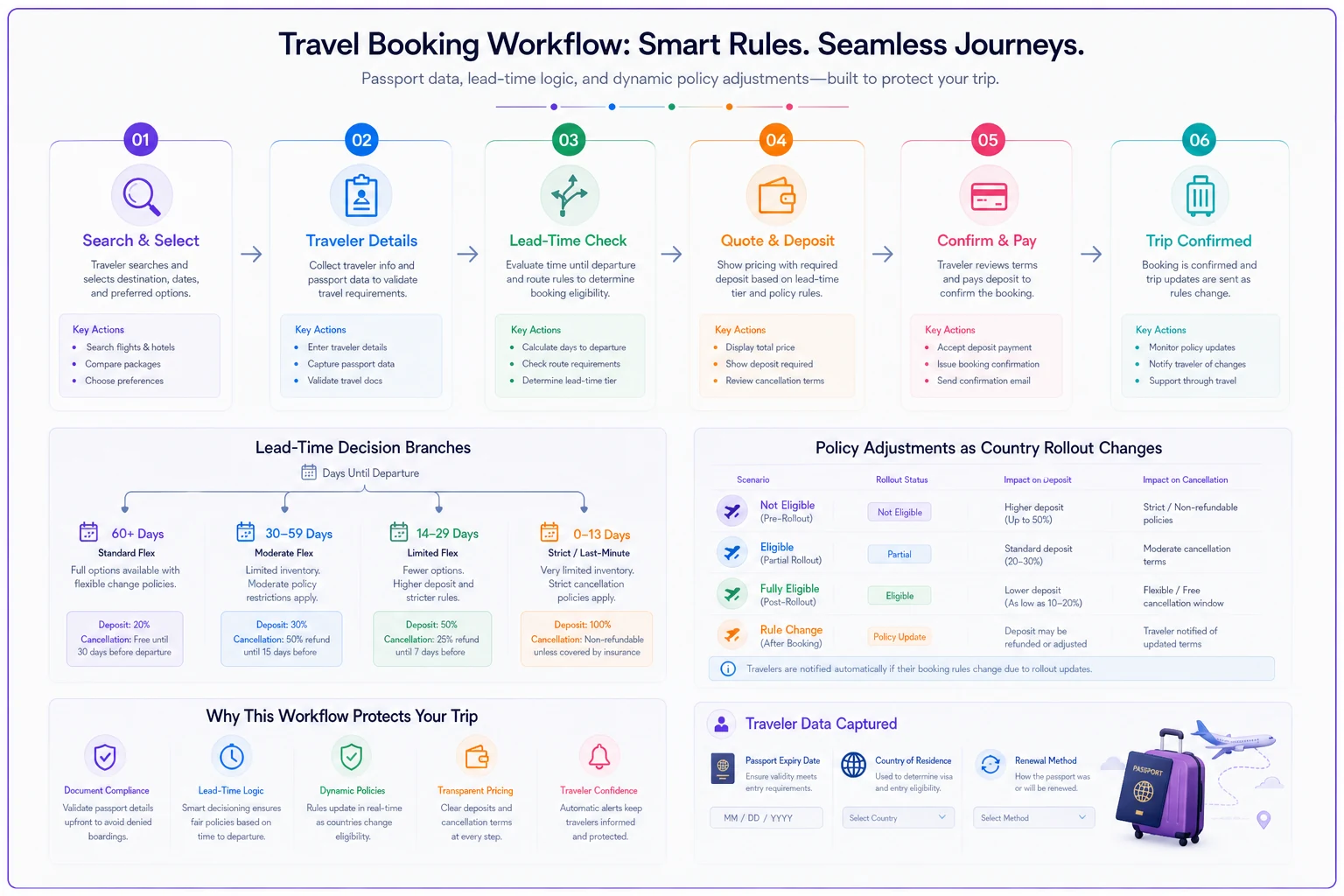
A quick sketch of the updated data capture and decision flow.
The deeper problem this exposes
This rule really surfaces something most agencies don't want to admit: regulatory assumptions get hardcoded into operations and never revisited.
Passport lead times. Visa processing windows. Entry requirements. These get baked into checklists, email templates, and agent training once — usually years ago — and then treated as permanent. When the underlying rule changes, the operation keeps running on the old assumption because there's no system that flags it.
This is the same structural weakness that makes agencies scramble every time an entry requirement shifts. It's the same pattern I broke down when covering the DHS Fixed-Period Visa Rule and the operational changes agencies needed before September 2026 — different regulation, identical failure mode. Rules embedded in templates and human habit, with no owner and no review cycle.
Updating your passport logic this one time isn't the real fix. The real fix is assigning ownership: someone whose job is to monitor regulatory timeline changes and push updates into your booking rules and client templates. Without that, you'll be back in this same spot the next time a rule moves.
A practical sequence for the next 60 days
The comment period runs through late October and rollout is phased, so you have a real window to prepare before this touches live bookings.
-
Audit where lead-time assumptions live. Search your CRM rules, email templates, pre-departure checklists, and onboarding questionnaires for anything referencing passport renewal timelines. Make a list. You'll be surprised how many places it shows up.
-
Add the residence and renewal-method fields to your client records now, even before rollout details firm up. Start collecting the data so you're not backfilling later.
-
Draft the tiered lead-time logic but keep conservative buffers until State publishes real per-country timelines. Don't get aggressive on assumptions that aren't confirmed yet.
-
Rewrite two client-facing templates the pre-departure document checklist and the "is your passport ready" advisory. Remove language that assumes long, universal renewal times.
-
Brief your agents on the change and — critically — on what's not yet confirmed. The biggest risk is an enthusiastic agent promising a client they can renew online in a country where rollout hasn't landed.
-
Assign a rollout monitor. One person checks travel.state.gov for phased-deployment updates and flags when a client's country becomes eligible.
-
Reprioritize your manual passport-assistance offers. If you've been offering renewal hand-holding as a value-add, some of that becomes lower-value as the online path expands. Redirect that staff time toward where it actually matters.
Sequence it rather than trying to overhaul everything at once.
Where the right systems quietly matter
This is the kind of change that's brutal to manage manually and fairly clean to manage if your booking data is centralized. When passport expiry, residence, and renewal eligibility live as structured fields in your platform, updating a lead-time rule is a rule change — not a retraining exercise across your whole team.
If your CRM supports custom flags, add a "rollout-eligible" flag now so agents see country-specific eligibility inline.
Agencies running an operational platform that lets you flag records by document status can surface clients whose situation changes as rollout expands mostly in the background. The client in a newly-eligible country gets flagged; the agent sees the updated lead-time guidance without having to remember the rule themselves. That's the difference between a workflow that adapts and one where a person has to catch every change by hand — and people miss things, especially on rules that shift quietly.
The point isn't the automation though. The point is that regulatory assumptions shouldn't live in your agents' memory. They should live in your data and your rules, where they can be updated in one place and trusted across the whole team.
A realistic scenario
Consider a mid-sized agency doing heavy international leisure work — expat family travel, destination weddings, that kind of thing. A solid portion of their client base lives overseas.
Under their old process, any client needing a passport renewal got quoted a 10-week buffer before agents would even build an international itinerary. Reasonable, historically. But it meant a steady trickle of shorter-lead inquiries — clients wanting to book 6 to 8 weeks out — got steered toward "let's plan for next year instead." Call it a handful of lost or deferred bookings a month, mostly higher-margin custom trips.
Once they add residence and renewal-eligibility fields and update their lead-time logic for clients in rollout-confirmed countries, those inquiries stop getting reflexively deferred. Agents can actually assess whether the trip is feasible instead of defaulting to no. Even converting a portion of those previously-deferred inquiries adds up over a season — and it's revenue that was walking out the door invisibly, because a "no" from an agent never shows up as a lost sale in most reporting.
The gain wasn't from marketing harder. It was from removing an outdated assumption that was quietly killing feasible bookings.
When to move fast, and when not to
Move fast on the internal audit and data fields. There's zero downside to knowing where your lead-time assumptions live and starting to collect residence and eligibility data. Do that now.
Be cautious on client-facing promises. Until the rule is finalized and rollout lands in a specific country, don't advertise faster international turnarounds as a guarantee. The proposed rule is exactly that — proposed — and the full text in the Federal Register makes clear the deployment is phased and subject to the comment process. Over-promising on an unconfirmed timeline is how you turn an opportunity into a refund dispute.
Who should hold off entirely: if your international volume is small and mostly long-lead, this is low priority. Update your templates when you refresh them next and move on. Not every agency needs to rebuild logic for a client segment they barely serve.
The takeaway
The passport rule itself is a modest regulatory update. What it really tests is whether your operation can absorb a change to an assumption you've relied on for years without breaking or leaking bookings. Most agencies can't, because those assumptions are buried in templates and habits nobody owns.
Fix the immediate thing — the fields, the tiered lead-time logic, the templates. But fix the deeper thing too: give someone actual ownership of the regulatory assumptions inside your workflows, so the next time a rule moves, you update a rule instead of scrambling. The agencies that treat this as a one-time patch will be back here soon. The ones that treat it as a signal to build a review habit won't.
The passport rule itself is a modest regulatory update. What it really tests is whether your operation can absorb a change to an assumption you've relied on for years without breaking or leaking bookings. Most agencies can't, because those assumptions are buried in templates and habits nobody owns.
Fix the immediate thing — the fields, the tiered lead-time logic, the templates. But fix the deeper thing too: give someone actual ownership of the regulatory assumptions inside your workflows, so the next time a rule moves, you update a rule instead of scrambling. The agencies that treat this as a one-time patch will be back here soon. The ones that treat it as a signal to build a review habit won't.
Ready to elevate your travel agency workflow?
Join 1,200+ travel agencies using Travexly to save time, improve client satisfaction, and boost operational efficiency.