

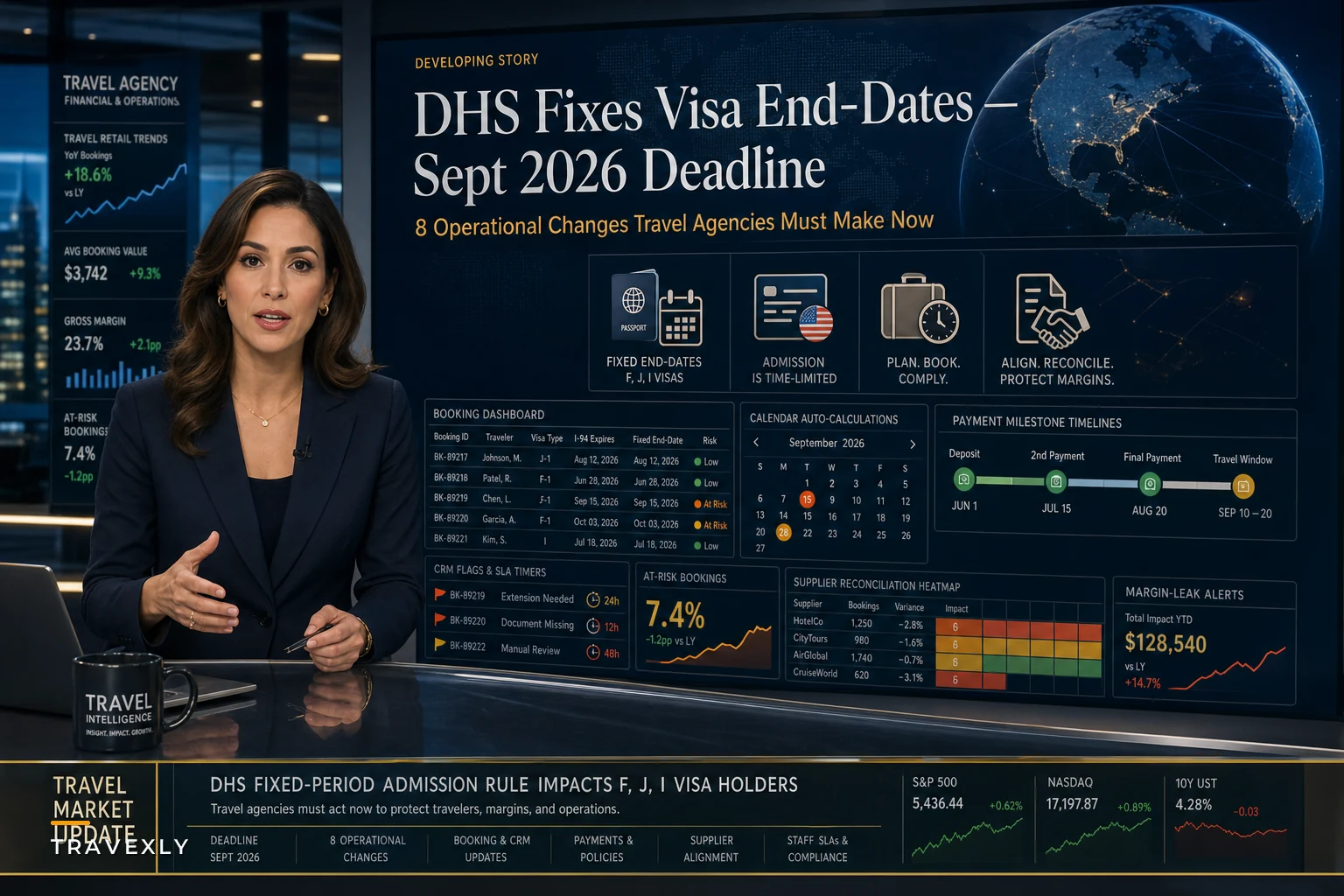

Starting September 15, 2026, international students, exchange visitors, and foreign media on F, J, and I visas lose the "duration of status" flexibility they've relied on for years. The DHS final rule published July 16 replaces it with fixed admission periods—hard end dates that require formal USCIS extensions and biometric vetting.
For travel agencies handling bookings for universities, exchange programs, study abroad groups, or educational tour operators, this creates immediate operational headaches. Clients whose travel plans might suddenly become invalid. Group bookings that span semesters could collapse. Payment schedules tied to academic calendars might need complete restructuring.
The real problem runs deeper than visa dates though. Most agencies handling educational and exchange groups operate with booking systems that assume stable, predictable client status. Your deposit structures, cancellation policies, and payment workflows probably don't account for clients who might lose legal status mid-trip or need to leave the country unexpectedly.
Why standard travel operations break under fixed admission periods
Travel agencies typically structure group bookings around academic schedules—spring break trips, summer programs, semester-long exchanges. These bookings often involve deposits placed six to eight months in advance, with final payments due 30-60 days before travel.
Under the new fixed admission rule, a student who books a May graduation trip in November might not know if their visa status will still be valid by travel time. Exchange visitors planning return flights might discover their authorized stay ends before their booked departure. Media professionals on assignment could find themselves scrambling to extend status while dealing with your cancellation penalties.
The operational mess compounds fast. Your staff starts fielding panicked calls about visa extensions. Suppliers want explanations for last-minute cancellations. Group bookings fall apart when half the participants need to apply for extensions—a process that according to DHS guidance can take several months and requires biometric appointments.
One agency I worked with last year handled bookings for a university's international student association. They had 48 students booked for a spring break trip to California—deposits paid, hotels confirmed, activities scheduled. When visa complications hit just three students, the entire group dynamic shifted. The organizers wanted partial refunds to redistribute costs. The suppliers wouldn't move on their group rate minimums. The agency ate over $4,000 in losses just to keep the relationship intact.
That scenario happened under the current flexible system. Fixed admission periods will multiply these situations across your entire international student and exchange visitor client base.
The cash flow trap most agencies miss
Agencies treat visa issues as isolated incidents instead of systematic risks. Each cancellation gets handled individually, supplier negotiations happen case-by-case, and losses get absorbed to preserve relationships.
Eliminate booking chaos and streamline operations.
Travexly helps you manage, confirm, and track travel bookings effortlessly.
- Unified booking management
- Automated client communications
- Team scheduling & itinerary tracking
No credit card required
But visa-related cancellations follow patterns. Students from certain countries face longer processing times. Exchange programs in specific fields encounter more scrutiny. Media visa holders on particular assignment types hit administrative delays. Once you recognize the patterns, you can build controls that protect margins automatically instead of reactively.
The timing problem makes it worse. International students tend to book travel during three windows: pre-semester orientation trips (June-August), winter break travel home (November-January), and spring break or summer trips (February-May). These booking windows now overlap directly with potential visa extension deadlines—which creates compounding cancellation risk that's hard to manage if you're not tracking it proactively.
A midwest agency specializing in international student travel shared their numbers—roughly 60% of their annual revenue comes from bookings during those three periods. If even 15% of those bookings face visa-related disruptions, they're looking at cash flow gaps that could threaten their operations.
Build visa status tracking into your booking flow
The first operational change seems obvious but most agencies won't do it properly: capture and validate visa expiration dates at booking.
Don't just add a form field. Build it into your qualification process. When someone inquires about travel, your intake system needs to flag if their travel dates approach or exceed their authorized stay period. This protects you from bookings that will inevitably cancel.
-
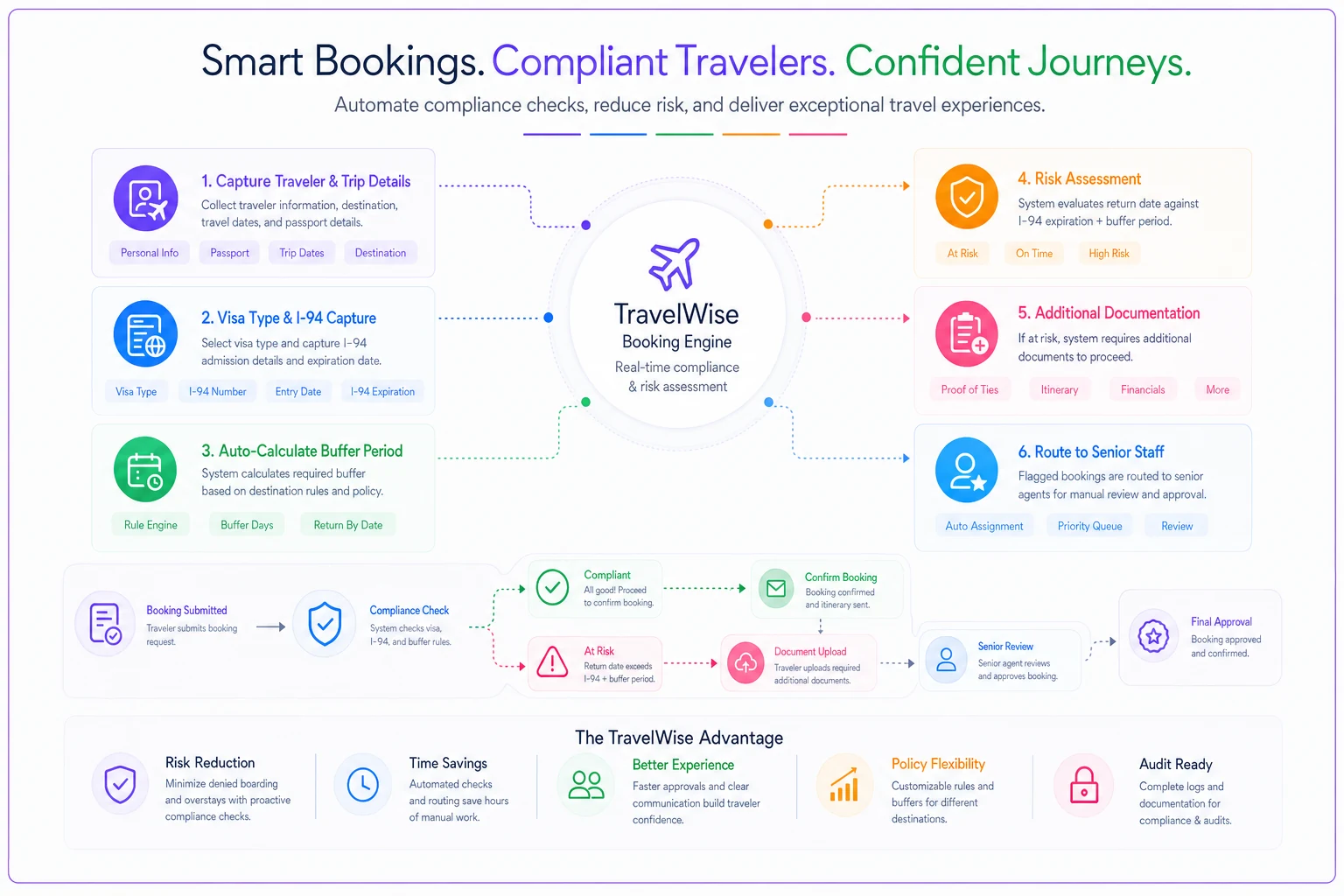
During initial inquiry, require visa type and current I-94 expiration date
-
Auto-calculate buffer periods (30 days for F-1 students, 60 days for J-1 exchange visitors)
-
Flag any booking where the return date falls within the buffer period
-
Require additional documentation for flagged bookings (proof of extension application, enrollment verification, etc.)
-
Route flagged bookings to senior staff for review before accepting deposits
One agency started doing this after eating over $30,000 in supplier penalties from visa-related cancellations in a single quarter. They discovered that roughly 80% of their problems came from bookings made within 90 days of visa expiration—clients who were optimistic about extensions that never came through.
Require a current screenshot or PDF of the client's I-94 at booking to reduce follow-up delays and document verification time.
This workflow reduces last-minute surprises by catching risky bookings early and routing them for senior review.
Restructure your payment terms for visa uncertainty
Your standard deposit and payment schedule probably follows the industry template: 25-30% deposit at booking, another 25-35% at 90 days out, final payment 30-45 days before travel. This structure assumes clients whose legal status won't change.
Under fixed admission periods, you need payment structures that protect your margins while accommodating real visa uncertainty. A tiered approach based on visa risk works well here:
-
Low-risk bookings (travel date 6+ months before visa expiration): - Standard deposit and payment schedule - Normal cancellation penalties
-
Medium-risk bookings (travel date 3-6 months before visa expiration): - Higher initial deposit (35-40%) - Accelerated payment schedule (final payment 60 days out) - Modified cancellation terms with visa contingency
-
High-risk bookings (travel date within 3 months of visa expiration): - Require full payment upfront OR - Proof of extension application before booking OR - Explicit acknowledgment of no-refund policy for visa issues
The key is making these tiers systematic, not discretionary. Your booking system should automatically categorize clients based on their visa timeline and apply the appropriate payment structure—not leave it up to whoever answers the phone that day.
| Risk Level | Criteria | Payment Terms |
|---|---|---|
| Low-risk bookings | (travel date 6+ months before visa expiration) | Standard deposit and payment schedule Normal cancellation penalties |
| Medium-risk bookings | (travel date 3-6 months before visa expiration) | Higher initial deposit (35-40%) Accelerated payment schedule (final payment 60 days out) Modified cancellation terms with visa contingency |
| High-risk bookings | (travel date within 3 months of visa expiration) | Require full payment upfront OR Proof of extension application before booking OR Explicit acknowledgment of no-refund policy for visa issues |
The key is making these tiers systematic, not discretionary. Your booking system should automatically categorize clients based on their visa timeline and apply the appropriate payment structure—not leave it up to whoever answers the phone that day.
Create visa extension assistance workflows
Most travel agencies avoid getting involved in visa matters—it feels like legal territory. But under the new fixed admission rules, basic visa timeline awareness becomes an operational necessity.
You don't need to provide legal advice. You need workflows that help clients navigate the intersection of travel planning and immigration timelines. Three workflows worth building:
Extension timeline alerts: For any client with bookings approaching their authorized stay period, trigger automated reminders at 150, 120, and 90 days before expiration about USCIS extension timelines.
Documentation checklists: Simple checklists for common scenarios—what documents a student needs to extend F-1 status, what forms exchange visitors need for J-1 extensions, basic requirements for I visa extensions. Position these as travel planning resources, not legal guidance.
Preferred provider network: Identify immigration attorneys who understand travel implications and can provide expedited consultations for your clients. Negotiate referral arrangements that get your clients priority scheduling.
An agency focused on educational travel built this system after losing a $78,000 university group booking to visa delays. They now catch potential issues four to five months in advance instead of weeks before travel. Their visa-related cancellations dropped by roughly 70% in the first year of using the system.
Modify group booking protocols for mixed visa situations
Group bookings get exponentially more complex when participants have different visa statuses and expiration dates. A study abroad program might include F-1 students, J-1 exchange visitors, and some permanent residents or citizens—each category facing different rules under the fixed admission period system.
Your group booking protocol needs new decision points.
Establish minimum group visa stability thresholds. If more than 20% of a group has visa expiration dates within six months of travel, require additional safeguards—higher deposits, shorter payment windows, or explicit cancellation risk acknowledgment.
Build visa audit checkpoints into your group workflow. At booking confirmation, 120 days out, 60 days out, and 30 days out, verify that all participants still have valid status through the travel dates. This catches problems before they cascade through the entire group.
Create group-specific cancellation provisions. Standard individual cancellation policies don't work when five students in a 30-person group suddenly can't travel due to visa issues. You need provisions for partial group dissolution, minimum group size requirements, and fare recalculation triggers.
Renegotiate supplier agreements with visa contingencies
Your existing supplier contracts probably don't account for systematic visa-related cancellations. Hotels, airlines, and ground operators built their group policies assuming normal attrition—someone gets sick, plans change, the usual. Mass visa-related cancellations are a different situation entirely.
Start renegotiating now, before September creates leverage problems. Focus on three areas:
Visa-specific force majeure language: Push for provisions that treat visa denials, unexpected status terminations, or extension delays as force majeure events. You won't get full refunds, but you might get meaningfully reduced penalties.
Sliding scale group minimums: Instead of fixed "must have 20 people or pay full price" terms, negotiate graduated scales. If visa issues drop your group from 25 to 18, you pay a smaller penalty than if you drop to 10.
Extended modification windows: Standard supplier agreements lock in details 30-60 days out. For international student and exchange visitor bookings, push for modification windows that stay open until 14-21 days before travel.
One educational travel specialist spent three months renegotiating supplier agreements before launching their international student division. The effort seemed excessive at the time. Their modified contracts saved them roughly $45,000 in penalties during the first year alone.
Staff training on visa timelines and red flags
Your booking agents need operational awareness of visa categories and timelines—not immigration law, just enough to catch obvious problems. They should know that F-1 students get 60-day grace periods after program completion while J-1 exchange visitors get only 30 days. They should recognize that certain visa types carry no grace period at all.
Train around scenarios, not rules:
-
A student wants to book a graduation trip for May 15; their I-20 ends May 10
-
An exchange visitor books a return flight for August 30; their DS-2019 expires August 15
-
A media professional extends their assignment but hasn't updated their I visa documentation
For each scenario, train staff on three things: what questions to ask, what documentation to require, and when to escalate to management.
Untrained staff either miss visa issues entirely—creating cancellation problems later—or become overly cautious and start rejecting profitable bookings. Proper training finds the middle ground.
Build early warning systems for at-risk bookings
You need systematic ways to identify bookings likely to face visa complications before they blow up your operations. This goes beyond tracking expiration dates.
Watch for these early warning indicators:
Behavioral flags: Clients who ask repeated questions about cancellation policies, payment flexibility, or hypothetical scenarios often know their visa situation is uncertain. Flag these inquiries for deeper review.
Timeline patterns: Bookings made very close to visa expiration dates, requests for open-ended return tickets, or sudden itinerary changes toward earlier dates frequently signal visa concerns.
Documentation delays: Clients who struggle to provide I-94 records, current visa documentation, or enrollment verification might be navigating status complications they haven't disclosed.
Payment hesitation: Delayed deposits, requests for extended payment terms, or attempts to switch payment methods partway through the booking process can indicate uncertainty about whether travel will actually happen.
Build a scoring system that weights these factors. Bookings that hit multiple indicators get routed for manual review before deposits are processed. An awkward conversation upfront is significantly less painful than a messy cancellation six months later.
The operational reality after September 2026
The DHS fixed admission rule changes how travel agencies serve international students, exchange programs, and foreign media. You're no longer just booking travel—you're navigating a complex overlap between travel planning and immigration timelines.
Agencies that adapt their operations now will be in a much stronger position than those scrambling to react after September. The operational changes follow a logical progression: identify visa risks, modify booking processes to account for those risks, protect cash flow through adjusted payment terms, and build controls that prevent problems rather than just respond to them.
Agencies still running on email chains and spreadsheets will struggle to track visa timelines across hundreds of active bookings. Those using AI-powered operational platforms that automatically validate visa dates, flag at-risk bookings, and trigger appropriate workflows will handle the transition with far less friction.
Start with visa tracking in your booking flow. Add payment structure modifications. Build from there. September feels distant, but operational changes take time to implement and actually work properly. The sooner you start, the smoother your transition—and the stronger your competitive position when other agencies start scrambling to catch up.
Ready to elevate your travel agency workflow?
Join 1,200+ travel agencies using Travexly to save time, improve client satisfaction, and boost operational efficiency.