

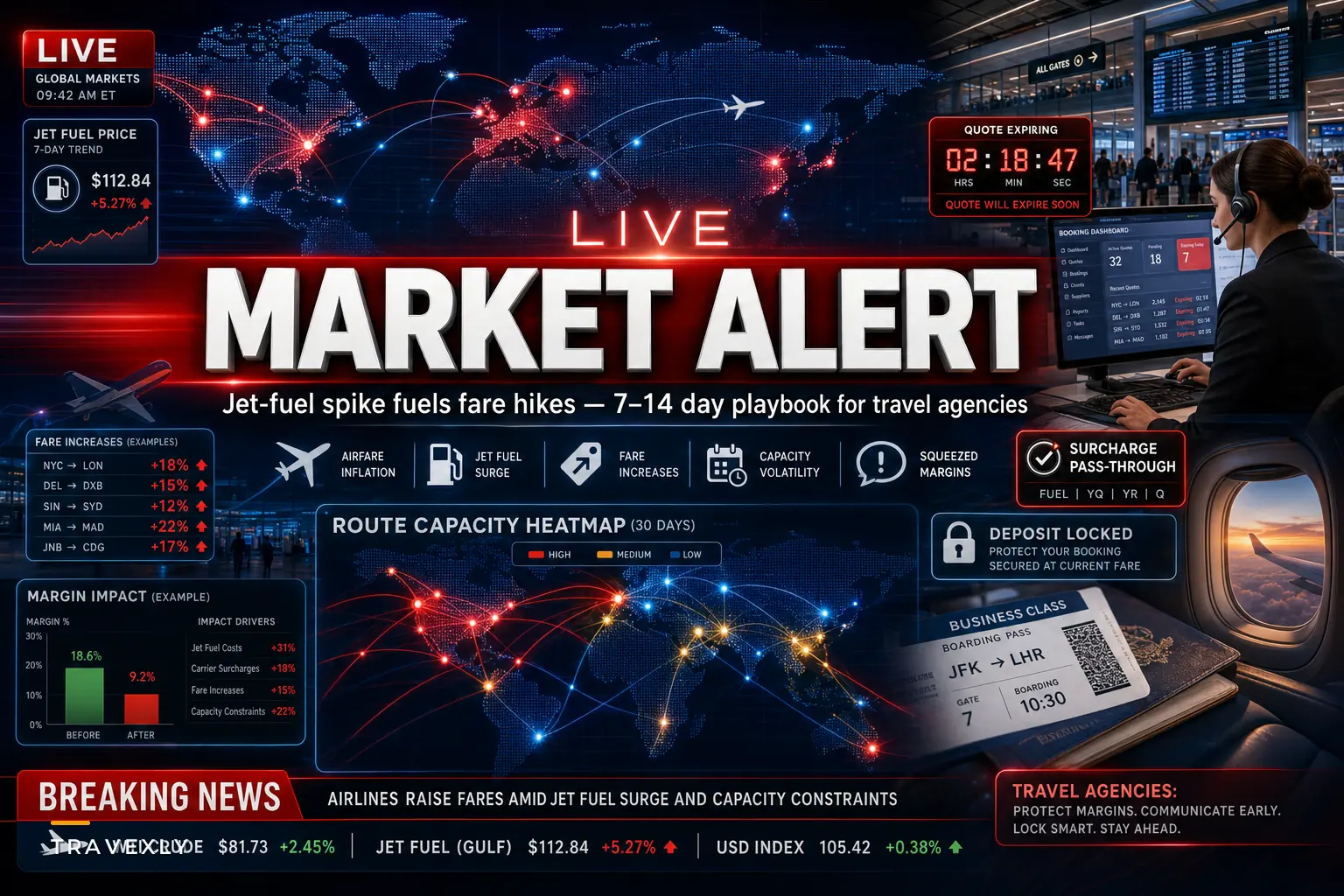

The fuel situation heading into this holiday season isn't subtle. As Reuters reported in late October, airlines have been quietly unwinding fuel hedges as the Middle East conflict drags on, which removes the cushion that normally protects carriers from sudden fuel spikes. When jet fuel jumps, that cost now hits ticket prices almost immediately instead of being absorbed for a quarter or two. NPR covered the downstream effect — holiday airfares climbing on the back of record jet fuel prices — right in the middle of peak booking season.
For agencies, the headline isn't really "fares are going up." You already knew fares move. The real problem is timing and volatility. Fuel-driven fare hikes during the exact weeks you're collecting deposits and locking packages expose a weakness most agencies don't notice until it's already bleeding them: your quotes, deposits, and client expectations are built on pricing assumptions that stop being true within days.
Here's what actually breaks — and what to change before your holiday book of business is fully committed.
The quiet margin trap: quotes that outlive their shelf life
An agent quotes a client a package in early November. The client "thinks about it" for ten days. In those ten days, the carrier reprices seats twice. When the client finally says yes, the fare the agent quoted is gone — but the client is holding you to the number they saw. Now you're either eating the difference to keep the goodwill or having an awkward conversation that makes you look disorganized.
Multiply that across a few dozen slow-converting leads during the busiest booking window of the year and the leakage adds up fast. A mid-sized leisure agency doing 40–60 holiday bookings a month can easily give back somewhere in the $4k–$7k range in a single peak cycle, just absorbing fare drift on stale quotes. Not from bad deals — from expired ones nobody re-ran.
The underlying issue isn't fuel. Fuel just made a pre-existing flaw expensive. Most agencies treat a quote like a promise with no expiry date. In a volatile fare environment, a quote is a snapshot, and it needs to be treated like one.
The fix is operational, not heroic:
-
Put a hard, visible validity window on every quote — 48 to 72 hours during volatile periods, not the vague "subject to availability" line nobody reads.
-
Re-price if a lead crosses the validity threshold before converting, and send the updated number before the client brings it up.
-
Break your quoted price into components the client can actually see
base fare, taxes and surcharges, your service fee. When the fare line changes, it's obviously the carrier — not you.
That last point matters more than it looks. When clients see the carrier surcharge line move and your fee stay flat, you stop being the villain. You become the person keeping them informed while everything else shifts around them.
Why "absorb it to keep the client" is usually the wrong instinct
There's a reflex among owners — especially ones who built on relationships — to eat small fare increases rather than go back to the client. It feels like good service. It's actually how you train your margin to disappear.
Eliminate booking chaos and streamline operations.
Travexly helps you manage, confirm, and track travel bookings effortlessly.
- Unified booking management
- Automated client communications
- Team scheduling & itinerary tracking
No credit card required
A $90 fare bump on one booking feels trivial. But fuel-driven volatility doesn't produce one bump — it produces a steady drip across dozens of bookings over several weeks. Agencies that absorb "just this once" repeatedly end up with a holiday season that looks busy and feels profitable but closes out thinner than last year, and they can never quite explain why.
A better way to think about it: your job isn't to protect the client from reality. It's to manage that reality cleanly and transparently. Clients tolerate price movement far better than they tolerate surprises.
When absorbing the cost actually makes sense
-
The increase is genuinely small relative to a high-value booking — a $75 bump on a $14k luxury itinerary, just absorb it.
-
The client is a repeat, high-LTV relationship and the gesture buys real loyalty.
-
Your quote error or slow response caused the delay, not the client's.
When absorbing it is a mistake
-
On thin-margin economy bookings where the increase is a meaningful chunk of your take.
-
When it becomes a habit across many bookings instead of a deliberate exception.
-
When the client never even saw the original number yet — you're inventing a problem.
The discipline is deciding this with a rule, not case-by-case in the moment when you're tired and the client is nice.
Rework deposits and payment timing around fare volatility
When fares are stable, a loose deposit structure is survivable. When fares and surcharges can shift between booking and final payment, your deposit and payment schedule is the only thing standing between you and funding someone else's price increase out of your own margin.
This is worth being deliberate about. The mechanics of staged deposits and partial refunds are covered in depth in this breakdown on structuring deposits and payment schedules without eroding margins. The fuel situation just raises the stakes on getting it right.
A few adjustments that matter specifically in a volatile-fare window:
| Element | Stable-fare approach | Volatile-fare approach (now) |
|---|---|---|
| Deposit timing | Collect within a week | Collect same-day on confirmed quote |
| Fare lock | Implied, loosely tracked | Explicit: "price confirmed only at ticketing" |
| Surcharge language | Buried in T&Cs | Called out as a separate, pass-through line |
| Final payment window | 30+ days out | Pulled earlier for fare-sensitive routes |
| Re-quote trigger | Manual, if someone remembers | Automatic at quote expiry |
The right column isn't about squeezing clients. It's about not letting the gap between "yes" and "paid" become a window where the carrier gets to reprice on your dime.
One thing to avoid: don't just raise deposit percentages across the board and call it a strategy. A blunt "we now require 50% up front" will cost you conversions on price-sensitive leads. The smarter move is tying deposit timing and fare-lock language to route volatility — tighter rules on fuel-exposed long-haul, looser on stable domestic. That precision keeps you competitive while protecting the exposure that actually matters.
Tie deposit deadlines to route volatility: require same-day deposits for fuel-exposed long-haul routes and keep looser timing for stable domestic itineraries.
Don't treat this as a one-size-fits-all change — use route-level rules so you protect margin without killing conversions.
A workable re-pricing and advisory workflow
This is less about tools and more about never letting a committed booking drift out of sync with reality.
-
Tag fare-sensitive bookings at quote stage. Long-haul and anything routing through fuel-exposed hubs gets flagged. These are the ones that bite.
-
Set the validity clock on the quote itself. Every quote carries a visible expiry. No expiry, no quote.
-
Re-pull fares on any flagged lead that crosses expiry before paying. Don't wait for the client to circle back with a stale number.
-
Send a short proactive advisory when a flagged route moves materially — one or two sentences, not a legal essay. "Heads up: fuel surcharges on this route moved up roughly $60 since your quote. Your package is updated and still available — want me to lock it?"
-
Lock at deposit, confirm the real number at ticketing, and make sure the client understood that distinction from the start.
-
Reconcile the surcharge pass-through so you're actually collecting what the carrier charged, not a figure from three weeks ago you forgot to update.
That advisory in step 4 does more work than any pricing tactic. Agencies that go quiet when prices move look incompetent. Agencies that send a calm, specific heads-up look like they're on top of it. Same fare increase — completely different client reaction.
Visual workflow below.
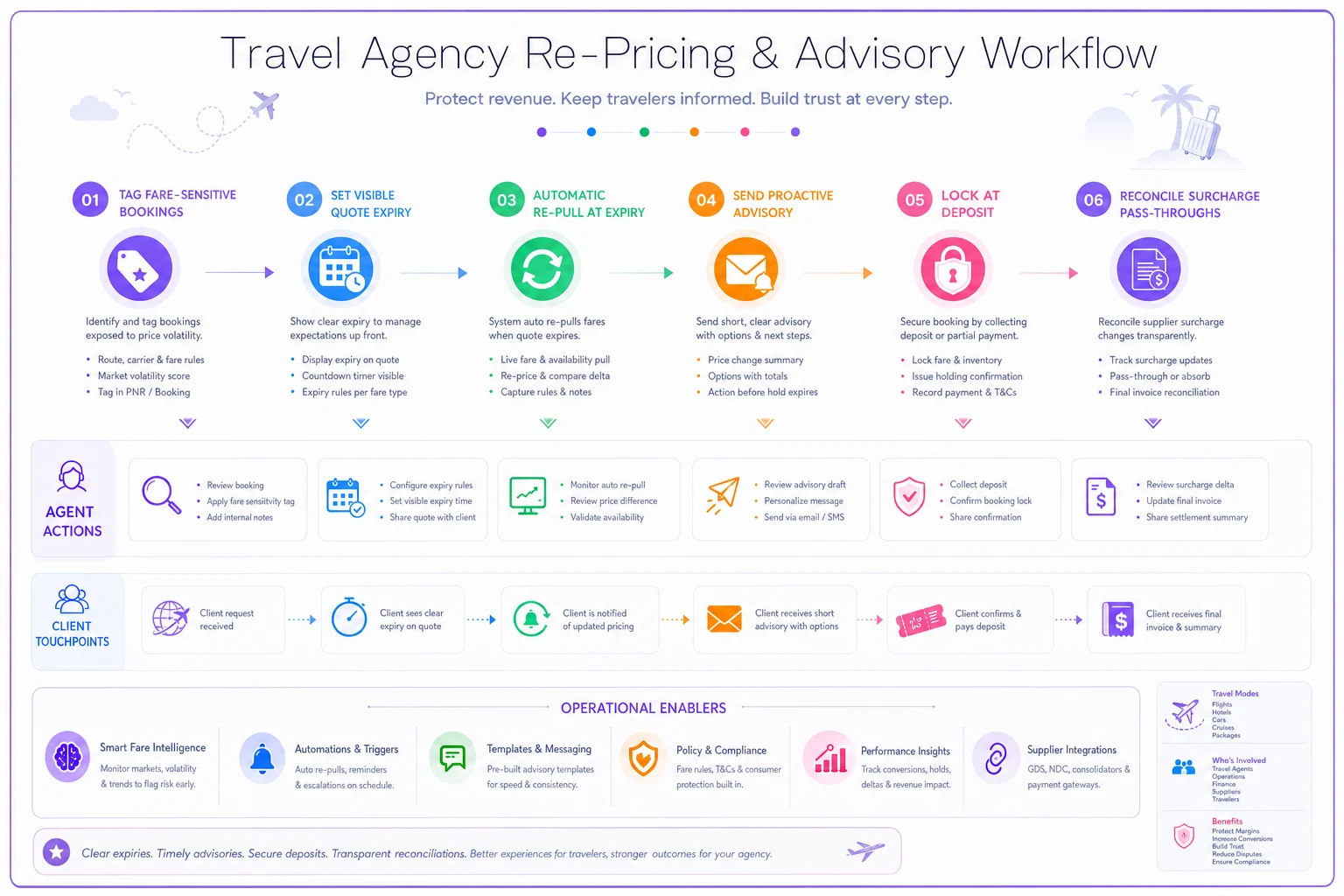
Keep this process tight and visible so clients feel informed, not surprised.
Where the busy season actually breaks: the CS bottleneck
The part owners underestimate is the support load. Fuel volatility doesn't just change prices — it generates inbound: "why did my price change," "can I still cancel," "is my flight going to be cut." Carrier capacity adjustments ahead of the holidays mean some itineraries get thinned or rerouted, which drives rebooking volume right when your team is thinnest.
A short pre-season checklist that genuinely reduces the chaos:
-
[ ] A one-paragraph client-facing explainer on why holiday fares are moving this year — so agents stop improvising answers
-
[ ] A saved advisory template for fare changes, ready to personalize in under a minute
-
[ ] A clear internal rule for when an agent absorbs vs. re-quotes, so junior staff aren't guessing
-
[ ] A watchlist of your most fuel-exposed routes and the clients currently booked on them
-
[ ] A simple log of which committed bookings still have open final payments at risk of surcharge drift
-
[ ] A rebooking priority order for capacity cuts — high-LTV and tight-timeline clients first
Most of this is just pre-writing decisions you'd otherwise be making frantically at 9pm during peak week. The agencies that stay calm in December aren't calmer by temperament. They made these calls in October.
Real scenario: a 7-person leisure agency that stopped the drip
A small leisure-focused agency — around 7 staff, mostly long-haul and multi-stop holiday packages — noticed their November book was converting fine but closing thinner than the same month a year earlier. Nothing dramatic, just a persistent gap of a few hundred dollars across a lot of bookings.
When they traced it, the cause was boring and fixable: agents were quoting, clients were taking 5–12 days to commit, and nobody was re-running the fare before confirming. On fuel-exposed routes, surcharges had moved in the meantime, and the agency was quietly absorbing the difference to avoid awkward conversations. Across roughly 50 holiday bookings, the leakage worked out to somewhere in the $3k–$5k range for the month.
The fix wasn't fancy. They added a 72-hour quote expiry, broke out the surcharge line separately on every quote, and wrote a two-sentence advisory template agents sent the moment a flagged route moved. No across-the-board deposit increase. No raised service fees. Just stopped letting stale numbers stand.
The next cycle, the margin gap mostly closed. More interesting: cancellations on repriced bookings didn't spike. Clients who got a clear heads-up about a $50–$70 surcharge increase almost all proceeded. The thing eroding trust had never been the price movement. It was the silence around it.
The real lesson underneath the fuel spike
Fuel prices will keep doing what fuel prices do. The durable takeaway isn't "fares went up" — it's that most agencies run on pricing assumptions they never revisit, and volatility simply makes that habit expensive enough to notice.
The agencies that come out of this holiday season intact will be the ones that treat a quote as perishable, make surcharges visible instead of buried, pull cash in before the carrier can reprice, and communicate movement plainly instead of hoping nobody asks. None of that requires predicting fuel markets. It just requires not letting the gap between "yes" and "paid" be the place where your margin quietly disappears.
Get those habits in place now, before the holiday book is fully committed. Once the deposits are in and the quotes are stale, your options narrow fast.
Ready to elevate your travel agency workflow?
Join 1,200+ travel agencies using Travexly to save time, improve client satisfaction, and boost operational efficiency.