

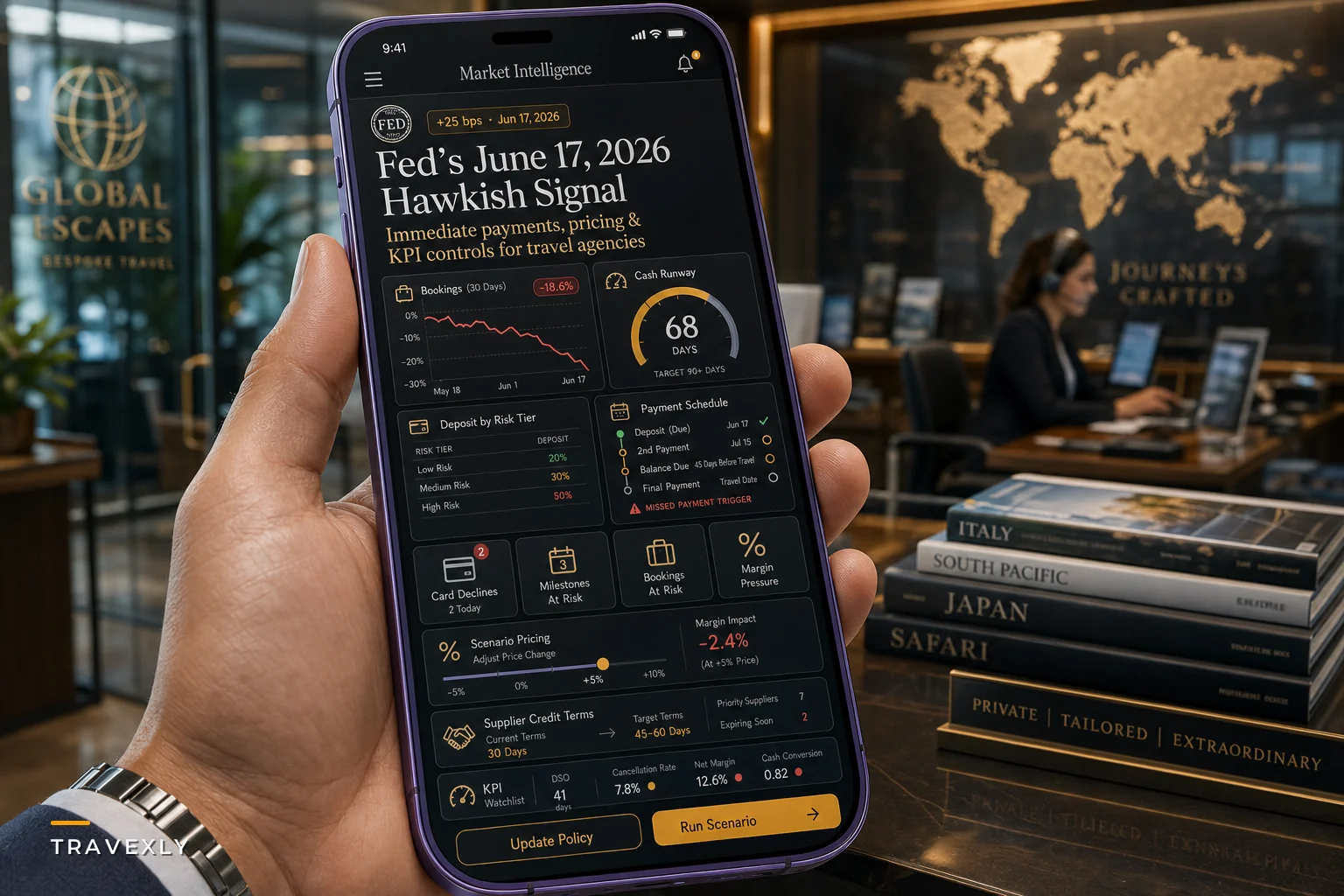

The Federal Reserve held rates steady yesterday but signaled at least one hike coming later this year. According to Reuters, the new Fed leadership under Warsh is taking a hawkish stance on inflation expectations. For travel agencies, this creates an operational problem that starts with your current bookings and compounds through peak booking season.
Clients who booked August and September trips made those decisions when they felt financially comfortable. Now they're watching credit card rates climb, home equity lines get more expensive, and monthly budgets tighten. The cancellations haven't started yet—but they will. And when they do, agencies with loose payment policies will watch their summer cash flow evaporate.
It runs deeper than cancellations, though. Every booking you're taking right now carries hidden risk. Clients are stretching payment plans, asking for more flexible terms, quietly shopping around even after putting down deposits. Meanwhile your supplier obligations stay rigid. Hotels want their guarantees. Airlines don't negotiate deadlines. Tour operators demand their cuts on schedule.
Why standard deposit structures fail when rates climb
Most agencies run deposit policies built for stable conditions. Take a typical $8,000 European vacation package. Standard practice: 25% down, another 25% at 60 days out, final payment 30 days before departure. Seems fine—until you realize that second payment lands exactly when clients are staring at higher credit card statements.
Payment default rates tend to jump roughly 15–20% for every 50 basis points of rate increases. Not immediate defaults—these are the slow-motion failures where clients miss the 60-day payment, promise to catch up, then stop responding by final payment. By then you've already committed supplier deposits and possibly turned away other bookings.
The math turns ugly fast. Say you're running 45 bookings per month at around $6,500 per package. Even a 10% payment failure rate means roughly $29,000 in expected revenue that doesn't come in—but you've already paid out close to $14,000 in supplier deposits you can't recover. That's your entire operating margin for the month, gone.
Agencies already adjusting are front-loading deposits—40% upfront on packages over $5,000. Yes, it reduces initial conversion. But it filters out clients who are already stretched and protects your cash position when real pressure hits later this year.
The supplier negotiation window closes in about 10 days
Every supplier relationship you have was negotiated under different economic assumptions. Commission structures, payment terms, cancellation policies—all of it assumes a certain level of consumer demand. The Fed's June statement basically invalidated those assumptions.
Eliminate booking chaos and streamline operations.
Travexly helps you manage, confirm, and track travel bookings effortlessly.
- Unified booking management
- Automated client communications
- Team scheduling & itinerary tracking
No credit card required
What happens next: hotels tighten group booking requirements, cruise lines reduce commission rates on new bookings, tour operators shorten payment windows. But there's usually a brief period—roughly two weeks after a Fed announcement—where suppliers haven't fully adjusted their terms. That's your window.
Contact every major supplier today. Not tomorrow. The conversation isn't about negotiating better rates—it's about locking in current terms through at least Q4. Focus on three things:
Commission protection clauses. Get written confirmation that current commission rates hold through December 31st regardless of market conditions. Many suppliers will agree to this if you commit to minimum booking volumes.
Extended payment terms for group bookings. Push for 45-day payment terms instead of 30. That extra 15 days of float matters when client payments start slowing.
Cancellation penalty waivers. Negotiate for one-time waivers if you need to adjust group sizes down by 10–15%. Position it as protecting their inventory from larger last-minute cancellations.
Start with the suppliers where you book the most volume—those conversations will yield the fastest written confirmations.
Agencies waiting until July to have these conversations will find suppliers have already tightened everything.
Building a defensive pricing model that actually protects margins
Traditional agency pricing follows a simple markup formula—cost plus 15–20% depending on service level. That model breaks when consumer spending tightens, because agencies start competing on price and eroding margins exactly when they need them most.
Variable margin rules based on booking risk work better. Here's the framework:
| Booking Type | Standard Margin | Adjusted Margin | Risk Factor |
|---|---|---|---|
| Domestic packages under $2,000 | 15% | 18% | Low cancellation risk, quick payment |
| International packages $2,000–5,000 | 18% | 22% | Medium risk, standard payment terms |
| Luxury packages over $5,000 | 20% | 26% | High cancellation risk, extended payments |
| Group bookings (10+ travelers) | 22% | 28% | Complex logistics, payment coordination |
| Last-minute bookings (under 30 days) | 12% | 15% | Lower risk, immediate payment |
Clients booking expensive, complex trips right now are the most likely to face payment pressure later. They need to carry higher margins to offset that default risk. Last-minute domestic bookings, on the other hand, actually become more attractive—immediate payment, minimal cancellation exposure.
Some agencies resist variable pricing because it feels complicated to explain internally. But you're either adjusting prices now or eating losses in September when the failures hit. There's no middle option.
Creating payment triggers that catch problems before they explode
The difference between agencies that survive rate hikes and those that don't usually comes down to early warning systems. Most agencies don't know they have a payment problem until the client has already missed two payments. By then, recovery rates drop below 40%.
Set up these monitoring triggers:
-
3-day payment delay trigger. Any client who misses a scheduled payment by 3 days gets a phone call. Not an email—a phone call. The conversation isn't about the missed payment; it's about "checking in on your trip planning." Most problems surface here before they spiral.
-
Credit card decline pattern. When a stored card declines, most agencies just send a payment link. Two declines within 10 days signals financial stress. Move that booking to high-risk status immediately and require cleared payment before any further supplier commitments.
-
Communication frequency drop. Track email open rates and response times by client. When an engaged client suddenly stops opening emails or takes several days to respond, that's often a leading indicator of buyer's remorse or financial pressure. Proactive outreach here saves bookings.
-
Modification request patterns. Clients requesting multiple itinerary changes—especially downgrades—are signaling budget concerns. Don't just process the changes; restructure the entire payment plan to make sure you're covered.
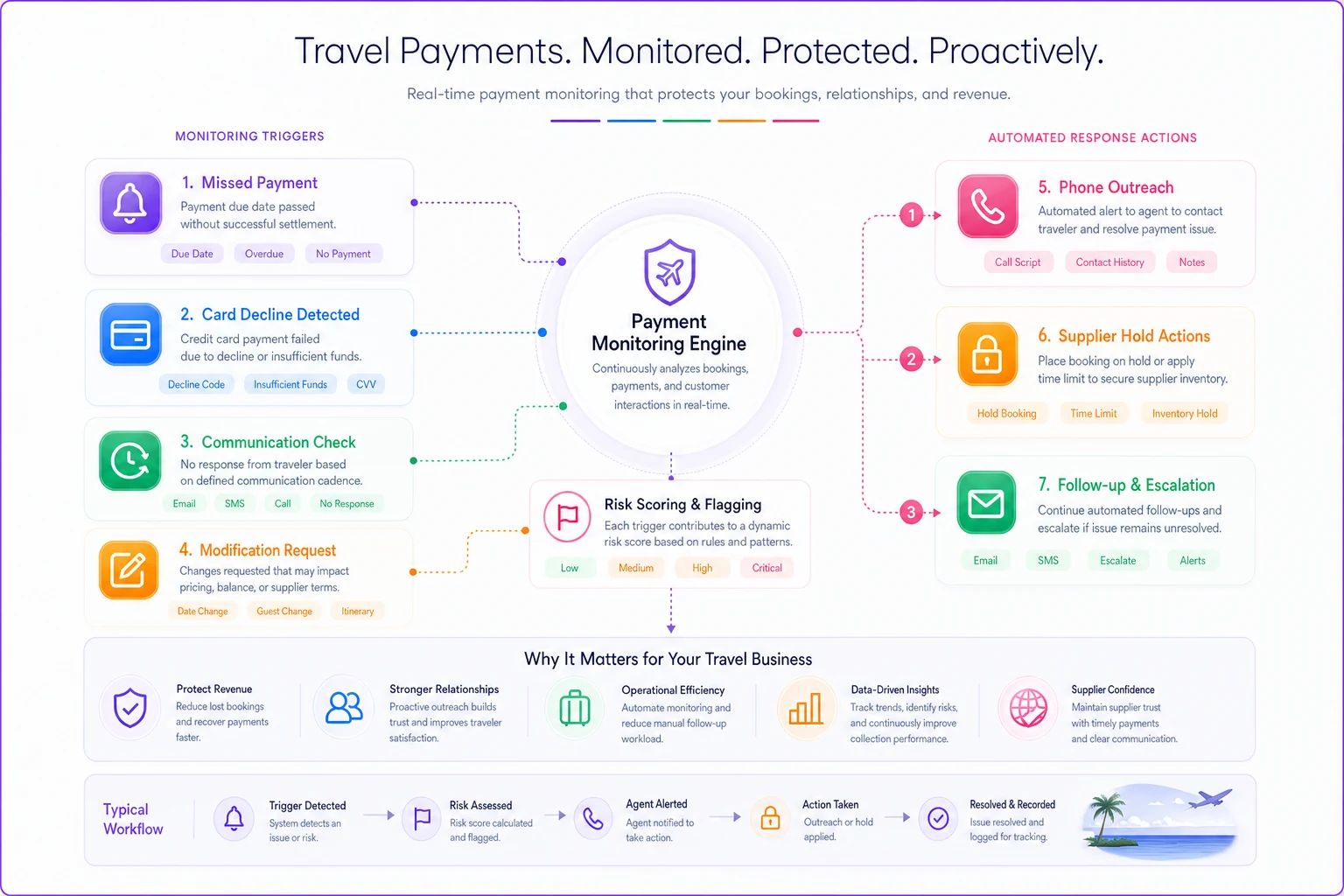
The image above shows how triggers feed into operational steps to contain risk early.
One agency that implemented these triggers caught around two-thirds of potential defaults before the first missed payment. Their actual loss rate stayed below 3% while competitors were seeing 15%+ default rates. Small operational changes, real financial difference.
The commission reconciliation sprint you need to run this week
Every agency has commission leakage. When margins compress, those small leaks become floods. The Fed announcement makes this a reasonable week to run a full audit because suppliers haven't adjusted their systems yet.
Start with your highest-volume suppliers. Pull every booking from the last 90 days and match it against commission statements. Look for:
-
Packages where you sold add-ons but only received base commission. This happens constantly with cruise lines—you sell the beverage package and excursions but only get commissioned on the cabin.
-
Group bookings where individual traveler commissions weren't aggregated. If you booked 12 people but the supplier system processed them separately, you might be missing group bonus commissions worth 2–3% extra.
-
Cancelled bookings where you provided replacement travelers. Many supplier systems don't properly track when you save a booking by finding a replacement. That saved revenue should still generate commission.
-
Rate changes after booking where commission didn't adjust. If a client upgrades their room after initial booking, the commission should increase proportionally. Most of the time, it doesn't get updated automatically.
A typical agency doing 40 bookings a month finds somewhere between $3,000 and $4,000 in missing commissions per quarter. Not huge money on its own, but when cash flow tightens, it matters a lot more than it used to.
Restructuring cancellation policies before the wave hits
Your current cancellation policy was probably written when clients rarely cancelled. That's about to change. The agencies that hold up over the next 12 months will be the ones that fix their policies now, before clients start testing every loophole.
The partial refund trap. Most agencies offer sliding-scale refunds based on cancellation timing—75% back if they cancel 60+ days out, 50% at 30–60 days. This sounds fair until you realize you're eating supplier penalties plus losing your margin. Every partial refund is effectively a money-loser.
Structure refunds as future travel credits with expiration dates instead. Client cancels 60 days out? They get 100% credit toward a new booking made within 6 months. Revenue stays in your pipeline. No cash refunds draining your working capital.
The insurance gap. Stop treating travel insurance as an optional add-on. For any booking over $3,000, position it as part of the package price with an explicit opt-out required. When clients decline, get it in writing with acknowledgment that cancellations forfeit all payments.
The group booking domino effect. One cancellation from a group can trigger a cascade. Your policy needs specific language about how group pricing adjusts when headcount drops. If a group of 10 shrinks to 8, the per-person price increases by a defined amount. Make this clear upfront, not after the first cancellation rolls in.
For deeper strategies on structuring these policies, check out our detailed guide on deposits and payment schedules.
Technology fixes that actually matter right now
When cash flow tightens, manual processes hurt agencies—not because they're slow, but because they hide problems until it's too late. Agencies managing well in this environment tend to have a few specific systems in place.
Automated payment monitoring. Every scheduled payment should trigger automatic follow-ups if missed. Not generic emails—messages that reference the specific trip and next steps. Automation handles the volume while you handle the actual problem clients.
Real-time margin tracking. Most agencies calculate margins monthly. That's too slow when conditions shift weekly. You need daily visibility into margin by booking type. When luxury booking margins drop below 22%, you know immediately to adjust pricing rather than finding out six weeks later.
Commission reconciliation workflows. Matching supplier statements to bookings manually takes forever and misses discrepancies. AI-assisted reconciliation can flag mismatches automatically, turning what used to be a week-long project into a two-hour review. When you need every dollar of owed commission, that time difference matters.
The operational software platforms that actually help here don't just track numbers—they create workflows that force action. Payment missed? Task created for a follow-up call. Margin below threshold? Pricing rules update. Commission discrepancy found? Supplier contact drafted and ready to send. The value isn't the automation itself—it's that nothing falls through the cracks when you're dealing with 40 active bookings and a tightening market.
What happens next: the 90-day sprint
The next three months will determine which agencies come out ahead and which spend 2027 recovering. Here's a practical execution timeline:
-
Week 1 (now)
Audit current bookings for payment risk. Contact suppliers to lock in terms. Implement payment monitoring triggers.
-
Weeks 2–3
Restructure deposit and cancellation policies. Update booking forms and marketing materials. Train staff on new policies and risk indicators.
-
Weeks 4–6
Run full commission reconciliation. Negotiate recoveries with suppliers. Implement automated monitoring systems.
-
Weeks 7–12
Monitor leading indicators daily. Adjust pricing based on actual margin performance. Build cash reserves from recovered commissions and improved payment capture.
Agencies that work through this list will enter fall booking season with stronger margins, better cash positions, and lower exposure. The ones that wait will spend the fall playing catch-up while dealing with payment failures and supplier pressure at the same time.
Operating through uncertainty
Rising rates don't kill travel agencies—poor cash flow management does. The Fed's signal gives you roughly 10–12 weeks before the full impact reaches consumer spending. That's enough time to build a stronger operational foundation, but only if you start moving this week.
The changes outlined here aren't permanent pivots. They're defensive positions that let you operate profitably while others struggle. When conditions improve, you can selectively relax policies. But agencies that don't adapt now won't be around to benefit from the recovery.
Focus on what you actually control: payment terms, supplier agreements, pricing rules, and operational efficiency. Agencies that consistently nail these four areas outperform regardless of the rate environment. The current pressure just makes the gap more visible.
The summer of 2026 will separate operationally solid agencies from those running on momentum. Make sure you're in the right group.
Ready to elevate your travel agency workflow?
Join 1,200+ travel agencies using Travexly to save time, improve client satisfaction, and boost operational efficiency.