

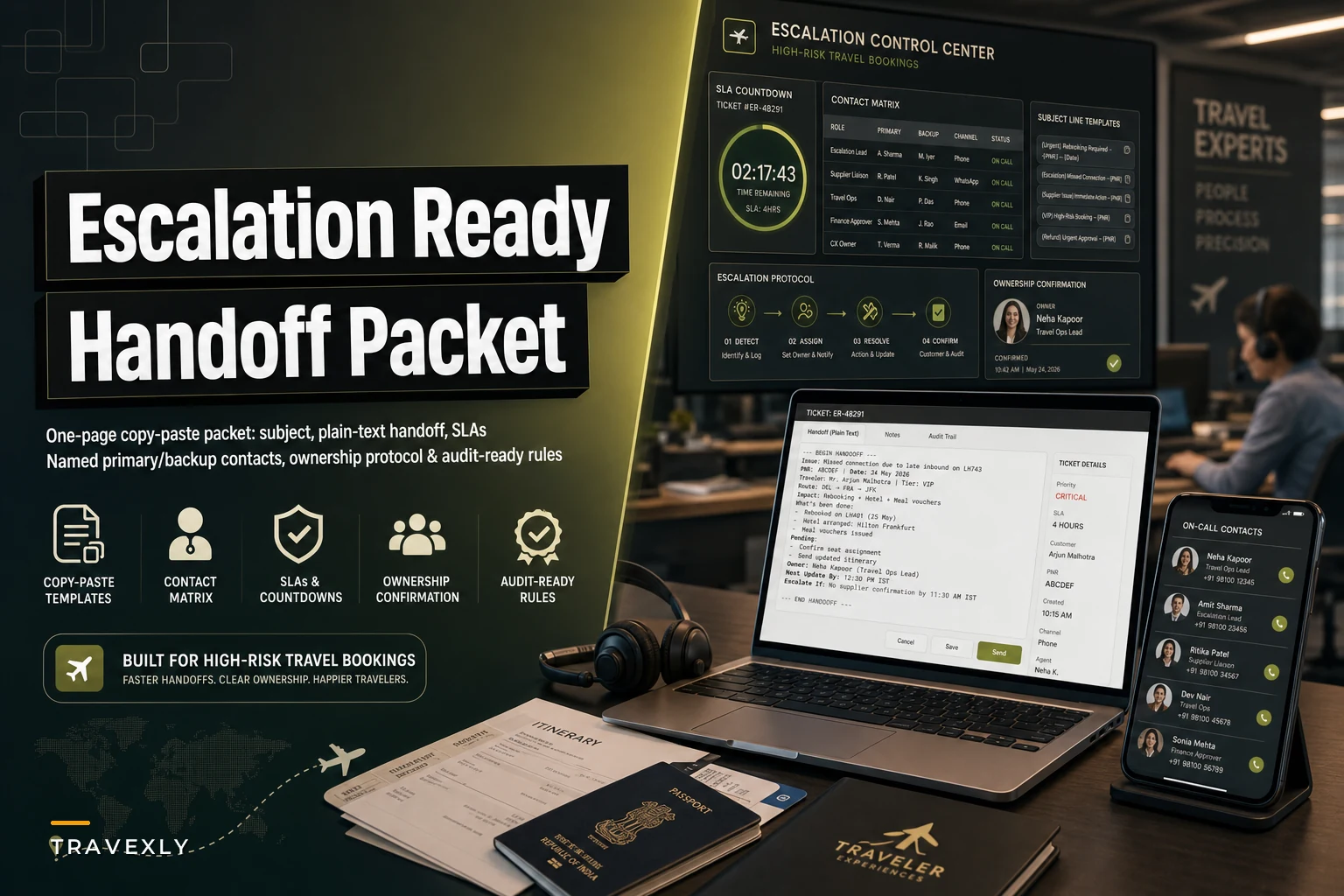

Most escalation failures in travel agencies don't happen because someone ignored a problem. They happen because the person who found the problem didn't know who to send it to, what to include, or how long to wait before assuming nobody saw it. The booking sits in limbo while a junior agent refreshes their email and a customer stands at an airport counter with no flight.
If you've already built out the when-to-escalate rules — and if you haven't, the one-page escalation protocol covering when junior agents must loop in seniors is worth reading first — this piece is the mechanical layer underneath it. The protocol tells people when to escalate. This packet tells them exactly how, in a format they can copy, paste, and send without thinking.
The whole thing is designed to fit on one page or one shared doc. No training required. A new hire on their third day should be able to run it correctly under pressure.
Why handoffs break even when the protocol is good
A travel agency with a solid escalation policy can still lose a booking because the handoff itself is unstructured. Here's the pattern:
A junior agent realizes a supplier cancelled a confirmed hotel for a four-room family booking departing in 36 hours. They know they should escalate. So they Slack their team lead: "hey the Marriott thing cancelled, what do I do?"
That message is useless. No booking ID. No customer name. No severity. No deadline. The team lead has to reply with five questions before they even understand the situation. Multiply that by three back-and-forth messages and you've burned 20 minutes on clarification before anyone touches the actual problem.
The fix isn't "communicate better." That's not enforceable. The fix is a standard packet that forces the right fields into every escalation, every time, so the receiving person can act on the first read.
The escalation contact matrix
The first thing that fails after hours is figuring out who to even contact. Put this at the top of the packet and keep it specific — names, not roles. A role like "duty manager" is meaningless at 2am when the person reading it doesn't know who that is this week.
Eliminate booking chaos and streamline operations.
Travexly helps you manage, confirm, and track travel bookings effortlessly.
- Unified booking management
- Automated client communications
- Team scheduling & itinerary tracking
No credit card required
| Severity | Primary contact | Method | Backup contact | After-hours on-call |
|---|---|---|---|---|
| SEV1 (traveler stranded, duplicate charge >$2k, legal/safety) | Priya N. | Phone call → then WhatsApp | Marcus T. | On-call rota phone: +1-555-0142 |
| SEV2 (confirmed booking broken, departure <72h) | Marcus T. | Slack #escalations + tag | Priya N. | On-call rota phone: +1-555-0142 |
| SEV3 (booking issue, departure >72h) | Team lead (Dana) | Slack #escalations | Marcus T. | Next business day |
| SEV4 (admin/billing, no travel impact) | Team lead (Dana) | Ticket only | — | Next business day |
A few things that make this matrix actually work:
-
For SEV1, the method is a phone call first. Not a message. People miss messages. You don't escalate a stranded traveler into a Slack channel and hope. You call, and then you leave the written trail.
-
The on-call number is a single rotating line, not a person's cell. Whoever's on call that week forwards it to their phone. When someone leaves the company, you don't have to rewrite the packet.
-
There's always a named backup. Primary doesn't answer within the acknowledge window? Go to backup immediately. No waiting, no guessing.
A common mistake: agencies list the contact matrix but never define what happens when the primary doesn't pick up. That gap is where SEV1s die. Make the backup escalation explicit and non-negotiable.
Ticket subject and metadata standard
Every escalation gets a subject line in exactly this format:
``
ESCALATION | [Severity] | [BookingID] | [Customer]
``
Real example:
``
ESCALATION | SEV2 | BK-48213 | Harrington family (4 pax)
``
This sounds trivial. It isn't. When your escalations channel has 14 threads on a disrupted travel day, a scannable subject standard is the difference between finding the stranded traveler in three seconds versus scrolling through walls of text. Severity leads so the eye catches it. Booking ID follows so anyone can pull the record instantly.
Enforce it. If a ticket comes in without this format, the standard response is: "Reformat the subject and resubmit." It feels harsh for about a week, then it becomes muscle memory and your whole queue becomes readable.
The machine-copyable handoff packet
This is the core of the whole thing. Plain-text fields, no formatting, designed to be pasted directly into a ticket or message. The junior agent fills the blanks and sends. Nothing to interpret.
``
--- ESCALATION HANDOFF ---
SEVERITY:
BOOKING ID:
CUSTOMER NAME:
TRAVELERS (count/names):
DEPARTURE DATE/TIME:
HOURS TO DEPARTURE:
WHAT BROKE:
WHEN DISCOVERED:
SUPPLIER INVOLVED:
MONEY AT RISK ($):
WHAT I ALREADY TRIED:
WHAT I NEED FROM YOU:
CUSTOMER TOLD (y/n + what):
ATTACHMENTS (redacted? y/n):
--- END ---
``
The two fields that matter most and get skipped most often are WHAT I ALREADY TRIED and WHAT I NEED FROM YOU.
Require 'WHAT I ALREADY TRIED' and 'WHAT I NEED FROM YOU' to be completed before any senior is paged, it saves immediate back-and-forth.
Without "what I already tried," the senior wastes time suggesting things the junior agent did 20 minutes ago. Without "what I need from you," the escalation is just a complaint — the receiver doesn't know if you want a decision, an approval, or someone to take over entirely.
A filled example:
``
--- ESCALATION HANDOFF ---
SEVERITY: SEV2
BOOKING ID: BK-48213
CUSTOMER NAME: Harrington family
TRAVELERS (count/names): 4 — R. Harrington +3
DEPARTURE DATE/TIME: 14 Mar, 06:40
HOURS TO DEPARTURE: ~34
WHAT BROKE: Supplier cancelled 2 of 4 hotel rooms, no notice
WHEN DISCOVERED: 13 Mar, 20:15
SUPPLIER INVOLVED: HotelBeds / property direct
MONEY AT RISK ($): ~$1,900 rebook gap
WHAT I ALREADY TRIED: Called supplier line (closed), checked
  live availability — only 1 comparable room left in area
WHAT I NEED FROM YOU: Approval to book 2 rooms at alt property
  (~$340 over budget) OR decision to rebook all 4 together
CUSTOMER TOLD (y/n + what): N — holding until I have options
ATTACHMENTS (redacted? y/n): Y — supplier email, card redacted
--- END ---
``
A senior reading that can make a decision in under a minute. That's the entire point.
This diagram shows the typical flow: junior spots issue → fills the handoff packet → routes to on-call senior with SLA timers visible.
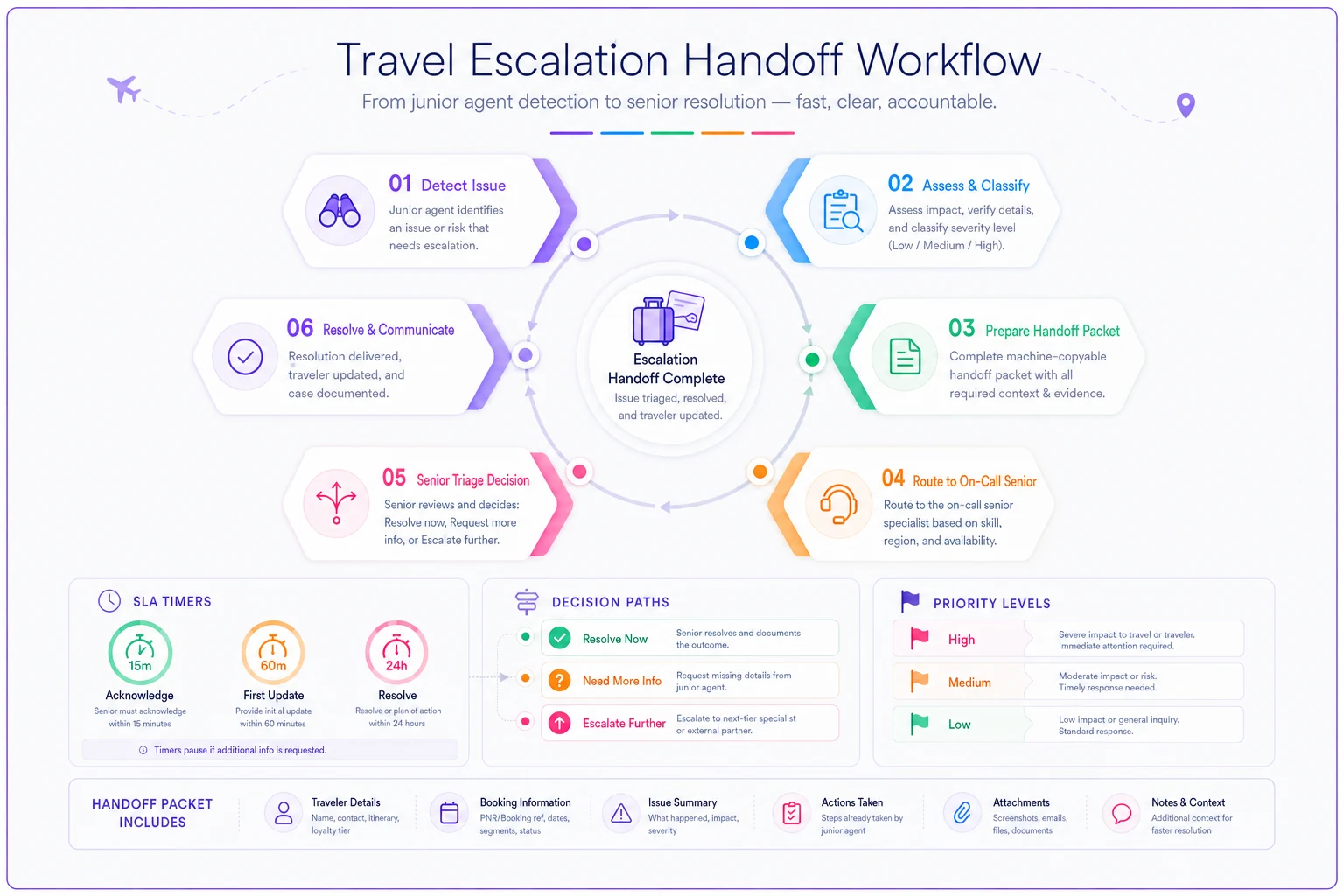
Keep the flow visually simple: detection → packet → acknowledge → take-ownership → resolve.
SLA table: Acknowledge vs Take-Ownership vs Resolve
The biggest source of dropped escalations is confusing acknowledgement with ownership. Someone replies "got it, looking into it" and both parties assume it's handled — but nobody actually took ownership, so it drifts.
| Severity | Acknowledge | Take-Ownership | Resolve (or next-step plan) |
|---|---|---|---|
| SEV1 | 10 min | 20 min | 2 hours |
| SEV2 | 30 min | 1 hour | 6 hours |
| SEV3 | 2 hours | 4 hours | 1 business day |
| SEV4 | 1 business day | 1 business day | 3 business days |
Definitions that need to be non-negotiable:
-
Acknowledge = "I've seen this and I'm aware." Nothing more. Buys time but commits nothing.
-
Take-Ownership = "This is now mine. I am the single person accountable for the next action." One name. Not a channel, not a team.
-
Resolve = problem fixed, OR a concrete plan with a committed timeline communicated to the customer.
Skipping the middle step — Take-Ownership — is exactly where escalations stall. Acknowledgement without ownership is how a SEV2 sits for four hours with everyone assuming someone else grabbed it.
Decision-authority (monetary) matrix
The second thing that stalls after-hours escalations is money approval. A junior agent can't rebook a stranded family because they don't know if they're allowed to spend $340 without sign-off, and the person who can approve is asleep.
| Action | Junior agent | Team lead | Ops manager | Owner / Director |
|---|---|---|---|---|
| Goodwill waiver / fee | up to $50 | up to $250 | up to $1,000 | above $1,000 |
| Refund (within policy) | up to $150 | up to $750 | up to $3,000 | above $3,000 |
| Emergency rebook over budget | — | up to $500 | up to $2,500 | above $2,500 |
| Discretionary refund (outside policy) | — | — | up to $1,000 | above $1,000 |
The key design choice: give the on-call team lead enough authority to handle most real emergencies without escalating money up the chain. If the majority of stranded-traveler rebookings land under $500, your team lead should be able to approve that alone at midnight. Nobody should be waking the owner to approve a $280 hotel swap.
One caveat: these bands only work if they're logged. Authority without an audit trail turns into "I thought I was allowed" arguments later. Which brings us to the log.
Escalation audit log template
Every escalation, regardless of severity, gets one row. This protects you in disputes, in chargebacks, and when you're trying to figure out why the same supplier keeps causing SEV2s.
``
DATE/TIME | BOOKING ID | SEVERITY | RAISED BY | OWNED BY |
MONEY APPROVED ($) | APPROVED BY | TIME TO ACK | TIME TO RESOLVE |
OUTCOME | NOTES
``
Keep it in one shared sheet. Don't overthink the tooling. The value isn't in a fancy system — it's in the discipline of logging every single one, including the ones that resolved quickly. The fast ones are your baseline; without them you can't tell when things are degrading.
Reviewing this monthly surfaces patterns a single incident never would. If three of your last eight SEV2s trace back to the same supplier cancelling confirmed inventory, that's not an escalation problem anymore — that's a supplier conversation.
Customer holding and triage scripts
While the escalation is in flight, the customer can't be left in silence. Give agents short, pre-approved scripts so they're not improvising reassurance that commits the agency to something it can't deliver.
Initial holding (customer aware of a problem): > "I've flagged this directly with our senior team and someone is working on it right now. I'll have concrete options for you within [timeframe]. You don't need to do anything on your end yet — I'll come to you."
Triage, cause not yet known: > "I'm confirming the details with the supplier so I give you accurate information rather than a guess. Expect an update from me by [specific time]."
Buying time on a SEV1: > "You're my priority right now. I'm on this and will call you back by [time] with a plan, even if it's just the next step."
Two rules that keep these scripts safe: always give a specific callback time, never "soon" — and never name a dollar figure or resolution before it's approved. "We'll refund you" said by a junior agent who then can't deliver creates a worse dispute than the original problem.
PII handling and redaction rules
Escalations are probably the most common place where card numbers and passport details end up in channels they shouldn't be in. Someone screenshots a supplier email with a full card number and drops it into a Slack thread so the senior can "see everything." Now you've got cardholder data sitting in a chat app indefinitely.
-
Never paste full card numbers. Last 4 digits only, always. Everything else redacted before it leaves the secure booking record.
-
Passport and ID numbers get masked except the last 3 characters when they must be referenced at all.
-
Redact before attaching, not after. "I'll delete it later" doesn't survive a disputed chargeback six months out.
-
The handoff packet has an
ATTACHMENTS (redacted? y/n)field for exactly this reason — if it says N, the receiver sends it back. -
Prefer linking to the secure record over attaching anything. The senior opens the booking system where access is controlled, instead of a copy floating in a thread.
A practical habit that sticks: train agents to redact at the moment of screenshotting, not as a separate step. The separate step gets skipped under pressure almost every time.
Auto-flagging triggers: a compact implementation checklist
The last piece is reducing the human judgment call about whether something should be escalated. If your booking system can flag high-risk conditions automatically, your junior agents stop having to decide — the flag decides for them, and they just run the packet.
-
[ ] Any confirmed booking where supplier status changes to cancelled/modified
-
[ ] Departure within 72 hours AND an open ticket on that booking
-
[ ] Any duplicate charge or refund over your SEV1 money threshold
-
[ ] A booking with no supplier confirmation received within X hours of payment
-
[ ] Any booking flagged "VIP" or "complex/multi-pax" with an open issue
-
[ ] Payment failure on a deposit for a departure inside 14 days
-
[ ] A customer message containing keywords like "stranded," "chargeback," "refused," "no room"
Each trigger should do one thing: drop a pre-formatted escalation ticket into the queue with the subject standard already applied and as many packet fields auto-populated as possible. The agent reviews, fills the human-judgment fields, and routes it. That removes the two slowest steps — noticing and formatting — without taking judgment out of the loop entirely.
This is also where AI-assisted operational software can quietly earn its keep. Tools that monitor booking status changes in real time and auto-generate a draft escalation packet when a flag fires aren't replacing the agent's judgment — they're just making sure the flag actually gets raised, even on a Saturday night when nobody's actively watching the queue. The agent still owns the decision. The software just handles the detection and the paperwork.
A real scenario
A mid-sized leisure agency — around a dozen agents, roughly 300–350 bookings a month — kept losing time on after-hours escalations. Their average time from "junior agent spots a broken confirmed booking" to "senior actually takes ownership" was over two hours on weekends, mostly burned on back-and-forth clarifying messages and figuring out who was allowed to approve a rebook.
They didn't change their escalation policy at all. They just implemented the packet: fixed subject standard, plain-text handoff fields, and monetary authority bands so the on-call lead could approve rebooks up to $500 without waking anyone.
Within about two months, their weekend take-ownership time dropped to under 40 minutes for most SEV2s. The single biggest contributor wasn't technology — it was the authority matrix. Roughly four out of five emergency rebooks fell under the team lead's $500 band, so the overnight bottleneck of waiting for owner approval largely disappeared. The audit log also surfaced that one supplier was behind a disproportionate share of their SEV2s, which eventually led to a renegotiated inventory agreement.
Putting it to work
Don't roll this out as a training session. Roll it out as a pinned document and a rule: no escalation gets actioned unless it uses the packet. The format forces the behavior, and the behavior becomes automatic within a few weeks.
Start with the contact matrix and the monetary authority bands — those two solve the after-hours stalls that cause the most customer damage. Add the handoff packet template next. Layer in the audit log and auto-flags once the basics are muscle memory.
The goal isn't to add process for its own sake. It's to make sure that when a confirmed booking breaks 34 hours before departure, the right person is already acting on it before the customer ever has to wonder whether anyone noticed.
The goal isn't to add process for its own sake. It's to make sure that when a confirmed booking breaks 34 hours before departure, the right person is already acting on it before the customer ever has to wonder whether anyone noticed.
Ready to elevate your travel agency workflow?
Join 1,200+ travel agencies using Travexly to save time, improve client satisfaction, and boost operational efficiency.