


When a cut fiber line in New Jersey pulled down FAA communications on Sept. 21, 2026, the ripple hit travel agencies almost before it hit the airlines. By the time Reuters reported the ground stops across the Northeast, agency phones were already lighting up — clients stuck on tarmacs, missed connections to cruise embarkations, group tours with half the party grounded in Newark.
The outage itself was resolved within hours. That's not the part that hurt agencies. The part that hurt was everything after: the rebooking scramble, the refund requests, the supplier claims, and the slow erosion of client trust when nobody picked up fast enough.
This isn't a post about the FAA. It's about what an event like this exposes in how most agencies handle mass disruption — and the specific moves that separate the agencies clients forgive from the ones clients quietly leave.
What breaks first (and it's not what you think)
Most owners assume the bottleneck during a mass delay event is rebooking capacity. It isn't. The first thing that breaks is triage.
When 60 clients are affected at once, agents instinctively work the queue in the order calls come in. That's the wrong order. The client with a flight tomorrow morning and the client whose cruise departs in four hours get treated identically, and the four-hour window closes while an agent is calmly rebooking someone who had plenty of slack.
The failure pattern is predictable: the loudest clients get served first, the most time-sensitive clients get served last, and the ones with the biggest financial exposure — non-refundable land arrangements, cruise no-show penalties — end up writing the angry reviews.
A USA Today report on the outage noted how quickly delays cascaded across connected hubs. For an agency, that cascade means your affected-client list isn't static — it grows for hours after the initial event. If your first move isn't segmenting by deadline risk, you're already behind.
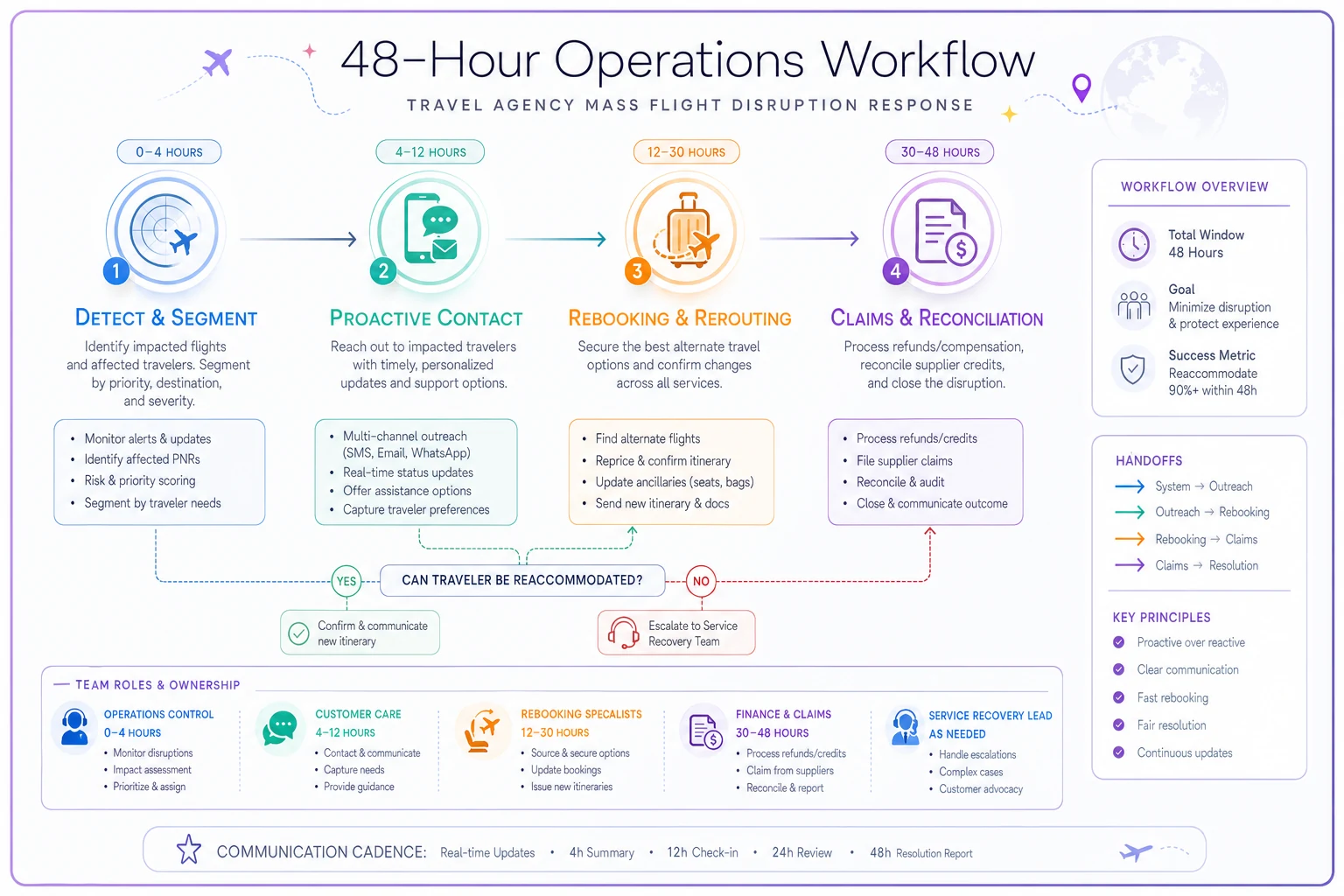
The 48-hour timeline, broken into what matters when
The mistake is treating all 48 hours as one continuous panic. Each phase has a different job.
Eliminate booking chaos and streamline operations.
Travexly helps you manage, confirm, and track travel bookings effortlessly.
- Unified booking management
- Automated client communications
- Team scheduling & itinerary tracking
No credit card required
| Phase | Window | Primary job | What goes wrong if you skip it |
|---|---|---|---|
| Detect & segment | 0–2 hrs | Identify affected bookings, rank by deadline risk | Serving low-urgency clients first |
| Proactive contact | 2–6 hrs | Reach clients before they reach you | Inbound volume buries your team |
| Rebooking & rerouting | 6–24 hrs | Secure alternatives, protect downstream bookings | Clients self-rebook and break your supplier chain |
| Claims & reconciliation | 24–48 hrs | Document everything for refunds and commission recovery | You eat costs suppliers should cover |
The reconciliation phase is the one everyone underinvests in, and it's where the margin damage hides.
Here's a quick visual of the 48-hour ops workflow.
Phase 1: Detect and segment (0–2 hours)
The agencies that handle this well have a pre-built query ready to run: show me every active booking touching the affected airports in the next 72 hours. If you're building that list by scrolling your booking system manually during a crisis, you've already lost an hour you didn't have.
-
Critical downstream connection or non-refundable event within 24 hours (cruise, tour start, non-refundable hotel night, visa appointment)
-
Urgent affected flight within 48 hours, flexible downstream
-
Monitor affected but with meaningful slack, or clients who may self-resolve
Work critical to monitor. Always.
Phase 2: Proactive contact (2–6 hours)
This is the single highest-leverage move in the entire playbook, and most agencies get it backward. They wait for clients to call, then drown.
The math is simple. One proactive message — "We're aware of the FAA disruption affecting your flight. We're already working on options and will update you by 3pm. You don't need to call us." — kills three or four inbound calls per client. Across 60 affected clients, that's the difference between a manageable afternoon and a total queue collapse.
Use a short template with a fixed next-update time to cut repeat inbound calls.
The message doesn't need to contain a solution yet. It needs acknowledgment and a next-update time. Clients who know someone is on it stop dialing. Clients who hear nothing call every twenty minutes.
Phase 3: Rebooking and rerouting (6–24 hours)
Two rules here save the most money.
First, don't let clients self-rebook on anything connected to a supplier arrangement you control. When a stranded client books their own replacement flight out of frustration, they often break the fare rules on the rest of the itinerary, void a connecting supplier's terms, or trigger a no-show that cancels downstream components. You end up rebuilding a booking that didn't need rebuilding.
Second, protect the downstream before you fix the flight. If a client misses a flight, the flight is replaceable. The non-refundable tour that starts tomorrow may not be. Call the land supplier, explain the disruption, and negotiate a hold or late arrival before the no-show penalty triggers. Suppliers are far more flexible during a documented mass-disruption event than on a normal day — but only if you reach them inside the window.
Phase 4: Claims and reconciliation (24–48 hours)
This is the unglamorous phase that decides whether the outage costs you money or just costs you a hard day.
-
Which booking was affected
-
What the original cost and commission were
-
What action was taken and by whom
-
Which supplier owes what, and under which policy
This is exactly the amendment-handling discipline that pays off in ordinary operations too — our deeper breakdown on building an SOP for amendments and supplier cancellations covers the documentation structure that makes crisis reconciliation far less painful.
The margin trap most agencies walk straight into
The pattern is quiet and it's common: the agency, trying to be a hero, eats costs that weren't theirs to eat.
A stranded client is upset. An agent, under pressure, issues a goodwill refund or covers a hotel night to calm things down — without first checking whether the airline's rebooking policy, the client's travel insurance, or the supplier's disruption terms already cover it. Multiply that across dozens of bookings and you've turned an airline's operational failure into your P&L problem.
A realistic version of this: an agency with roughly 45 affected bookings during a disruption. Moving fast, the team issues goodwill credits and absorbs change fees across maybe a third of them to protect relationships. That feels like good service. But if even half of those costs were recoverable from airlines or carrier delay policies and simply never got claimed, you're looking at several thousand dollars left on the table — on an event that wasn't your fault.
The fix isn't to be stingy. It's to know what's recoverable before you give anything away. Goodwill is a tool; it works best when it's a deliberate choice, not a panic reflex.
A short real scenario
A mid-sized leisure agency — the type that runs heavy on cruise and escorted tours — got caught by a Northeast ground stop with around 30 clients in transit to a Caribbean embarkation port.
Their old approach would have been reactive: answer calls as they came, rebook flights one by one, and hope people made the ship. Instead, their ops lead ran the affected-bookings query immediately, flagged the eight clients with embarkation deadlines inside 24 hours as critical, and got proactive texts out to all 30 within the first couple of hours.
The result wasn't magic. Two clients still missed the sailing and had to be rerouted to the first port of call. But because the agency contacted the cruise line early with documented disruption details, the penalty got waived and the reroute was coordinated instead of chaotic. Inbound call volume stayed roughly half of what a similar event had produced the year before — because clients who'd already heard from the agency stopped calling.
The qualitative outcome mattered more than the stats: clients talked about how handled they felt. Two of them sent referrals within the next quarter, specifically citing how the agency managed the mess.
Your 48-hour disruption checklist
Keep this somewhere your whole team can find it in sixty seconds —
-
Run the affected-bookings query (airports × next 72 hours)
-
Segment into Critical / Urgent / Monitor by deadline risk
-
Send proactive acknowledgment to all affected clients with a next-update time
-
Assign a single owner per critical client — no booking sitting in two people's hands
-
Contact downstream suppliers before no-show penalties trigger
-
Block clients from self-rebooking anything tied to a controlled supplier chain
-
Log every action, cost, and supplier commitment in real time
-
Before issuing any goodwill, confirm what's recoverable elsewhere
-
Day 2
file supplier and airline claims while documentation is fresh
-
Day 2
reconcile commission exposure on every amended booking
-
Post-event
hold a 30-minute debrief on what broke and what to pre-build
not buried in a shared drive nobody opens during a crisis.
When proactive outreach is a bad idea
Worth stating, because blanket advice gets agencies in trouble: don't mass-message clients who aren't actually affected just because something is in the news.
If your client's flight is on a carrier or route that's running normally, a "we're aware of the disruption" text just creates anxiety and generates the exact inbound volume you were trying to avoid. The value of proactive contact comes entirely from it being targeted — the right clients, with accurate information. A shotgun blast to your whole list during a news event is how you manufacture a crisis out of a non-event.
The real lesson underneath all of this
Mass flight disruptions aren't rare anymore, and the specific trigger — a cut fiber line this time — barely matters. What matters is that agencies who come through these windows with their reputation intact aren't the ones who worked the hardest or refunded the most. They're the ones whose response was pre-decided before the disruption started.
The difference between a chaotic 48 hours and a controlled one is almost entirely preparation: a ready query, a segmentation rule, a proactive message template, a documentation habit. None of it is heroic. All of it is boring. That's precisely why it works — because during a crisis, the last thing you want to be doing is inventing your process.
Write the playbook now, while the airspace is quiet. The next outage won't send a warning.
Ready to elevate your travel agency workflow?
Join 1,200+ travel agencies using Travexly to save time, improve client satisfaction, and boost operational efficiency.