



The worst amendments never come at a convenient time. It's the Friday night text from a client whose grandmother is in hospital, or the supplier email at 6am saying the boutique hotel your honeymoon couple booked "regrets it can no longer honor the reservation." By the time you're properly awake, the client is already awake too, refreshing their inbox.
What separates agencies that handle these cleanly from the ones that lose money and sleep isn't experience or instinct. It's having a documented last minute booking change SOP that removes guesswork in the exact moment your judgment is worst — tired, rushed, and being pushed by an anxious client. The agencies that struggle treat every last-minute change as a fresh crisis. The ones that stay calm have already decided, in advance, what happens in each scenario.
This isn't about writing a giant manual. It's about three things: a severity tier so you know how fast to move, a refund-vs-rebook decision tree so you stop debating it live, and scripts you can send in under two minutes so nobody's waiting.
Why last-minute changes turn into chaos (and it's not the client's fault)
The chaos rarely comes from the change itself. It comes from the delay between the change happening and someone deciding what to do about it.
A supplier cancels. The agent who owns that booking is off-shift. Whoever picks up the phone doesn't know the deposit terms, doesn't know if there's a comparable alternative, and doesn't want to promise a refund they're not authorized to give. So they say "let me check and get back to you." Then they go check. Then they can't reach the supplier. Two hours pass. The client has gone from mildly worried to actively furious — because silence reads as incompetence even when you're working hard behind the scenes.
The other big driver is that refund and rebook decisions get made emotionally under pressure. When a client is upset on the phone, a junior agent will offer a full refund the agency can't actually recover from the supplier — because it feels like the right thing to do. That single call can wipe the margin off two or three other bookings.
In practice, the difference between a $0 loss and a $600 loss on the same cancellation is almost always who handled it and whether they had a rule to follow. Not the situation itself.
Step one: sort every change into a severity tier
Before you decide refund or rebook, you decide how fast this needs to move. Not everything is a five-alarm fire, and treating a minor date shift with the same urgency as a same-day supplier collapse burns your team out.
Eliminate booking chaos and streamline operations.
Travexly helps you manage, confirm, and track travel bookings effortlessly.
- Unified booking management
- Automated client communications
- Team scheduling & itinerary tracking
No credit card required
Three tiers is enough. More than that and people stop using it.
| Tier | Trigger examples | Response window | Who owns it |
|---|---|---|---|
| T1 – Critical | Supplier cancels within 72h of travel; client medical emergency; flight cancellation with no auto-rebook; travel-day no-show by supplier | Acknowledge within 15 min, plan within 1 hour | Senior agent + owner notified |
| T2 – Urgent | Change requested 3–14 days out; partial supplier failure (one component); name correction near ticketing deadline | Acknowledge within 2 hours, resolve same day | Booking owner |
| T3 – Routine | Change requested 15+ days out; preference swaps; upgrade requests; minor itinerary tweaks | Acknowledge same day, resolve within 48h | Any agent |
The tier isn't about how upset the client is. It's about how much time you have before the situation becomes unfixable. A client can be hysterical about a T3 change and completely calm about a T1. Your response speed follows the clock, not the volume of the complaint.
One thing worth building in: a T1 automatically loops in a second person. Not because the first agent can't handle it, but because critical decisions made alone at 6am are where the expensive mistakes happen. If you haven't set a clear line for when junior staff must escalate, T1s become guessing games.
Step two: the refund-vs-rebook decision tree
This is the part most agencies never write down, and it's the part that costs them the most. When something falls apart, the instinct is to ask "should we refund?" — but that's the wrong first question. The right sequence is about recoverability and salvage before you ever touch the client's money.
-
Is the trip salvageable with a comparable rebook? If a supplier cancels but you can substitute a hotel of equal or better standard within budget, rebook first. Most clients want their trip, not their money back. Lead with the solution.
-
Can you recover the cost from the supplier or a waiver? Before promising anything, check whether the cancellation is supplier-caused (they eat it), force majeure (waiver territory), or client-caused (your cancellation terms apply). This determines who absorbs the loss, and it changes what you can offer.
-
Is the client's request driven by emergency or preference? An emergency changes your tone and often your flexibility. A preference change 20 days out gets the standard policy — no exceptions you'll regret later.
-
What's the margin exposure of each path? Rebook usually protects margin. A full refund on a non-recoverable deposit is a direct loss. Sometimes a partial refund plus a credit is the cleanest outcome for everyone.
A quick way to think about the fork:
-
Rebook when the trip dates still work, a comparable option exists, and the client's core intent — the destination, the occasion — is intact.
-
Refund when the reason for travel is gone (cancelled event, medical, bereavement), no acceptable alternative exists, or the recoverable amount makes a refund cheaper than fighting to rebook.
-
Credit/partial when you can't fully recover from the supplier but you want to keep the relationship — offer future credit for the non-recoverable portion instead of cash.
The mistake that comes up constantly: agencies default to refund because it ends the awkward conversation fastest. But a rebook that keeps the client's trip alive is almost always the better outcome for both the client's experience and your margin. Refund is the exit door, not the first option.
When a full refund actually makes sense
-
The client has genuinely lost the reason to travel and a credit would feel tone-deaf (a cancelled wedding, a death in the family).
-
The recoverable amount is high enough that refunding costs you almost nothing.
-
The client has already made up their mind and pushing a rebook just erodes trust.
In these moments, a fast, gracious refund buys you a repeat client and a decent review. Reading which situation you're in is the actual skill — the SOP just makes sure you're choosing deliberately instead of defaulting.
Here's a quick visual of the decision flow.
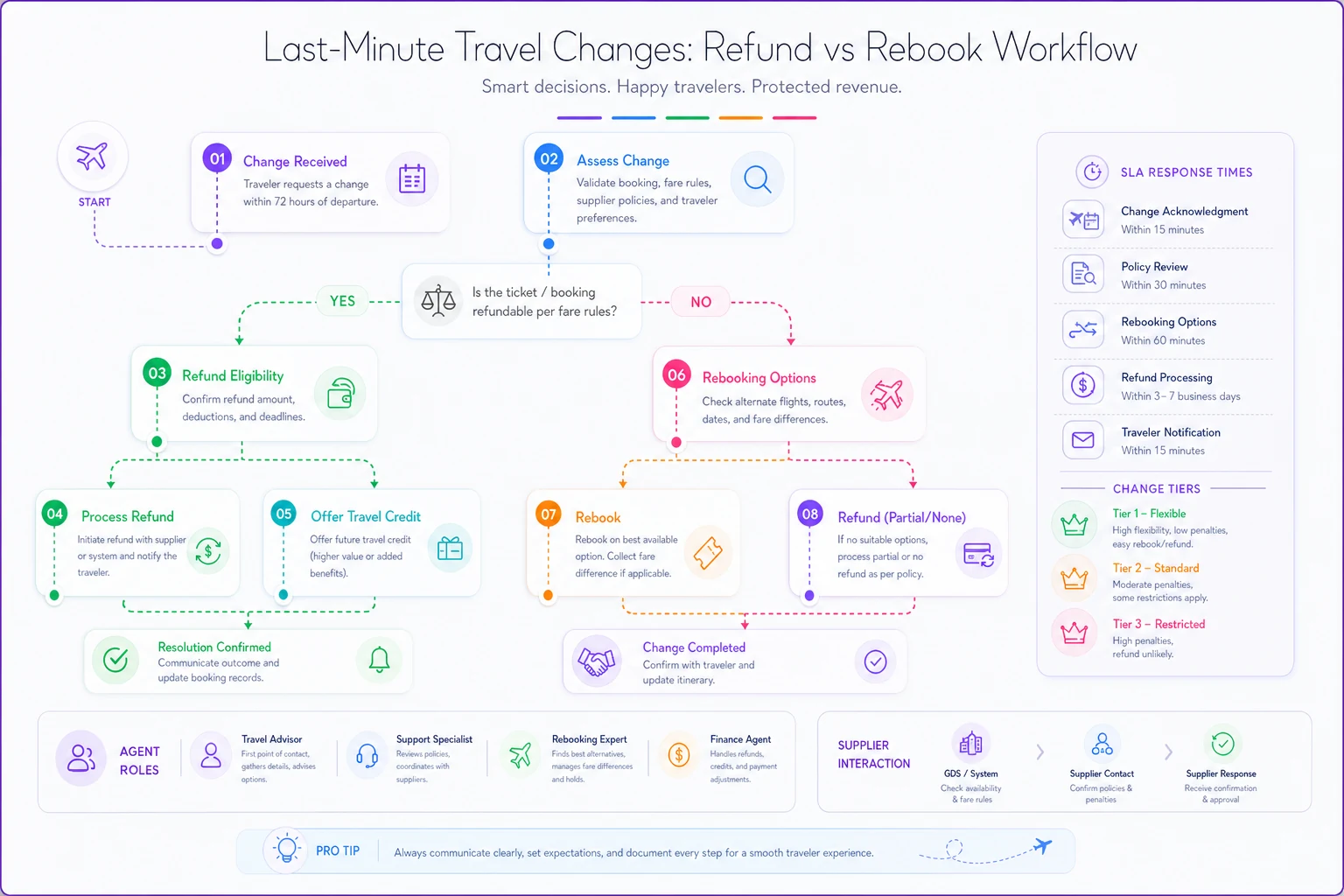
This visual maps the steps above for quick reference.
Step three: SLA timings that keep clients from spiraling
Silence is what turns a manageable problem into a complaint, a chargeback, or a nasty review. Clients forgive problems. They don't forgive being ignored while a problem is happening.
Your SLA doesn't have to promise a solution fast. It has to promise contact fast. There's a big difference. "We're on it and I'll update you by 11am" resets the client's anxiety clock. Every SLA below is about the acknowledgment and the update cadence, not the final fix:
-
T1 First human reply within 15 minutes. Update every 30–45 minutes until resolved, even if the update is "still working on the alternative."
-
T2 First reply within 2 hours. One mid-point update if it'll take more than half a day.
-
T3 First reply same business day. Set expectation for resolution timing in that first reply.
The underappreciated move here is the holding message — a reply that acknowledges, commits to a next-update time, and stops the client from chasing you. Agencies that send holding messages consistently get fewer angry follow-ups, because the client isn't sitting in a vacuum imagining the worst.
Tie holding-message reminders to the booking's SLA timer so on-shift agents get a prompt before the window closes.
If you're already running an SLA-driven operations system, these change-management timings should slot straight into it rather than living as a separate policy nobody remembers.
Ready-to-send scripts
Scripts get judged unfairly. People assume canned messages sound robotic. In practice, a good script that goes out in 90 seconds beats a heartfelt custom message that goes out in two hours. Speed is the empathy here. Keep a few of these saved as snippets so anyone on shift can send them.
Client holding message (T1 — supplier cancellation):
> Hi [Name] — I want to flag something quickly and reassure you we're already on it. [Supplier] has had to cancel [component], but your trip is our priority and I'm sourcing a comparable alternative right now. I'll come back to you with options by [specific time]. Nothing is at risk on your end — leave this with me.
Client rebook offer:
> Good news — I've secured an alternative that I think works well: [option, with a one-line why it's comparable or better]. It keeps your dates and budget as planned. If you're happy, I'll confirm it in the next hour so we lock it in. Any questions, call me directly on [number].
Client refund confirmation (emergency):
> [Name], I'm so sorry you're dealing with this. I've processed the cancellation and you'll see a refund of [amount] within [timeframe]. There's nothing further you need to do. When you're ready to travel again, I'd be glad to help — no rush at all.
Supplier escalation (demanding a waiver or alternative):
> Hi [Contact] — booking ref [X] for travel on [date] has been affected by [cancellation/change on your end]. As this is a supplier-side cancellation within [timeframe], we're requesting [full waiver of cancellation fees / a comparable alternative at no additional cost]. The client travels in [X days], so I'd appreciate confirmation by [time] today. Happy to jump on a call if that's faster.
Supplier — chasing a stalled response:
> Following up on booking [X] — I haven't had a reply and the client travels [date]. I need a resolution by [time] or I'll have to source and rebook elsewhere and reconcile the cost against our account. Please advise urgently.
That last line matters. A soft chase gets ignored. A chase that names a deadline and a consequence gets answered.
A real scenario
A mid-sized leisure agency handling roughly 280–320 bookings a month kept losing money on last-minute supplier cancellations — not because cancellations were frequent, but because the response was inconsistent. Whoever caught the problem made the call, and those calls swung wildly. One agent would rebook and protect the margin; another would refund in full to make the client happy, eating deposits the agency couldn't recover.
Over a quarter they traced around $4k–$5k in avoidable losses to refunds issued when a rebook was available, plus a couple of chargebacks from slow responses — clients who went quiet, then disputed the charge because they assumed nobody was helping.
They put in a three-tier system, the decision tree above, and five saved scripts. Nothing fancy. The change wasn't dramatic overnight, but within two months the pattern shifted: refunds dropped as rebooks became the default first move, and the chargebacks stopped almost entirely because holding messages meant no client was ever left guessing. The owner's rough estimate was that they recovered most of that quarterly leak, and the on-call stress dropped even more than the numbers showed.
The interesting part wasn't the money. It was that the junior agents stopped panicking, because they finally had a rule to follow at 6am instead of a decision to agonize over.
Where this quietly gets easier
None of this requires software to work — a shared doc with the tiers, tree, and scripts will get you most of the way there. But the friction shows up in the moment: the on-shift agent has to find the right script, know the supplier's cancellation terms, and remember to send the next update on time.
That's where an AI-powered operational platform earns its keep. When your booking system already knows the deposit terms and cancellation window for each supplier, tags a change with its severity tier, and nudges the agent when an SLA update is due, the SOP runs itself instead of depending on someone remembering it under pressure. Automated reminders and pre-loaded scripts mean the 15-minute holding message actually goes out at minute 12, not minute 90. The judgment stays human — the follow-through stops slipping.
But start with the paper version. A decision tree taped next to the desk beats the best software nobody's configured yet.
The one thing to take away
Last-minute changes will always happen. What you control is the gap between the change and your response — and whether that response is a considered decision or a panicked guess. Sort by severity so you know how fast to move. Run the refund-vs-rebook tree so you stop deciding emotionally. Send the holding message before the client has time to spiral. Get those three things documented and rehearsed, and the 6am supplier email stops being a crisis and starts being just another thing you handle before your coffee's cold.
Ready to elevate your travel agency workflow?
Join 1,200+ travel agencies using Travexly to save time, improve client satisfaction, and boost operational efficiency.