


Most travel agencies treat their customer database like a phone directory. They blast the same Caribbean cruise offer to everyone, whether that client booked a $30,000 African safari last month or an $800 weekend getaway three years ago. The result? Terrible open rates, annoyed VIP clients, and missed revenue from travelers who would've booked if you'd sent them something relevant.
CRM segmentation for travel agencies isn't about fancy marketing theory. It's about recognizing that the family who books Disney vacations every summer has completely different triggers than the couple who splurges on one anniversary trip every five years. When you segment properly, you stop wasting time on dead-end follow-ups and start generating actual bookings from your existing client base.
The three segments that actually matter for travel agencies
Agencies waste months creating 47 different micro-segments based on destination preference, zodiac sign, and favorite airline. Meanwhile, they're missing the three basic cuts that drive most of their repeat bookings.
Trip type segmentation
Your clients fall into distinct travel patterns that predict future bookings better than any demographic data.
Luxury travelers (trips over $8,000 per person) book differently than everyone else. They plan 6-12 months out, expect white-glove service, and often book multiple trips annually. These clients generate roughly 35-40% of revenue while representing maybe 8% of your database. One agency found their luxury segment averaged $42,000 in annual bookings per household, compared to $3,400 for their general leisure segment.
Family vacation planners cluster around school schedules and predictable destinations — Disney, all-inclusives, cruises. They book the same type of trip repeatedly, usually 4-8 months in advance. What's worth noting: these families often graduate from one trip type to another as kids age. The Disney family becomes the teen adventure family, then the multi-generational cruise family.
Adventure seekers book experiential travel — safaris, expeditions, active tours. Lower frequency (every 18-24 months) but higher margins and solid referral potential. They respond to unique inventory and limited-time expeditions, not generic destination sales.
Business bleisure travelers who mix work and personal travel need different messaging entirely. They book closer-in (2-6 weeks out), care about flexibility, and often upgrade accommodations since "the company is paying for the flight anyway."
Spend tier classification
Raw trip cost tells you less than spending patterns over time. Here's what actually works:
VIP tier ($15,000+ annual spend): These clients fund your business. Usually 5-8% of clients generating 40-50% of revenue. They expect proactive outreach with curated suggestions, not mass emails about deals.
Core tier ($3,000-$15,000 annual spend): Your bread and butter. They book annually or bi-annually, respond well to seasonal campaigns, and appreciate personalized recommendations within their comfort zone.
Opportunistic tier (under $3,000 annual spend): They book when the price is right or for special occasions. Worth nurturing but not worth extensive personalization efforts.
The critical mistake agencies make is treating a client who spent $20,000 on their honeymoon three years ago as a VIP forever. Spend tiers need continuous recalculation based on rolling 24-month windows.
Recency scoring that predicts booking likelihood
A client's last booking date predicts their next booking better than almost any other factor. The drop-off is steep:
-
0-6 months since last booking
34% book again within the next year
-
7-12 months
18% book again
-
13-24 months
7% book again
-
25+ months
under 2% book again
What most agencies miss — recency interacts with trip type. That adventure traveler who booked 18 months ago? Still warm. The weekend getaway client from 18 months ago? Probably gone. Luxury clients maintain higher booking probability even past 24 months, while budget travelers drop off sharply after 12.
Campaign #1: The luxury client reactivation sequence
A real campaign targeting dormant luxury clients (last booking 13-24 months ago, previous spend over $8,000 per person). This segment typically represents 200-400 contacts in a mid-sized agency database but holds significant revenue potential.
Eliminate booking chaos and streamline operations.
Travexly helps you manage, confirm, and track travel bookings effortlessly.
- Unified booking management
- Automated client communications
- Team scheduling & itinerary tracking
No credit card required
Week 1 — The reconnaissance email Subject: "Quick question about your travel preferences" Don't pitch anything. Send a brief email asking about their travel plans for the upcoming year. Include a two-question survey: preferred travel season and bucket list destination. This email typically gets 42-48% open rates because it's clearly not selling anything.
Week 2 — The insider inventory email Subject: "Before this goes public — [Destination they mentioned]" Share exclusive inventory or a new luxury property in their survey destination. Include specific dates, actual availability, and one compelling detail (new safari camp, renovated suite category, exclusive charter). Position it as insider information you're sharing with select clients.
Week 4 — The personalized inspiration package Subject: "Three trips I thought of for you" Present three specific trip ideas based on their travel history. Not generic packages — actual itineraries with dates, properties, and pricing. Include one aspirational option (slightly above their usual spend), one in their comfort zone, and one "quick escape" option.
Week 6 — The social proof nudge Subject: "Where the [Last Names] are traveling this year" Share 2-3 brief stories about similar clients' upcoming trips. "The Johnsons just booked their second African safari, this time focusing on Victoria Falls..." Make it conversational, not promotional. Include a soft CTA about planning their next adventure.
Week 8 — The planning deadline email Subject: "Heads up on 2025 availability" Create urgency with specific inventory warnings relevant to their travel pattern. "Suites at [property they've stayed at] are 70% sold for March-April" or "The migration camps are booking into late 2025 already." End with a calendar link for a planning call.
Expected results across 300 dormant luxury clients:
| Metric | Range |
|---|---|
| Average open rate | 38-45% |
| Click rate | 8-12% |
| Reactivation rate (book within 90 days) | 14-18% |
| Average booking value | $18,000-$24,000 |
| Campaign ROI | ~28:1 |
A real campaign targeting dormant luxury clients (last booking 13-24 months ago, previous spend over $8,000 per person). This segment typically represents 200-400 contacts in a mid-sized agency database but holds significant revenue potential.
Campaign #2: The family vacation upgrade path
This campaign targets families who've booked the same trip type repeatedly — the Disney family, the all-inclusive family, the cruise family. The goal is to introduce them to their next evolution of family travel while maintaining their booking rhythm.
Start with families who've booked two or more similar trips, with kids aging into new trip categories — Disney families with kids approaching 10-12, all-inclusive families with teens.
Month 1 — The transition story email Subject: "When the Andersons graduated from Disney" Share a client story about a family who made the exact transition you're suggesting. Disney to European river cruise. All-inclusive to Costa Rica adventure. Include specific ages of kids, what worked, what surprised them. Make it relatable, not salesy.
Month 1, Week 3 — The comparison guide Subject: "Disney vs Adventures by Disney — what nobody tells you" Send a detailed comparison that acknowledges their current preference while introducing the upgrade. Include honest pros/cons, pricing differences, and which families thrive with each option. This positions you as an advisor, not a salesperson.
Month 2 — The hybrid suggestion Subject: "Best of both worlds for your 2025 trip" Propose a trip that bridges their comfort zone with something new. For Disney families: a cruise with great kids' clubs plus European ports. For all-inclusive families: Costa Rica resort with adventure add-ons. Include specific dates and pricing.
Month 2, Week 3 — The kids' perspective Subject: "What teens actually think about family trips" Address the elephant in the room — keeping older kids engaged. Include quotes from actual teen travelers (anonymized from your client base), Instagram-worthy destinations, and trips that give teens some independence while maintaining family time.
Month 3 — The early booking incentive Subject: "Lock in your spring break before the chaos" Present three specific options for their key travel period (spring break, summer, winter holiday). Include the upgrade option alongside their traditional choice. Add genuine urgency — "Disney's spring weeks are 65% sold" or "Only 2 family suites left on the July sailing."
Expected results across 200 family segment clients:
| Metric | Range |
|---|---|
| Average open rate | 45-52% |
| Conversion to new trip type | 22-26% |
| Traditional rebooking rate | 35-40% |
| Average transaction increase per booking | $2,100-$2,800 |
| Total revenue lift from segment | 18-24% |
This campaign targets families who've booked the same trip type repeatedly — the Disney family, the all-inclusive family, the cruise family. The goal is to introduce them to their next evolution of family travel while maintaining their booking rhythm.
Message cadence rules that prevent unsubscribes
The fastest way to burn your database is wrong frequency. Luxury clients who get daily deal emails will unsubscribe. Budget travelers who hear from you twice a year forget you exist.
VIP clients need quarterly touchpoints maximum, unless they're actively planning. One personal email beats five promotional broadcasts. Set up your CRM to flag any VIP getting more than one mass email monthly — that's your early warning system for relationship damage.
Active planners (inquiry within 30 days) can handle 2-3 touches weekly during the planning phase. But once they book or go quiet, immediately dial back to monthly. The agency that keeps hammering prospects after they've booked elsewhere trains clients to ignore everything.
Seasonal bookers need communication clustered around their actual booking window. The family that books spring break in October doesn't need July emails about spring break deals. Map their historical booking pattern and concentrate touches in their decision window.
Dormant clients get one reactivation attempt per quarter maximum. More than that and you're just training spam filters. The exception: major life events you know about — retirement, kids graduating — that change travel patterns.
Why generic segmentation fails travel agencies
An agency invests in expensive CRM software, spends weeks setting up 30 segments based on destination history, then sends everyone the same "Europe on Sale!" email anyway because they don't have time to create 30 campaigns.
Or worse, they segment correctly but send the wrong message. Promoting budget Caribbean deals to clients who spent $30,000 on a private jet tour last year. The segmentation was right but the strategy was backwards.
Segments that sound smart but don't drive bookings:
-
Demographic cuts (age, income, location) without behavioral data
-
Destination preference without recency or spending power
-
Source channel (how they found you) after the first transaction
-
Preferred travel season without trip type context
Your segmentation works when you can predict what offer will resonate before you send it. If you're guessing, your segments are either too broad or built on the wrong attributes.
Building triggered campaigns that actually convert
The best campaigns run on client behavior. Set these up once and let them generate bookings automatically.
-
The anniversary trigger — One month before their previous trip date, send "This time last year you were planning [destination]..." with suggestions for their next adventure. Conversion rate: 8-12%.
-
The booking momentum trigger — When someone books, wait 72 hours then send complementary trip ideas. "Since you're going to Italy in May, have you thought about adding Croatia?" Strike while travel is top of mind.
-
The inquiry abandonment sequence — Client requests info but doesn't book within 14 days? Trigger a three-email sequence: alternative dates, different property tier, then a simple "What would make this work?" message. Recovers 15-20% of dead inquiries.
-
The milestone trigger — Kids turning 10 (Disney graduation age), 16 (Europe becomes interesting), 18 (graduation trips). Parents hitting 60 (luxury travel peaks). Set these up using birthday data layered against booking history.
Below is a simple workflow to set up these triggered campaigns.
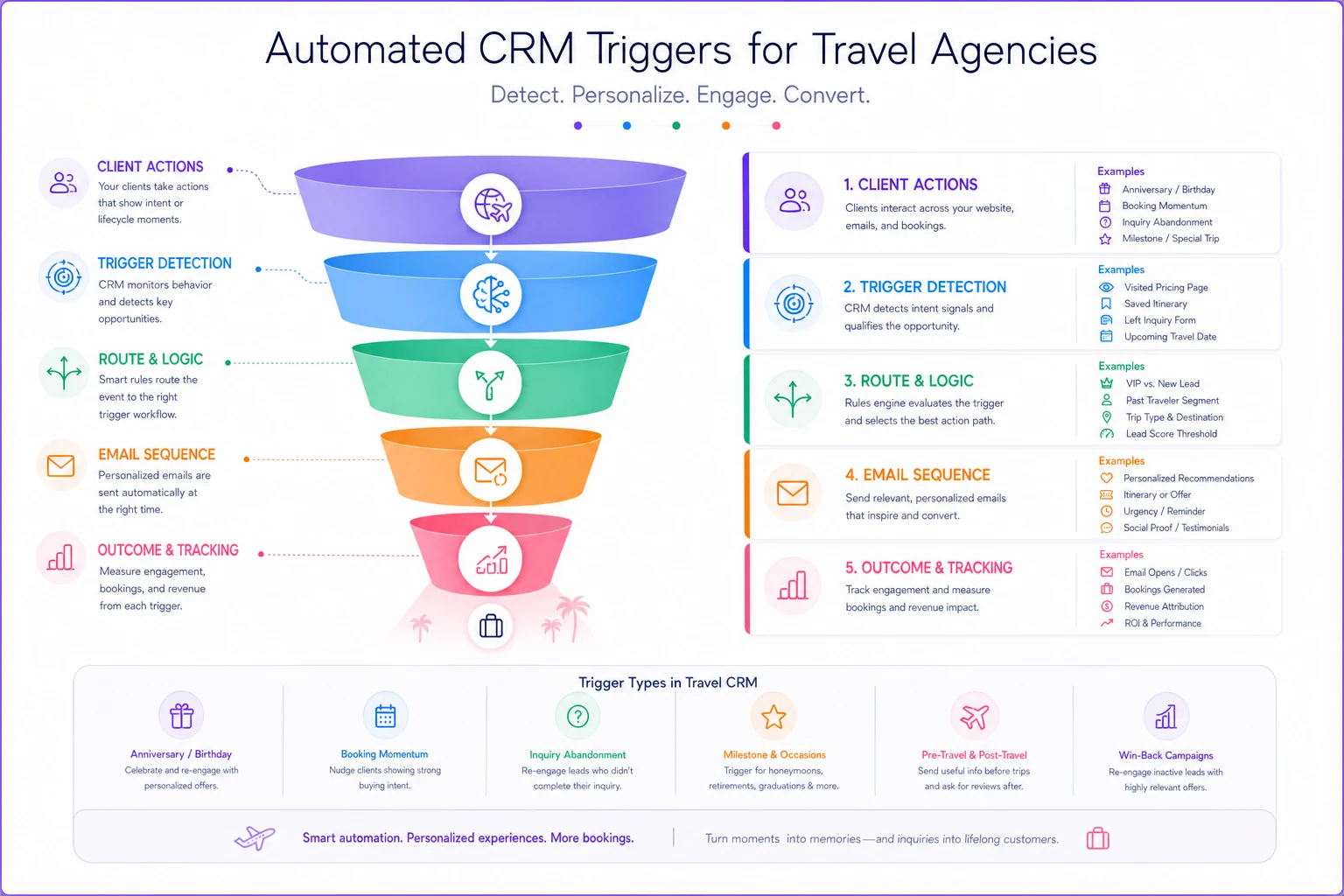
These triggers work because they're tied to actual client behavior, not your promotional calendar. Once they're built, they run without anyone manually managing them.
Measuring what matters in travel agency segmentation
Stop tracking email open rates like they're the point. Track revenue per segment member and booking velocity instead.
Revenue per segment member tells you if your segmentation actually identifies valuable clients. VIP segment averaging $8,000 annually while Core averages $7,500? Your segmentation is broken.
Booking velocity (time from last touch to booking) indicates message relevance. Luxury segments should book within 45-60 days of targeted campaigns. Family segments book within 30 days of seasonal campaigns. Longer gaps usually mean wrong message or wrong timing.
Segment migration rate shows if clients are moving up your value chain. What percentage of Core clients became VIPs this year? What percentage of VIPs dropped to Core? This tells you whether you're growing relationships or just maintaining them.
Campaign attribution accuracy requires tracking beyond last-click. That luxury client who booked after your fifth email? Track all five touches, not just the final one. Most agencies discover their "failed" campaigns actually initiated journeys that converted weeks later.
The tech stack that makes segmentation manageable
Manual segmentation kills agencies. You update it once, swear you'll maintain it monthly, then realize six months later that your VIP segment includes three clients who haven't booked in two years.
Modern travel CRM systems should automatically recalculate segments based on booking data, not require manual updates. The system should track transaction history, calculate rolling spend tiers, and monitor recency without spreadsheet exports.
Generic CRM tools make travel agency segmentation unnecessarily complex. They're built for B2B sales or e-commerce, not the specific patterns of travel booking. You end up fighting the system to track what actually matters — booking value, travel dates, party composition, supplier commission.
AI-powered operational platforms change this meaningfully. Instead of manually maintaining segments, the right system continuously analyzes booking patterns and adjusts classifications automatically. It can flag when a budget traveler starts researching luxury trips, when a family traveler's kids age into new categories, or when booking velocity suggests someone's planning a major celebration — all without anyone manually pulling reports. One agency cut their segmentation maintenance from around 8 hours monthly to almost nothing after switching to an AI-assisted platform. Clients moved between segments based on behavior, appropriate campaigns triggered automatically, and new patterns surfaced in the data without anyone having to go looking.
That said, the tech only amplifies a good strategy. The best platform in the world won't help if you're segmenting by the wrong attributes.
Common segmentation mistakes that burn client relationships
Oversegmenting creates more problems than it solves. One agency built 67 segments based on every possible combination of destination, budget, and travel style. They spent three months building campaigns nobody ever saw because each segment had 12 people in it.
Undersegmenting is equally dangerous. Treating everyone who spent over $5,000 as "VIP" means your honeymoon couple gets the same messages as your quarterly business traveler. Neither feels understood.
Static segmentation ignores how clients evolve. The couple who booked budget trips in their 20s might be luxury travelers in their 40s. The family who did Disney exclusively might be ready for European adventures. Segments need to be living classifications that adjust to changing patterns.
The worst mistake: letting your promotional calendar drive segmentation instead of client behavior. "It's February so let's email everyone about spring break!" Meanwhile, your luxury clients are planning fall trips and your adventure travelers are booking next year's expedition.
The compound effect of proper segmentation
Get segmentation right and everything else improves. Your close rate goes up because you're pitching relevant trips. Service quality improves because you're not wasting time on poor-fit inquiries. Margins improve because you're matching clients with appropriate suppliers.
One agency tracked the compound effect over 18 months after overhauling their segmentation approach:
| Metric | Change |
|---|---|
| Email-to-booking conversion | +40% |
| Inquiry time (better qualified leads) | -25% |
| Average transaction value | +30% |
| "Just browsing" inquiries | -50% |
The less obvious benefit was operational. Agents stopped feeling like telemarketers pushing unwanted trips. They became advisors presenting relevant opportunities to interested clients. Staff satisfaction improved. Referrals increased. The agency owner put it bluntly: "We went from chasing anyone with a credit card to cultivating relationships with clients who value what we offer."
Starting your segmentation overhaul
Don't rebuild everything at once. Start with one clear cut: identify your top 20% of clients by revenue. That's segment one. Everyone else is segment two. Run different campaigns to each for a month and measure the difference.
Then add recency. Split each segment by "booked within 12 months" versus "older than 12 months." Now you have four segments. Run this for another month.
Only after you've proven the value of basic segmentation should you layer in trip type, seasonality, or lifecycle stage. Build complexity gradually and prove ROI at each step. Agencies that start simple and evolve their segmentation consistently outperform those that build elaborate systems they can't maintain. A perfectly designed 50-segment matrix means nothing if you abandon it after three months.
Moving from random acts of marketing to predictable revenue
CRM segmentation for travel agencies isn't about complex attribution models or sophisticated automation. It's about recognizing that your clients have patterns, preferences, and rhythms that predict their next booking better than any demographic data ever will.
When you segment properly, you stop broadcasting into the void and start reaching people who are actually receptive. Your luxury clients get white-glove treatment. Your family travelers get timely, relevant suggestions. Your adventure seekers get exclusive opportunities that feel curated, not mass-produced.
The agencies doing well right now aren't the ones with the most segments or the most sophisticated CRM. They're the ones who understand their clients' patterns and consistently show up with the right message at the right time. They've turned their database from a list of past transactions into a source of predictable future revenue. That transformation doesn't require perfect technology or a massive budget — it requires understanding that the family who books Disney every February needs different treatment than the couple planning their once-in-a-lifetime anniversary trip. Get that right, and everything else follows.
Ready to elevate your travel agency workflow?
Join 1,200+ travel agencies using Travexly to save time, improve client satisfaction, and boost operational efficiency.