

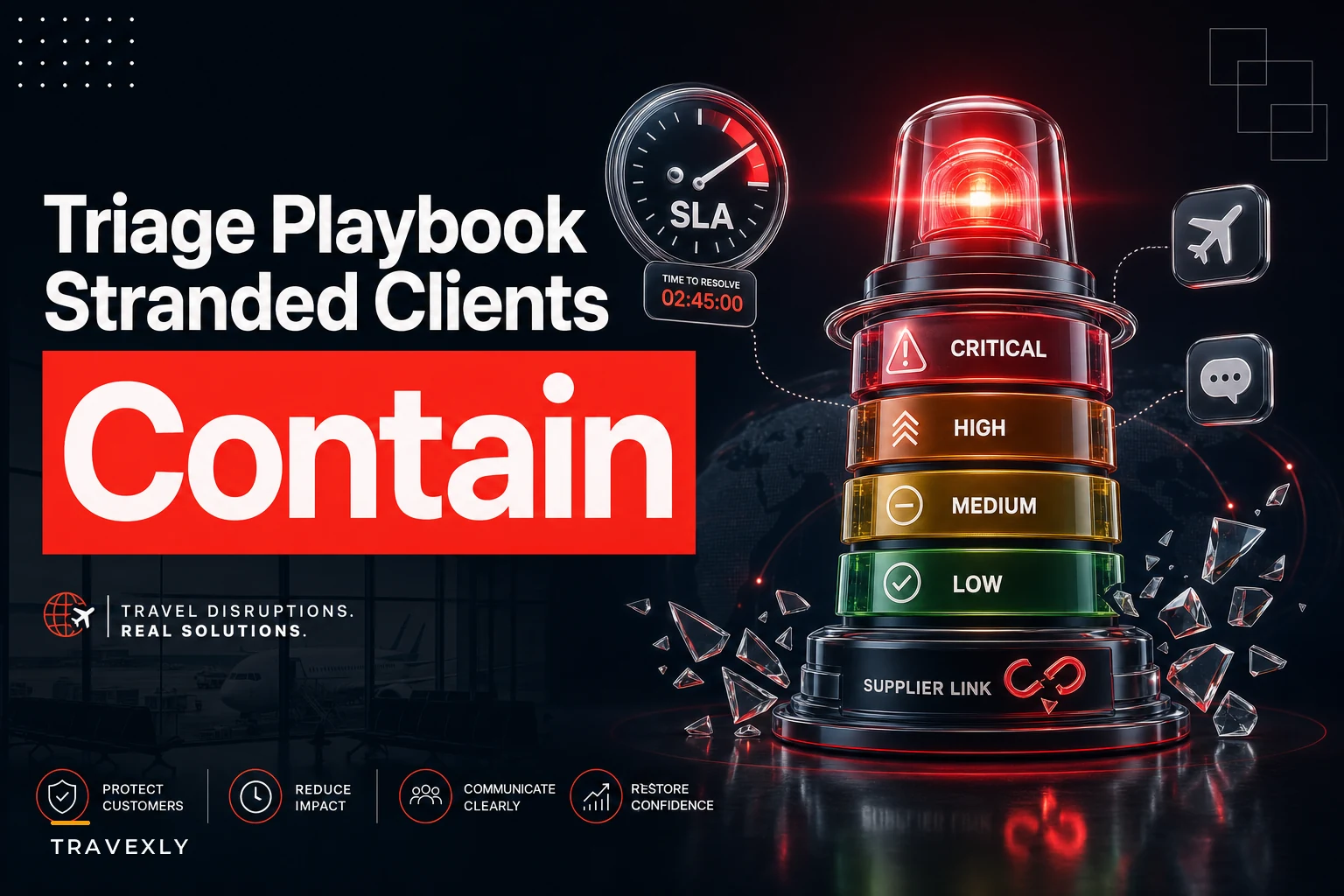

When a hotel chain quietly cancels 14 confirmed rooms three days before a group arrival, or a DMC stops answering emails the week a tour is running, the hardest part isn't the failure itself. It's the next 90 minutes. Who do you call first? Which client gets the honest message and which one can wait? What do you actually promise?
Most agencies handle this on instinct, and instinct falls apart the moment two or three supplier problems land in the same afternoon. The agents who stay calm aren't smarter — they're working off a triage system that already answered those questions before the panic started. This is that system: severity tiers, SLA timelines you can actually hit, escalation paths that don't dead-end, and the client messaging that keeps people from filing chargebacks while you fix things.
This is a supplier failure playbook for travel agency operators who want to stop improvising during the worst moments of the job.
Why supplier failures feel chaotic even to good agencies
The chaos almost never comes from the failure itself. It comes from the fact that everything feels urgent at once, so everything gets treated as a five-alarm fire — including the stuff that could've waited six hours.
A typical pattern: a supplier sends a vague "we're experiencing issues" email at 4pm. An agent forwards it to three clients immediately, phrased badly, because they're rattled. Now you've got three anxious clients calling back, two of whom weren't even affected yet, and the actual stranded family — the one whose flight connects tomorrow morning — is sitting at the bottom of the inbox because they emailed politely instead of calling.
The root problem is that there's no shared definition of how bad is this, really. Without severity tiers, every agent uses their own gut, and gut-based triage is wildly inconsistent. One agent treats a delayed refund like an emergency; another treats a client sleeping in an airport like a routine follow-up. During a multi-client incident, that inconsistency is what sinks you.
The four severity tiers
Severity should be defined by client impact and time sensitivity, not by how angry the supplier made you or how big the booking was. A $12,000 luxury booking with a problem that resolves itself in two days is lower severity than a $2,200 booking where a family is physically stranded tonight.
Eliminate booking chaos and streamline operations.
Travexly helps you manage, confirm, and track travel bookings effortlessly.
- Unified booking management
- Automated client communications
- Team scheduling & itinerary tracking
No credit card required
| Tier | Definition | Example | Response SLA | Client update cadence |
|---|---|---|---|---|
| SEV-1 | Client stranded or in active disruption right now | Family at airport, hotel refusing check-in, tour no-show on arrival day | Acknowledge within 15 min, action within 30 min | Every 30–60 min until stable |
| SEV-2 | Confirmed failure affecting travel within 72 hours | Hotel cancels rooms for a trip leaving Friday | Acknowledge within 1 hr, plan within 4 hrs | Every few hours, then daily |
| SEV-3 | Failure affecting future travel (4+ days out) | Supplier insolvency, cancelled tour for next month | Acknowledge same day, plan within 24 hrs | Daily or on milestone |
| SEV-4 | Financial/administrative only, no travel impact | Delayed refund, commission dispute, wrong invoice | Acknowledge within 1 business day | Weekly until resolved |
The single most useful thing this table does is give your team permission to not panic about SEV-3 and SEV-4 while a SEV-1 is live. When someone's stranded, the delayed refund waits. That sounds obvious written down, but in the moment, without a tier label, everything screams equally loud.
One nuance worth flagging: severity can escalate. A SEV-2 hotel cancellation becomes SEV-1 the instant the client is standing in the lobby being turned away. Your system needs to allow re-tiering mid-incident, and whoever owns the case needs the authority to bump it up without asking permission.
Mapping SLA timelines you can actually meet
SLAs only work if they're honest about your staffing. An agency with two people can't promise a 15-minute acknowledgment at 11pm unless someone's genuinely on-call. Writing SLAs you can't hit is worse than having none — it trains your team to ignore the clock.
-
Acknowledgment time — how fast a human responds to the client at all, even just "We see this, we're on it, next update by 6pm." This is almost always what prevents chargebacks and angry reviews. Clients forgive slow fixes far more than silence.
-
Resolution or plan time — how fast you have an actual path forward. This is slower and depends on the supplier, so you commit to a plan, not a guaranteed outcome.
For a small agency, a realistic SEV-1 SLA during business hours is acknowledgment in 15 minutes and a workable rebooking option within an hour. After hours, it depends entirely on whether you run an on-call rota. If you don't have one, your honest SEV-1 after-hours SLA might be "acknowledge within an hour via the emergency line" — and that's fine, as long as clients traveling in high-risk windows actually know that number exists.
The quiet mistake agencies make here is measuring SLAs against the supplier's response time instead of their own. You can't control when a DMC calls back. You can control whether your client heard from you within 15 minutes. Judge yourself on the part you own.
Vendor escalation paths that don't dead-end
The reason escalation fails is almost always that the only contact anyone has is a generic reservations email that goes unwatched during exactly the moments you need it. When a supplier is failing, their front-line channel is overwhelmed too.
-
Level 1 Normal reservations line/email — fine for SEV-3 and SEV-4.
-
Level 2 Your account manager or BDM's direct mobile. This is the person who actually cares about keeping your business.
-
Level 3 Regional ops manager or a 24-hour emergency ops desk, if the supplier has one. Many DMCs and consolidators do; most agencies just never ask for the number.
-
Level 4 Senior commercial contact — the person who negotiated your contract. Reserved for insolvency, mass cancellations, or when Levels 1–3 have gone silent past SLA.
The pattern worth internalizing: escalate by time elapsed, not by frustration. Set a rule like "if Level 2 hasn't responded within 30 minutes on a SEV-1, jump to Level 3 automatically." Agents hesitate to escalate because it feels aggressive or because they're worried about the relationship. A time-based rule removes that hesitation — it's not personal, it's protocol.
Log the time and channel of every escalation attempt so you can prove attempts later when chasing compensation.
For high-risk bookings especially, having the escalation contacts assembled and confirmed in advance saves the frantic scramble of digging through old emails for a phone number while a client waits.
Client messaging sequences that hold up under pressure
Acknowledge before you have the answer. The instinct to wait until you "have something to tell them" is exactly backward. A 15-minute "we're aware and working it, next update at 6pm" buys you hours of goodwill. Silence while you work reads as abandonment.
Promise a next-update time, not a resolution time. Never say "we'll have this fixed by 7." Say "I'll update you by 7 regardless of whether it's resolved." Then actually send that update even if it's just "still working, next update by 8." The reliability of the updates is what calms people, not the speed of the fix.
Match tone to tier. A SEV-1 message to a stranded client should be short, human, and action-focused — "I'm sorting your hotel now, stay at the desk, calling you in 10." A SEV-3 message about a future cancellation can be more detailed and reassuring, laying out options and timelines.
A rough SEV-1 messaging sequence looks like:
-
T+0–15 min Acknowledge, confirm you're on it, give a next-update time. Phone for the truly stranded; a polite email isn't enough when someone's standing in a lobby.
-
T+30–60 min First substantive update — either the fix or a clear "here's what I'm doing and the two options I'm chasing."
-
Every 30–60 min after Short updates until the client is physically stable (checked in, rebooked, en route).
-
Within 24 hrs post-resolution Written summary of what happened, what you did, and what comes next on any refund or compensation.
That final written summary matters more than it looks. It's your record, it reassures the client that loose ends aren't forgotten, and it heads off the "nobody ever followed up" complaint that drives disputes weeks later.
The operational triage checklist
When an incident lands, run this in order. It's built so a junior agent can execute the first several steps without waiting for a senior.
-
Classify the tier. Client impact and time sensitivity first. Write the tier on the case. Re-tier if it worsens.
-
Assign a single owner. One name on the incident. Shared ownership during a crisis means nobody owns it.
-
Acknowledge the client within the SLA for that tier — even with no solution yet.
-
Pull the booking facts. Confirmation numbers, supplier refs, payment status, what's actually confirmed vs. requested.
-
Open the escalation path at the correct level for the tier, and start logging contact attempts with timestamps.
-
Identify the fallback options before the supplier replies. For SEV-1 that means alternative hotels/flights priced and ready, not waiting on the failing supplier.
-
Communicate the plan, always with a next-update time.
-
Execute and document every action and cost as you go — you'll need this for compensation claims.
-
Confirm the client is stable, then downgrade the tier.
-
Debrief within 48 hours. What failed, was the SLA met, does this supplier's reliability need a second look.
The part teams skip under pressure is identifying fallback options before the supplier replies. Waiting on the failing supplier to fix their own failure is how a two-hour problem becomes an overnight one. Assume they won't come through and build your plan B in parallel.
Here's a simple diagram of the operational steps if it helps the team visualize who does what and when.
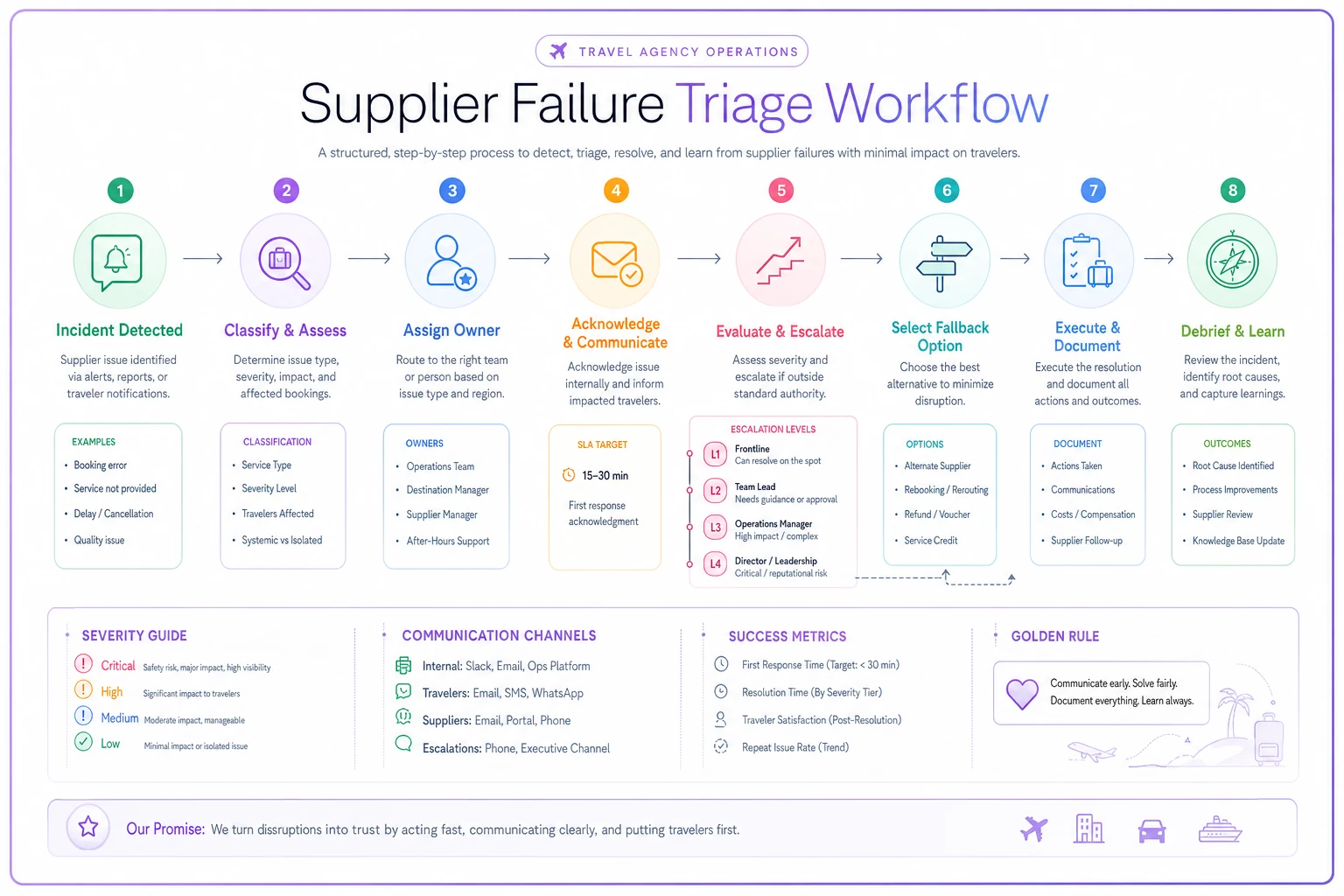
Use this flow as the single reference during an incident so decisions don't get re-litigated in the moment.
When to formalize this — and when it's overkill
A tiered playbook like this makes sense once you're handling enough volume that two incidents can genuinely collide, or once you're selling travel where a failure strands someone far from home. If you run complex multi-supplier itineraries or group departures, you need this.
Where it's overkill: a one-person agency selling mostly simple domestic packages with a handful of trusted suppliers may get away with a single-page version — just the tier definitions and the one emergency number that matters. Don't build a four-level escalation matrix for suppliers you've used reliably for a decade. The goal is clarity under pressure, not bureaucracy.
Who should not treat this as optional: anyone selling as principal rather than agent, anyone running group departures, and anyone whose clients travel internationally. For those, a stranded-client incident isn't hypothetical — it's a matter of when.
A real scenario
A mid-sized agency running escorted small-group tours had a ground operator in Southern Europe go effectively dark mid-season — confirmations stopped matching reality, and two groups arrived to find transfers unbooked. Before they had a triage system, the first such incident consumed most of three people's day, generated two formal complaints, and cost somewhere in the range of $4k–$6k in last-minute transport and a goodwill partial refund they hadn't planned for.
After mapping severity tiers and pre-building escalation contacts for their top dozen suppliers, the second similar failure — a cancelled transfer for a 16-person group — was handled by one agent in about an hour. The stranded group got a text acknowledgment within 15 minutes, a rebooked private coach within the hour from a backup operator already on file, and a written summary that night. No complaint, no chargeback, and the documented log let them recover most of the extra cost from the failing operator afterward.
The improvement wasn't the staff getting better. It was that the decisions — who to call, how fast to respond, what to promise — were already made before the crisis started.
The takeaway for your operation
The agencies that handle supplier failures well aren't the ones with the best suppliers. Everyone's suppliers fail eventually. They're the ones who decided, in a calm moment, exactly how they'd triage when it happened — which client gets the call first, which number gets dialed at 30 minutes of silence, and what the client hears while the fix is still in progress.
Write your tiers down. Build the contact matrix for your top suppliers this week, before you need it. Set SLAs you can genuinely hit and judge yourself only on the part you control. Do that, and the next time a supplier goes dark, the problem stays a problem instead of becoming a catastrophe.
Ready to elevate your travel agency workflow?
Join 1,200+ travel agencies using Travexly to save time, improve client satisfaction, and boost operational efficiency.