


An enquiry lands in your inbox. "Hi, thinking about a trip to Portugal in September, can you help?" You reply with something warm, throw in a couple of ideas. They ask about prices. You spend an hour pulling options together. Then silence. Two weeks later they've booked it themselves online, or gone with someone else.
This pattern eats more revenue than most owners realise, because it never shows up as a "loss." It just shows up as a slightly lower conversion rate that gets shrugged off as normal.
What separates agencies converting 40%+ of qualified enquiries from ones stuck around 15% usually isn't charisma or better supplier deals. It's that the high-converting ones have travel agent sales scripts — tested, repeatable phrasing for the three or four moments where deals actually die: the first response, the price objection, the "let me think about it," and the follow-up.
This post covers the actual scripts. Phone and email. Plus a qualification flow so you stop burning hours quoting people who were never going to book, and a follow-up timing playbook so warm leads don't just quietly disappear.
Qualify before you quote — the flow that kills the back-and-forth
The single biggest time-sink in a travel agency is quoting unqualified enquiries. Someone asks "how much for two weeks in Japan?" and an agent burns 90 minutes building an itinerary for someone with a $2,000 budget and champagne expectations.
The fix is a qualification flow that runs before you build anything detailed. You're not being pushy — you're being precise. And clients actually respond better to an agent who asks sharp questions than one who instantly floods them with options.
Here's the qualification sequence, in order of importance:
-
Dates / flexibility — "Are your dates locked, or is there some flexibility either side?" (Flexibility is where your margin and availability live.)
-
Budget range — the one everyone's scared to ask. Script below.
-
Party composition — number of travellers, ages, any mobility or dietary needs.
-
Trip intent — "Is this more a relax-and-recharge trip, or do you want it packed with things to do?"
-
Decision timeline — "When are you hoping to have this booked by?"
-
Who's deciding — "Is it just you, or will you be running the options past someone before deciding?"
The budget question trips up most agents. They dance around it or skip it entirely. Try this instead:
> "To make sure I'm sending you options you'll actually love rather than wasting your time — do you have a rough per-person or total budget in mind? Even a ballpark helps me pitch this at the right level."
Position the budget question as saving them time — most people answer honestly when it's framed that way.
The framing matters. You're positioning the budget question as saving them time, not screening them out. Most people answer honestly when it's put that way.
A quick note on what qualifying actually does to your numbers. An agency handling around 60 enquiries a month at a 20% close rate is landing 12 bookings. Add a proper qualification step and two things happen: your close rate on the qualified pool jumps — often to 35–45% — and you stop spending hours on people who were never serious. You might quote 30% fewer people and still book more trips.
The first-response script (email)
Speed matters more than polish here. Enquiries answered within the first hour convert dramatically better than ones answered the next day — the client is still in "planning mode" and hasn't opened five other tabs yet.
Eliminate booking chaos and streamline operations.
Travexly helps you manage, confirm, and track travel bookings effortlessly.
- Unified booking management
- Automated client communications
- Team scheduling & itinerary tracking
No credit card required
But speed doesn't mean sending prices. It means sending a fast qualifying response that signals expertise and asks the right questions.
First-response email template:
> Subject: Your Portugal trip — a few quick questions > > Hi [Name], > > Great choice — September is genuinely one of the best months for Portugal (warm, but the summer crowds have thinned out). > > I can absolutely help put this together. Before I start pulling options, a few quick questions so I get it right the first time:
-
Are your dates fixed, or flexible by a few days either way?
-
Roughly how many of you travelling, and any little ones?
-
Do you have a ballpark budget in mind? Even rough helps me pitch options at the right level.
-
Relaxed pace, or do you want it fairly active?
> Once I have these I'll come back with two or three tailored options — not a generic list, but things that actually fit what you're after. > > Talk soon, > [Name]
The line "not a generic list" does real work. It signals you're not just forwarding a package brochure, and it sets up the expectation that the next email is worth waiting for.
Phone scripts for the objections that actually come up
Phone converts better than email for anything above a couple of thousand pounds or dollars. And yet most agents freeze when objections hit. Here are the three that come up constantly, with responses that work.
Objection: "That's more than I expected."
> "Totally fair — can I ask, is it the total that's the issue, or is it more about the value for what's included? Because I can look at a couple of ways to bring the number down, but I want to make sure I'm cutting the right things."
This tells you whether it's a real budget ceiling or a value perception problem. If it's value, you get to re-sell what's included rather than just slashing the price.
Objection: "I can find this cheaper online."
> "You probably can, honestly — the raw components are out there. What you're paying me for is that if the connection gets missed, or the hotel overbooks, or a strike hits your travel day, you call me and I fix it, instead of sitting on hold with an airline for three hours. For most people that's the difference between a holiday and a headache."
Said plainly, without defensiveness. You're not competing on price — you're reframing what the price actually buys.
Objection: "Let me think about it / talk to my partner."
> "Of course, big decision. What usually helps — shall I hold this pricing and availability for you until [specific day]? That way it's not sitting on your mind, and if you're a yes by then, nothing's changed. If not, no problem at all."
You've created a soft deadline and a concrete reason to come back to you. Vague follow-ups — "let me know!" — almost never get answered.
Comparison: reactive quoting vs a scripted, qualified flow
Below is a direct comparison between the two approaches.
| Stage | Reactive approach (most agencies) | Scripted + qualified approach |
|---|---|---|
| First reply | Sends prices or a big option list | Sends 4 qualifying questions, fast |
| Time per enquiry | 60–90 min building quotes upfront | 10 min until client is qualified |
| Price objection | Discounts or gets defensive | Isolates concern, re-sells value |
| "Let me think" | Says "no worries, let me know" | Sets a hold + specific follow-up date |
| Follow-up | Random, or forgotten | Fixed cadence (below) |
| Typical close rate | 15–20% of all enquiries | 35–45% of qualified enquiries |
The reactive column is a series of small leaks, and each one is fixable with phrasing you decide on once and reuse.
The reactive column is a series of small leaks, and each one is fixable with phrasing you decide on once and reuse.
The follow-up timing playbook
Most bookings that "went quiet" didn't say no. They got busy. Life happened. Agencies that win them back have a follow-up cadence they actually stick to — not "I'll chase when I remember."
Here's a cadence that works for a warm quoted lead who's gone silent:
-
Day 1 (same day as quote) Send the options with a clear "here's what I'd pick and why."
-
Day 2 Short nudge — "Any questions on the options I sent? Happy to tweak anything."
-
Day 4–5 Value follow-up, not a "just checking in." Add something — a tip about that destination, a note that a hotel has limited availability, a small upgrade you found.
-
Day 8 The deadline nudge — "I can hold this pricing until [day], after that I'd need to re-quote."
-
Day 14 The soft close — "Should I keep this on file, or has the timing shifted for you?"
That last message is underrated. Asking someone to "release" you often triggers the reply you actually wanted. People don't like closing a door, so a fair chunk of them come back with "no no, still keen, just been mad busy."
On the value follow-up specifically — the reason "just checking in" gets ignored is that it puts all the work on the client. Every follow-up should give them a reason to reply that isn't "have you decided yet." A price-availability note, a local tip, a small upgrade — anything that reads as you thinking about their trip rather than chasing your commission.
Here's a quick visual of that cadence.
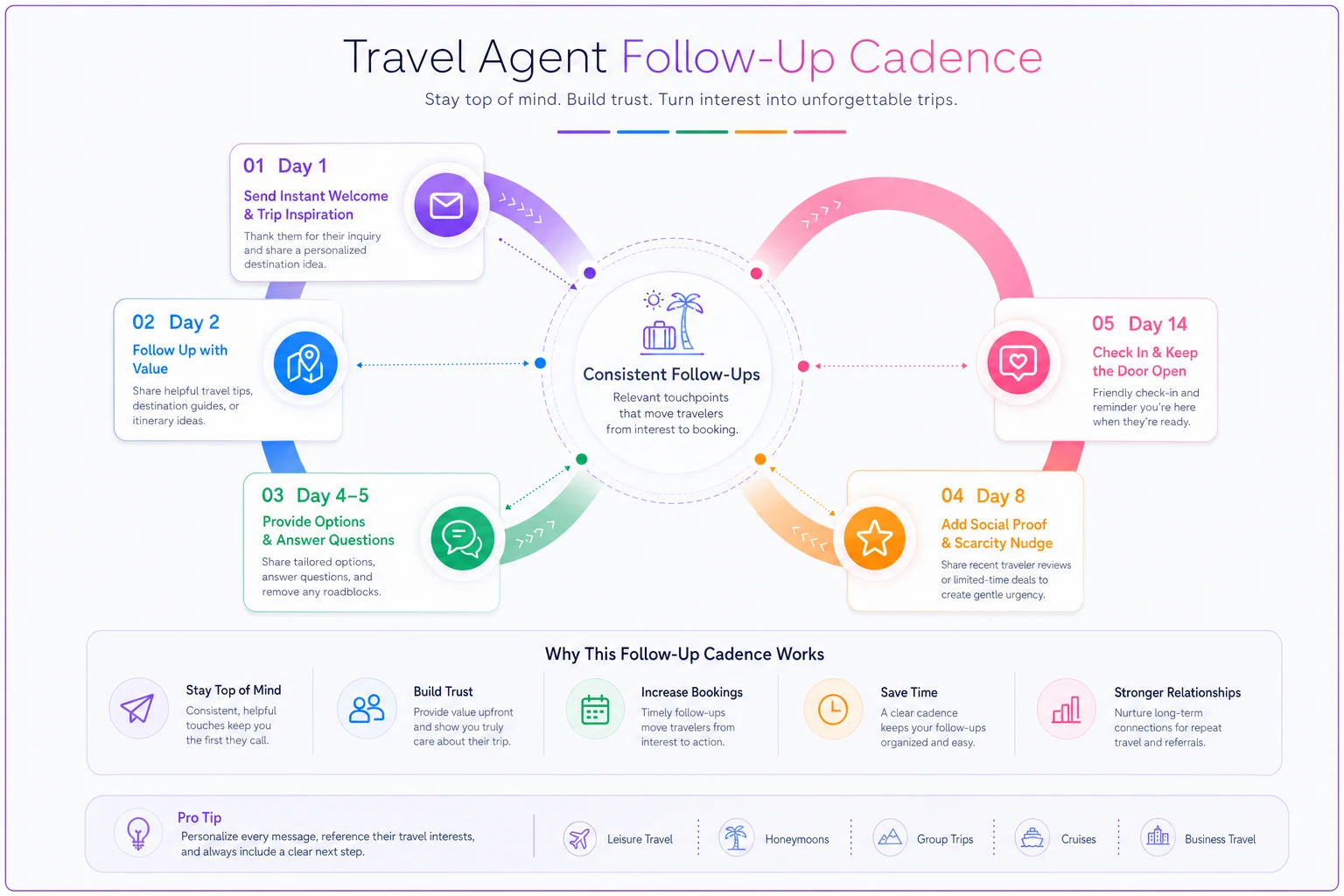
Use the visual as a reminder of the moments to add value rather than just ask for a decision.
A real scenario
A three-person leisure agency was handling somewhere around 70–80 enquiries a month and converting about 16% of them. Not terrible, but the owner knew good leads were slipping.
The problems were textbook. Every enquiry got a same-day reply, but it was a wall of options and prices — no qualification upfront. Follow-ups happened whenever someone remembered, which on a busy week meant not at all.
They made two changes. The qualifying first-response email became the standard reply — no prices until the client answered the four questions. And the follow-up cadence got written on a whiteboard and assigned to whoever owned the enquiry.
Over the following few months, quoting time dropped noticeably because they stopped building full itineraries for people who weren't serious. Close rate on qualified leads climbed into the mid-30s. Total bookings went up even though they were technically quoting fewer people. The owner's rough estimate was an extra handful of bookings each month — meaningful revenue for a shop that size.
None of it required new talent or better suppliers. Just phrasing and discipline.
Where this quietly breaks down
The scripts work. The reason they fail in real agencies is human: on a busy week, the qualification step gets skipped, follow-ups get forgotten, and everyone reverts to reactive quoting. The system is only as good as how consistently it runs.
This is where a decent CRM or booking platform earns its keep — not by writing your scripts, but by making sure the cadence actually happens. Enquiries get logged, follow-up tasks get triggered on day 2, 4, 8 and 14, and templated messages sit one click away so nobody's writing the "hold until Friday" email from scratch on a Tuesday afternoon. The judgment stays human; the remembering gets handled for you.
You don't need automation to start. You need the scripts and the cadence written down somewhere. Tooling just stops your best-performing week from being undone by your busiest one.
When to lean hard on scripts — and when not to
Scripts are strongest for volume enquiries: standard leisure trips, repeat destinations, the day-to-day flow of "can you help with X." That's where consistency beats improvisation.
They matter less for high-touch bespoke work — a $40k multi-country honeymoon or a complex corporate account. Those clients need real conversation, and reading from a template will feel cold. Use the qualification logic, but drop the word-for-word phrasing.
And a fair warning: don't let scripts turn robotic. The goal is to stop reinventing your best lines every time, not to sound like a call centre. A retired couple planning an anniversary cruise and a 28-year-old organising a stag trip should not get identical wording, even if the underlying flow is the same. Adapt the tone. The script is a starting point, not a cage.
The takeaway
The enquiries you're already getting are worth more than the ones you're chasing. Most agencies don't have a lead-generation problem — they have a conversion-and-follow-up problem that's hiding as a normal-looking close rate.
Write down your first-response email. Decide your three objection responses before you need them. Pin a follow-up cadence somewhere visible and actually run it. Do those three things and you'll convert more of the same enquiry volume, spend less time quoting people who were never going to book, and stop losing warm leads to nothing more than silence.
Ready to elevate your travel agency workflow?
Join 1,200+ travel agencies using Travexly to save time, improve client satisfaction, and boost operational efficiency.