



Why the same package structure quietly bleeds margin across three very different trip types
Most agencies price all three trip archetypes the same way: total up supplier costs, slap on a markup percentage, and quote a number. It feels clean. It also leaves money on the table for luxury clients, prices you out of adventure deals, and turns corporate trips into low-margin admin nightmares that eat your team's time without paying for it.
The problem isn't that agencies don't understand margin. It's that a single markup logic can't serve three buyers who value completely different things. A luxury client barely reacts to a $400 price bump if the experience feels curated. An adventure client will walk over $150 because they're comparing you against three other operators on a spreadsheet. A corporate client doesn't care about your markup at all — they care about invoice terms, change flexibility, and whether their finance team can reconcile it.
So instead of one pricing formula, this is about how the unit economics actually differ, and where the real margin levers sit for each. The price packaging travel agency owners get right is the one that matches the structure to how each buyer actually thinks about cost.
The three archetypes have three completely different cost structures
Before touching markup, you need to see where your costs actually live in each trip type. They don't sit in the same place, and that's the whole reason a uniform markup underperforms.
| Cost / margin factor | Luxury | Adventure | Corporate |
|---|---|---|---|
| Base supplier cost as % of price | 60–70% | 75–85% | 80–90% |
| Where margin comes from | Curation, exclusivity, add-ons | Volume, gear/logistics add-ons | Service fees, volume rebates, net-rate spreads |
| Price sensitivity | Low | High | Medium (terms-sensitive, not price-sensitive) |
| Typical net margin achievable | 22–35% | 12–18% | 10–20% + service fees |
| Biggest margin killer | Free upgrades/"comps" | Over-discounting to win the deal | Scope creep and unbilled changes |
| Refund/change exposure | Moderate | High (weather, permits) | High (frequent reschedules) |
The luxury row is where agencies underprice most often. The corporate row is where they overwork for too little. Adventure is where they discount reflexively and don't build in the add-on structure that would actually save the deal.
Luxury: stop marking up the trip, start pricing the curation
A typical luxury pricing mistake looks like this. The agent sources an $18,000 villa-and-transfers package, applies a standard 15% markup, quotes around $20,700, and feels good about it. Meanwhile the client would have paid $23,000 without blinking — because the number isn't really the point for them. The confidence that everything is handled is the point.
Eliminate booking chaos and streamline operations.
Travexly helps you manage, confirm, and track travel bookings effortlessly.
- Unified booking management
- Automated client communications
- Team scheduling & itinerary tracking
No credit card required
A luxury package that protects margin usually splits into three layers:
-
Base itinerary — marked up conservatively (12–15%) so the headline number stays comfortable
-
Curated enhancements — private guides, restaurant access, a fixer on the ground, sunset yacht slot — priced at 40–60% margin because the client is buying access, not a commodity
-
Concierge retainer — a flat handling fee (often $500–$1,500 per trip) for 24/7 availability and pre-arrival coordination
Luxury clients almost never object to the concierge retainer once you name what it covers. What they object to is a vague "service fee." Spell out "dedicated coordinator, priority rebooking, on-trip support," and the same fee reads as reassurance instead of a tax.
When this makes sense — and when it doesn't
This layered model works when your client base genuinely wants white-glove handling. It's a bad fit if you're serving aspirational buyers who want luxury but are actually price-shopping. Those clients will pick apart every enhancement line. For them, bundle the enhancements invisibly into the base and quote one confident number.
Adventure: your margin lives in logistics, not the trip
Adventure is the archetype agencies get emotionally wrong. The instinct is to discount to win, because the client is clearly comparing operators. But cutting your markup from 15% to 9% on a $4,500 trekking package barely moves the client's decision — you've handed away roughly $270 to save a deal the client may not have even been choosing on price.
A realistic adventure add-on structure:
-
Gear packages — rent-or-buy bundles marked up 30–50%; clients happily pay to not lug their own equipment
-
Logistics tier — private transfer vs. shared, extra acclimatization night, porter support
-
Safety add-ons — evacuation insurance, satellite comms rental, medical kit
-
Difficulty upgrades — the "harder route with a specialist guide" version at a premium
Adventure clients will fight you on the base price and then spend another 20–30% of that base on add-ons without much resistance, because each add-on maps to a real fear — getting cold, getting stranded, getting hurt. Price the base competitively to win the booking. Make your margin on the fear-and-comfort layer.
A quick real-world shape of this: an operator selling a $3,800 base trek who discounted to win deals was netting around 11%. Rebuilding around a competitive $3,650 base plus a gear-and-safety add-on menu pushed blended margin closer to 19–21% on trips where clients took two or more add-ons — which was most of them.
Corporate: the trip is nearly break-even, the fees are the business
Corporate travel is where agencies confuse revenue with margin. A company books $45,000 of flights and hotels through you, you feel busy and important, and you net maybe 3–5% after airline and hotel net rates. Then a VP reschedules twice, an assistant emails at 9pm, finance disputes a line item — and the "big" account is now costing you money.
-
Service fees per transaction — a flat fee per air ticket, per hotel booking, per change (this is the actual product)
-
Change/reschedule fees — because corporate travel changes constantly, and unbilled changes are the single biggest margin leak here
-
Management fees or retainers — a monthly fee for managing a company's travel program, priced on volume and support level
-
Volume rebates and net-rate spreads — real, but secondary to fees for most small agencies
The mistake almost everyone makes: absorbing changes to "keep the client happy." A corporate account that reschedules 15 trips a quarter and pays nothing for changes is a slow-bleed account. You're not keeping them happy — you're subsidizing their disorganization.
A corporate structure that survives contact with reality:
-
Transparent per-transaction fee (published, not negotiated per booking)
-
A change fee that kicks in after the first free change per trip
-
Clear invoice terms and a defined scope of what "management" includes
-
Everything outside scope quoted separately, before you do the work
Who should NOT chase corporate this way
If you're a two-person leisure agency, don't bolt on corporate hoping for volume. The service intensity will quietly consume the hours you'd spend on higher-margin luxury work. Corporate rewards process and scale. Take it on only when you can actually staff the responsiveness it demands.
The margin levers that apply across all three
A few things move margin regardless of archetype, and they're the ones agencies most consistently underuse:
-
Name every fee. Unnamed fees get disputed; named fees get paid. "Coordination fee" beats "service charge" every time.
-
Bill scope changes before you do them. The moment work happens before a quote, margin disappears.
-
Bundle to obscure comparison; unbundle to justify premium. Use bundling for price-shoppers, itemization for value-buyers.
-
Set a discount floor per archetype. Give your team a hard minimum margin they can't quote below without approval.
-
Track margin per trip, not per month. Monthly totals hide the individual deals that are losing money.
That last one is where a lot of agencies are flying blind. When quotes, add-ons, and change fees live across email threads, spreadsheets, and a booking tool, nobody sees that trip #47 actually netted 4% because two changes went unbilled. A workflow platform that ties each quote to its final margin — including add-ons and post-booking changes — turns pricing from a guess into something you can actually manage. Not because the software prices for you, but because it makes leakage visible while there's still time to fix it.
Here's a simple workflow that makes margin visibility obvious.
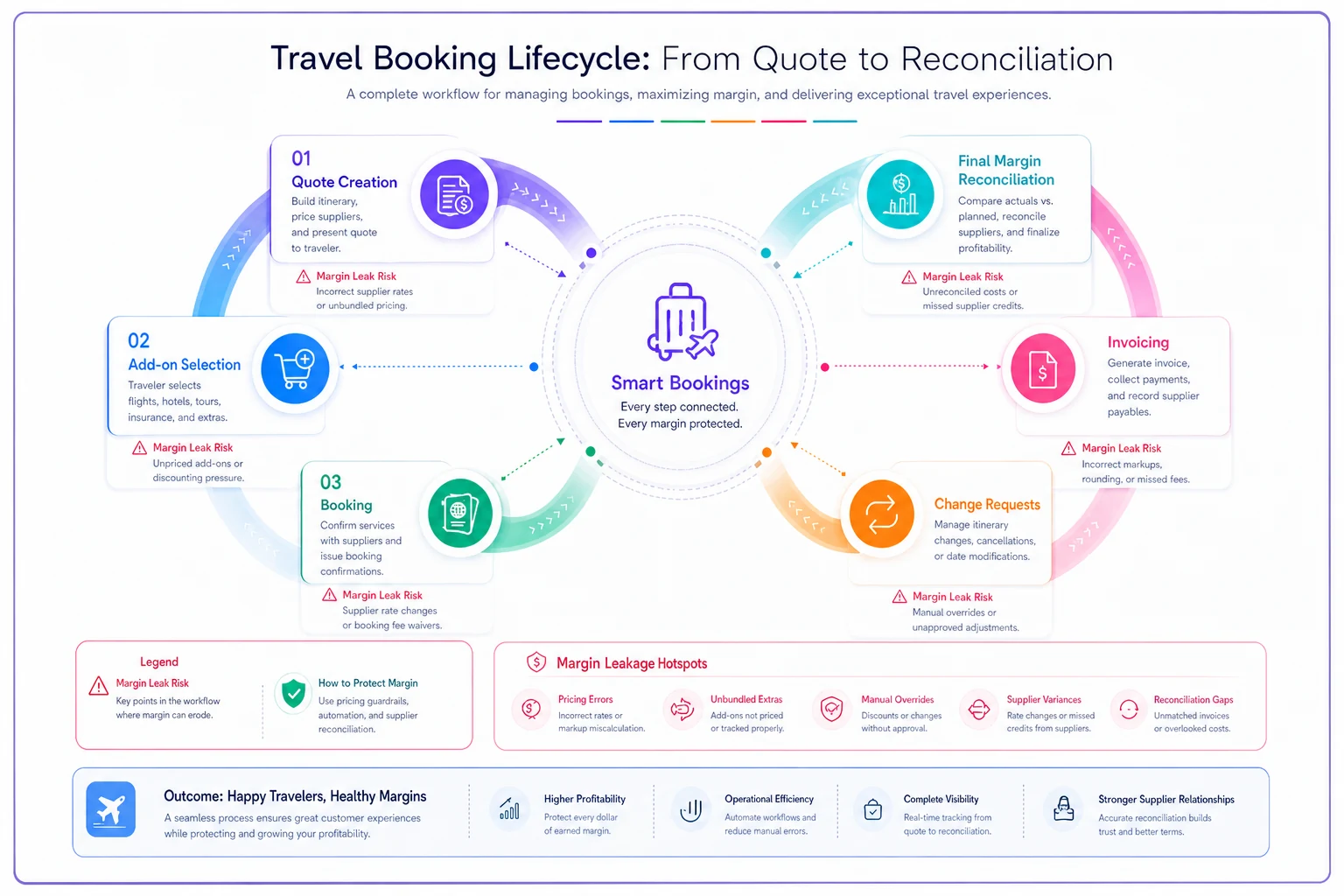
Use this workflow to tie each quote to its final margin and stop leakage early.
A real scenario: mixed-portfolio agency, uniform markup problem
A mid-sized agency running all three trip types was applying a flat ~14% markup across the board. Their books looked fine at the top line. Underneath, it was messier.
-
Luxury trips were netting around 14% when the market would have borne 25%+ — leaving roughly $1,200–$2,000 per trip uncaptured.
-
Adventure trips were being discounted to ~9% to win deals, with add-ons sold informally and inconsistently.
-
Corporate accounts were netting low single digits after unbilled changes ate the spread.
They didn't change suppliers or raise headline prices dramatically. They restructured: luxury moved to layered curation with a named concierge fee, adventure kept a competitive base with a formal add-on menu, and corporate introduced per-transaction and change fees. Blended net margin moved from roughly 11% to somewhere around 17–18% over two quarters — mostly by capturing value that was already sitting in the trips they were already selling.
Nothing about that required winning more clients. It required pricing three different buyers three different ways.
The bottom line
The reason one markup formula fails is straightforward: you're not selling one product. You're selling reassurance to luxury clients, safety-and-comfort to adventure clients, and predictability to corporate clients. Each buyer reveals where they'll pay more — and it's almost never the base trip.
Match the structure to the buyer, name your fees, bill your changes, and watch margin per trip instead of margin per month. The agencies that protect margins aren't the ones charging the most. They're the ones who stopped pretending three different businesses could share one price sheet.
The reason one markup formula fails is straightforward: you're not selling one product. You're selling reassurance to luxury clients, safety-and-comfort to adventure clients, and predictability to corporate clients. Each buyer reveals where they'll pay more — and it's almost never the base trip.
Match the structure to the buyer, name your fees, bill your changes, and watch margin per trip instead of margin per month. The agencies that protect margins aren't the ones charging the most. They're the ones who stopped pretending three different businesses could share one price sheet.
Ready to elevate your travel agency workflow?
Join 1,200+ travel agencies using Travexly to save time, improve client satisfaction, and boost operational efficiency.