



The itineraries that blow up aren't usually the complicated ones. It's the four-provider trip where a client pushes their return flight back one day and nobody catches that the airport transfer, the last hotel night, and the winery tour on the final morning are all now wrong. The flight amendment gets confirmed. The rest silently doesn't.
That's the core failure in multi-provider work: providers don't talk to each other, and neither do the confirmations sitting in your inbox. A change to one anchor date should cascade to everything touching it, but in most agency workflows that cascade is a person remembering to check. And people forget, especially on a Friday afternoon with six other files open.
This is a tight, practical multi-provider itinerary checklist built around one idea — assemble and confirm in an order that makes mismatches obvious before the client pays, not after they land.
Why date and supplier mismatches actually happen
Almost every mismatch traces back to one of three things, and none of them are "the agent was careless."
The first is assembly order. Agents build itineraries in the order things get quoted, not in the order the trip actually happens. You book the hotel first because that quote came back fast, then the flights three days later, and by then the flight arrival is 11:40pm but you'd already told the hotel a 3pm check-in with no late-arrival note. The pieces were correct individually and wrong together.
The second is no single source of truth for dates. The flight PDF says one thing, the hotel voucher says another, the tour operator's email says a third, and the master itinerary you sent the client says a fourth. When four documents each carry their own dates, there's no version that's automatically "the truth." A mismatch can live across those documents for weeks.
The third is confirmations arriving out of sequence. In real operations this usually happens when a downstream provider confirms before an upstream one. The transfer company confirms a pickup based on the flight time you gave them — but that flight was still on a waitlist and the final ticketed time shifted by 90 minutes. The transfer is now "confirmed" and wrong.
The error rarely comes from the hard parts. It comes from a small change late in the process that nobody re-ran against the whole chain.
The real cost, in plain numbers
A missed transfer on arrival isn't a $40 problem. Here's what a single mismatch on a mid-tier package tends to actually cost:
Eliminate booking chaos and streamline operations.
Travexly helps you manage, confirm, and track travel bookings effortlessly.
- Unified booking management
- Automated client communications
- Team scheduling & itinerary tracking
No credit card required
| Failure | Direct cost | Hidden cost |
|---|---|---|
| Missed arrival transfer (flight moved) | Rebook taxi ~$60–$120 | Client's first impression, goodwill credit later |
| Hotel night booked for wrong date | 1 non-refundable night, ~$180–$400 | Time to fight for a refund, sometimes lost |
| Tour scheduled after client departs | Full tour cost, often non-refundable | Client feels the whole trip was sloppy |
| Whole chain off by one day | Compounds across all of the above | Refund requests, chargeback risk, no rebooking |
On a trip worth roughly $6k–$9k, a single one-day chain error can easily eat $500–$900 in direct costs plus a goodwill credit you offer just to keep the relationship. And the client who had one thing go wrong tells the story as "everything went wrong."
The quieter cost is staff time. Untangling a mismatch after confirmations have gone out means contacting three or four providers, some of whom now want amendment fees, and doing it while the client is anxious. That's often two to three hours of senior time on a trip that earned you maybe $600 in commission.
The sequencing rule that prevents most of this
The single most useful change is to stop building in quote-arrival order and start building in dependency order. Everything in a trip depends on the arrival and departure anchors. Build outward from those.
-
Lock the arrival and departure anchors first. Ticketed flights (or confirmed rail), with actual times, not quoted times. Nothing else gets confirmed until these are real.
-
Book accommodation against confirmed flight dates. Check-in matched to arrival day, checkout to departure day, late-arrival notes added where the flight lands after 9pm.
-
Add ground transfers only after both flights and hotels are locked. Transfers are downstream of two things — never confirm them off a quoted flight time.
-
Slot tours and activities into the remaining full days. A day is only "full" if the client is in the destination for all of it. Arrival and departure days are half-days at best — treat them that way.
-
Add buffers, then confirm. Only after the shape is right do you send confirmations to providers.
The insight most people miss: the first and last days of any trip are the highest-risk slots. That's where transfers, check-in/out, and any early-morning or late-day tour collide with flight times that can still move. Treat arrival and departure days as fragile. Don't stack a 7am tour on a departure day where the client checks out at 11am and flies at 2pm — you've left zero margin.
Contingency windows — build the buffer in, don't hope for it
A contingency window is just deliberate slack between two connected events. Most mismatches that turn into disasters were technically "correct" but had zero buffer, so any small slip broke them.
-
International arrival → first activity don't schedule anything firm for at least 4–6 hours after landing. Jet lag, immigration, baggage, transfer delays.
-
Flight landing → transfer pickup transfer companies should quote pickup based on landing time plus 45–60 minutes for a domestic arrival, 75–90 for international.
-
Tour end → departure flight on a departure day, the last activity should end at least 4 hours before the client needs to be at the airport, and that's tight.
-
Connecting internal flight → hotel check-in if the hotel check-in is standard 3pm and the internal flight lands at 1pm, you're fine; if it lands at 8pm, add a late-arrival note or you risk a released room.
When you scan an itinerary, find the single tightest connection first — it's usually on an arrival or departure day and is the biggest risk.
The pattern to watch for: a trip where every connection is technically possible but nothing has slack. That itinerary looks great on paper and fails the first time any provider runs 30 minutes late. When you review an itinerary, look specifically for the tightest connection in the whole chain — that's your weakest link, and it's usually on an arrival or departure day.
The unified confirmation package — one document, one truth
The fix for "four documents, four sets of dates" is a single unified confirmation package that becomes the one authoritative version. Every provider confirmation gets reconciled into it, and the client only ever sees this.
-
Provider name and booking reference
-
Confirmed date and time (with time zone stated explicitly)
-
Confirmation status
quoted / requested / confirmed / ticketed
-
The dependency it relies on (e.g. "transfer depends on flight AA904 arrival")
-
Amendment/cancellation deadline and any fee
-
Last-verified date
Here's what makes it work as a control, not just a nicer PDF: status must be per-component, not per-trip. A trip that's "80% confirmed" tells you nothing. A trip where the arrival transfer is still "requested" while everything else is "confirmed" tells you exactly where the risk is. When you list dependencies next to each line, a one-day flight change instantly shows you every downstream item you have to re-check — because they're literally labeled as depending on that flight.
A simple discipline that catches a lot: before anything goes to the client, read the package top to bottom in chronological trip order, not the order you booked things. Reading it as the client will actually live it is when you spot that the tour is the morning after they've already flown home.
A quick real scenario
A mid-size leisure agency handling roughly 40–50 multi-provider trips a month kept hitting the same problem: about one trip in twelve had a date or transfer mismatch caught only when the client called from the destination. Most were arrival-day transfers built off flight times that later moved.
They changed two things. First, dependency-order assembly — no transfer confirmed until flights were ticketed. Second, a single reconciliation pass where one person read every confirmation into a unified package in chronological order before client send-off.
Over the next few months, in-trip mismatch calls dropped to roughly one every couple of months, and the ones that slipped through were genuine provider failures rather than sequencing errors. The bigger win was quieter: senior staff stopped losing afternoons to untangling chains, because the errors were being caught at the desk instead of in the field. No dramatic revenue jump — just fewer goodwill credits and calmer clients.
The working checklist
Run this before any multi-provider itinerary gets confirmed or sent:
-
Arrival and departure flights are ticketed, not quoted, with actual times
-
Hotel check-in/out dates match confirmed flight dates exactly
-
Late-arrival note added for any hotel where the flight lands after 9pm
-
Transfers confirmed only after flights and hotels are locked
-
Transfer pickup times include a 45–90 min buffer past landing
-
No firm activity within 4–6 hours of an international arrival
-
Departure-day activities end at least 4 hours before airport time
-
Every component has a per-line status (quoted/requested/confirmed/ticketed)
-
Each downstream item lists the dependency it relies on
-
Time zones stated explicitly on every time
-
Package read top-to-bottom in chronological trip order before client send
-
Amendment deadlines and fees noted per component
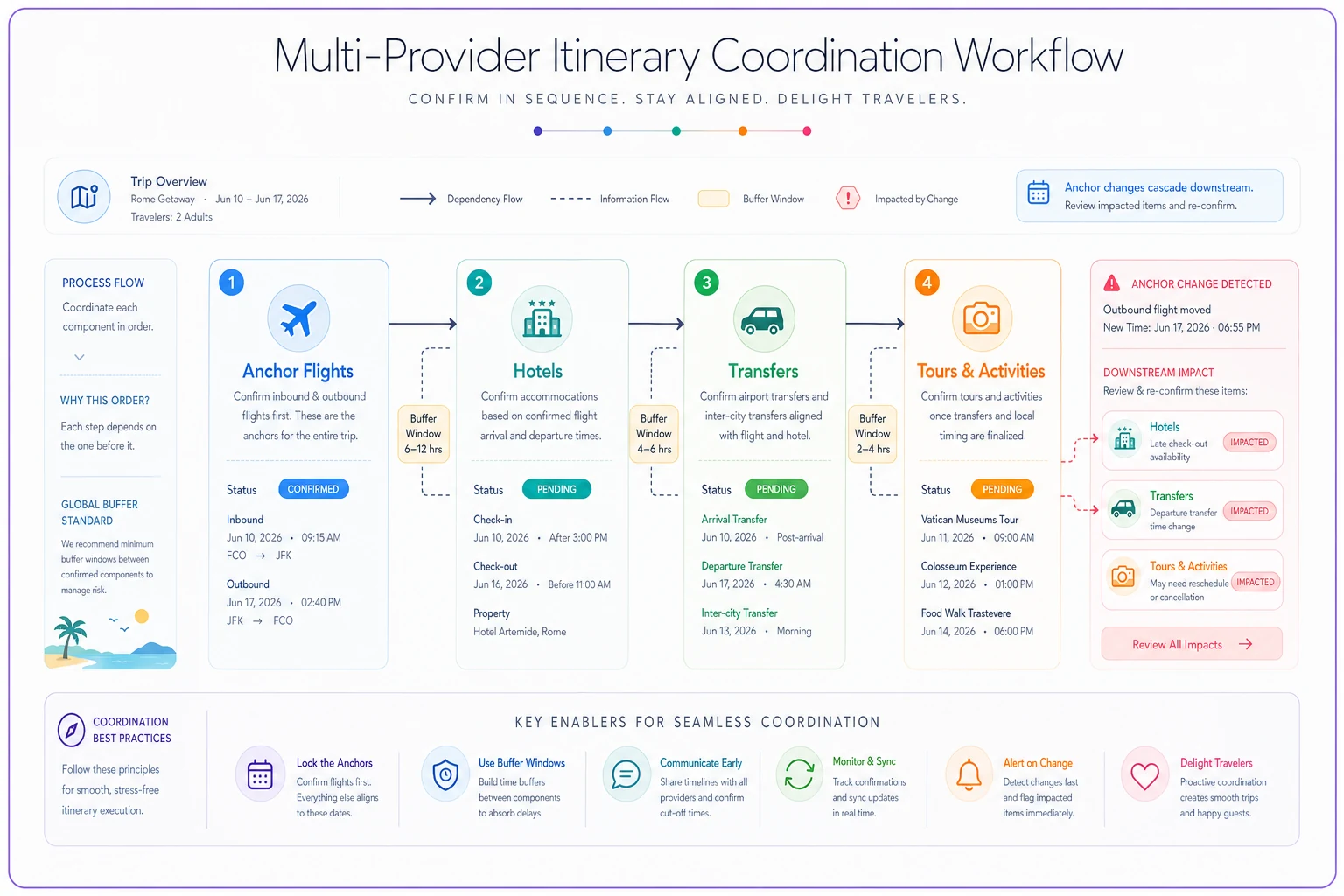
This diagram shows the recommended confirmation sequence and where to place buffers and dependency checks.
Where automation genuinely helps here
The reconciliation pass is exactly the kind of repetitive checking that people skip when they're busy — which is precisely when errors slip in. This is where a workflow platform earns its place: keeping one authoritative record of dates per component, flagging when a confirmed downstream item still depends on an unconfirmed upstream one, and automatically surfacing every dependent item the moment an anchor date changes.
The point isn't to replace the agent's judgment on sequencing. It's to make sure that when a flight moves at 4pm on a Friday, the transfer and the last hotel night and the departure-day tour all get flagged for re-check — instead of relying on someone to remember. Centralizing dates and confirmation status into a single view, with dependencies made explicit, turns "did anyone re-check the chain?" from a hope into a system.
When this level of rigor is worth it — and when it isn't
For single-provider or two-component trips (flight + hotel, nothing downstream), the full package process is overkill. A quick date-match check covers you.
The stepwise checklist earns its keep the moment you cross three interdependent providers — where a change to one has to ripple to others. That's the threshold where human memory stops being reliable and structure starts paying for itself.
And the trips where you should never skip it are the ones with tight arrival/departure-day connections, international legs with waitlisted or unticketed flights, or any itinerary where a downstream provider has non-refundable terms. Those are the files where one missed cascade turns a $600-commission trip into a $900 loss and a client who won't come back.
Mismatches feel like bad luck when they happen, but almost all of them are sequencing and reconciliation gaps you can close before the client ever pays. Build outward from the anchors, keep one authoritative version of every date, and read the whole chain in the order the trip actually unfolds. That's most of the battle.
Ready to elevate your travel agency workflow?
Join 1,200+ travel agencies using Travexly to save time, improve client satisfaction, and boost operational efficiency.