



Most agency quoting pain isn't the trip design. It's the rebuild. Every time a Honolulu family package or a Patagonia trek quote goes out, someone is copying last month's version, deleting the bits that don't apply, hunting for the current hotel rate, and quietly forgetting to add the airport transfer markup. That rebuild is where hours disappear and where margin leaks out the back door.
The fix isn't a prettier PDF template. It's treating an itinerary as a set of blocks that each carry their own pricing logic, so you assemble quotes instead of rewriting them. That's what "itinerary templates travel agency modular" actually means in practice — and done right, it changes both your speed and your profitability.
The real problem with "template" folders
Most agencies already think they have templates. What they actually have is a folder of old quotes with a client's name still buried in paragraph three.
Here's what that looks like day-to-day. An agent gets an enquiry for a couple's 10-day Italy trip. They open the "Italy Romantic" doc from four months ago. Swap the dates. Update two hotels because one closed for renovation. Change the per-person price — but by eyeballing the old total and adding a bit. The transfer markup that used to be baked in? Gone somewhere in the editing. Nobody noticed.
Multiply that across a team. Three agents using the "same" template produce three different structures, three different markup levels, and three different upsell lists. There's no shared logic underneath. The document looks consistent. The economics are chaos.
The core issue: a flat document mixes content (what the trip is) with pricing (what it costs and what you make). When those two live in the same editable blob, every edit risks breaking the math.
What a modular block actually is
A block is a self-contained chunk of an itinerary that carries three things at once:
Eliminate booking chaos and streamline operations.
Travexly helps you manage, confirm, and track travel bookings effortlessly.
- Unified booking management
- Automated client communications
- Team scheduling & itinerary tracking
No credit card required
-
The client-facing content (description, inclusions, images)
-
The cost (what the supplier charges you)
-
The pricing lever (markup %, fixed uplift, or commission assumption)
So a "Private Rome Transfer" block isn't just a paragraph. It's a paragraph plus a €90 cost plus a 22% markup rule. Drop it into any itinerary and both the words and the margin come with it. Pull it out and the total recalculates cleanly.
Once you think in blocks, an itinerary becomes a stack:
-
Arrival block → transfer + welcome arrangement
-
Accommodation blocks → one per property, each with its own rate and margin
-
Experience blocks → tours, tastings, guided days
-
Transit blocks → internal flights, trains, car hire
-
Buffer/contingency block → your padding for FX or rate shifts
-
Departure block → final transfer + checkout support
The agent's job shifts from writing to choosing and sequencing. Because every block already knows its margin, the quote total is always honest.
Why this matters more for different trip types than people assume
The instinct is to build one universal template system. In practice, families, couples, and adventure trips have genuinely different block logic, and forcing them into one structure is where quoting slows back down.
| Trip type | Block behaviour | Where margin lives | Common upsell blocks |
|---|---|---|---|
| Family | Lots of repeated blocks (connecting rooms, multiple kids' tickets, group transfers) | Volume — small markup across many line items | Private vs. shared transfer, skip-the-line passes, kids' club day |
| Couples | Fewer blocks, higher value each | Experience and accommodation upgrades | Room category jump, private dining, sunset/photography add-on |
| Adventure | Modular by day, heavy on logistics and gear | Guides, permits, and bundled multi-day segments | Single-supplement, extra acclimatisation day, gear rental |
Families are a quantity game, couples are an upgrade game, and adventure is a logistics bundling game. Your block library should reflect that. A family template where every transfer is a separate manual line is slow. A couples template without clearly priced upgrade blocks leaves money on the table every single quote.
Where the margin actually leaks during quoting
When agencies ask why their effective margin is lower than their stated markup, the answer is almost always in the editing, not the pricing sheet.
-
Agents drop transfers to "keep the price competitive" on roughly 1 in 4 quotes
-
Supplier cost went up €40 since the template was built, but nobody refreshed it
-
A discount gets applied to the total instead of to specific blocks, so it eats margin unevenly
-
The contingency buffer gets deleted whenever a client pushes back on price
None of these are huge individually. Together, on a trip quoted at €4,200, you might be running an effective margin closer to 13–14% instead of the 20% on the spreadsheet. Across a few hundred trips a year, that gap is real money — the kind of quiet erosion that's easy to miss because every individual quote looked fine at the time.
Modular blocks fix this structurally. If the markup lives inside the block and discounts apply per block rather than to the total, you can see exactly which block you gave away margin on. You can also lock certain blocks so agents can't silently delete the margin-critical ones.
Building your block library: a practical starting sequence
You don't need to map every trip you've ever sold. Start with your highest-volume routes and work outward.
-
Pull your last 30–40 quotes and sort by destination/trip type.
-
Identify the blocks that repeat across them — you'll usually find 15–20 blocks cover the majority of your quoting.
-
For each block, lock in three fields cost, markup rule, and a clean client-facing description.
-
Tag each block by trip type (family / couples / adventure) and by role (core / optional / upsell).
-
Flag margin-critical blocks that agents shouldn't delete without approval — usually transfers, buffers, and bundled segments.
-
Build 3–5 "starter stacks" per trip type so an agent begins from a near-complete skeleton, not a blank page.
Step 6 is the one most agencies underestimate. A good starter stack means the agent opens an adventure quote and already has 70% of the blocks in place — they're swapping specifics, not building from scratch.
> Quoting block assembly flow
>
> Select trip type → Load starter stack → Swap destination-specific blocks → Confirm supplier costs → Apply markup rules → Review margin summary → Export quote
Start with routes that generate the most enquiries — you'll cover the majority of your quoting quickly.
Here's a simple workflow to visualise the library build.
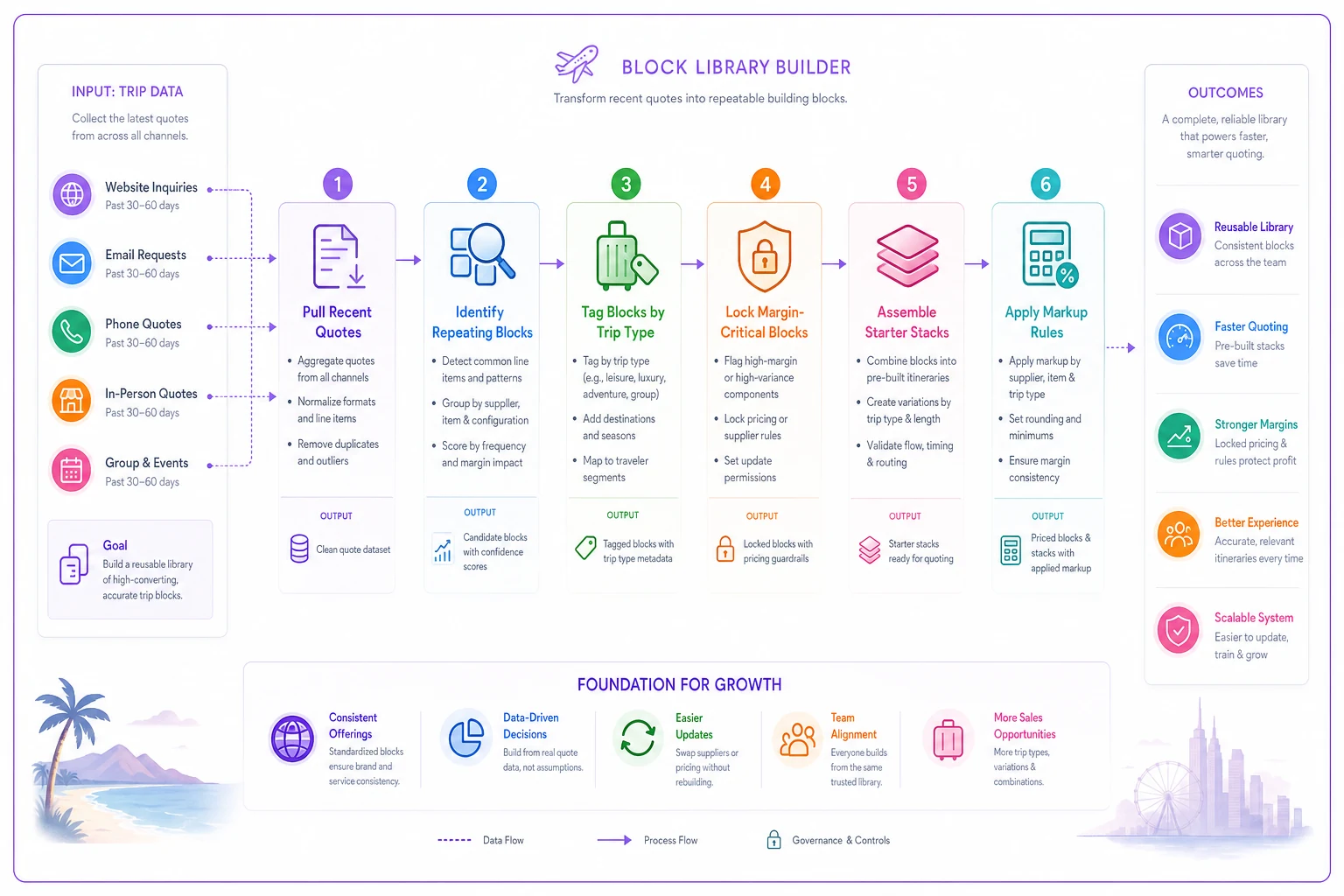
Use this flow as a checklist while you build your first starter stacks.
A real scenario
A six-person agency doing mostly family beach packages and a growing line of couples' Europe trips was averaging close to 90 minutes per quote. Their quotes often went back and forth two or three times because pricing felt inconsistent across the team.
They rebuilt around blocks over about three weeks. Nothing fancy — a shared library of roughly 24 blocks for their core destinations, each carrying its own cost and markup, plus four starter stacks.
The shift was noticeable pretty quickly. Average quote time dropped to around 25–30 minutes. Effective margin tightened back toward target because the transfer and buffer blocks were locked. Upsell attach rate went up on couples' trips, simply because the upgrade blocks were already sitting in the stack instead of being something the agent had to remember to mention.
Nothing about their trips changed. The assembly changed. That's the whole point.
Editable templates without breaking the math
The fear with locking down pricing is losing flexibility. Clients want custom trips, and a rigid system that can't flex is worse than a messy Word doc.
The way around this is separating two kinds of editing:
-
Content editing is open. Agents can rewrite descriptions, swap images, reorder days, adjust what the client sees.
-
Pricing editing is governed. Markup rules, buffer blocks, and margin-critical line items require either a set rule or an approval.
An agent can fully customise how the trip reads while the underlying margin logic stays intact. This is also what makes genuine personalisation fast — you're not afraid to tweak a quote heavily because the tweaking can't accidentally cost you 7 points of margin.
This is where AI-assisted operational platforms genuinely earn their place. A system that stores blocks with live cost feeds can flag when a supplier rate has moved since a block was built, auto-suggest the right upsell blocks based on trip type, and recalculate margin instantly as an agent edits. The automation isn't doing the thinking — it's doing the recalculating and the checking that humans forget under time pressure. That's the difference between a template folder and an actual quoting system.
When this makes sense — and when it doesn't
Worth building when:
-
You quote the same destinations or trip types repeatedly
-
You have more than one person quoting, so consistency matters
-
Your effective margin is lower than your target and you can't easily explain why
-
Quoting speed is capping how many enquiries you can handle
A bad idea when:
-
Almost every trip is a genuine one-off bespoke design with no repeatable patterns
-
You're a solo agent handling very low quote volume, where the setup time outweighs the gain
-
You don't actually know your true supplier costs yet — modular pricing on top of unreliable cost data just automates the errors
That last point matters more than people think. Blocks are only as good as the cost and margin data inside them. If your supplier costs are stale or inconsistent, fix that first. A modular system built on bad numbers produces fast, confident, wrong quotes.
The mistake most agencies make first
They start by making the document prettier. New fonts, nicer layout, a polished PDF export. That's the visible layer, so it feels like progress.
But the quoting bottleneck was never the layout. It was the rebuild and the margin guesswork underneath it. Prettier templates on top of the same flat structure just means agents now spend time keeping the pretty version consistent too.
Start with the economics layer — blocks that carry cost and margin — and let the presentation follow. A plain-looking quote assembled from reliable blocks beats a beautiful quote that quietly gave away a quarter of your margin.
Bringing it together
Modular blocks turn quoting from writing into assembly, and that single shift fixes three problems at once: speed, consistency, and margin control. Families get fast repeated-block stacks, couples get upgrade blocks sitting ready to attach, and adventure trips get logistics bundled into clean reusable segments.
The agencies that get real leverage out of this aren't the ones with the nicest templates. They're the ones who decided that pricing logic belongs inside the itinerary, not in a separate spreadsheet an agent might forget to check.
Build the library, lock what matters, keep the content flexible — and your next quote starts at 70% done instead of a blank page.
Ready to elevate your travel agency workflow?
Join 1,200+ travel agencies using Travexly to save time, improve client satisfaction, and boost operational efficiency.