



Most itinerary bloat doesn't come from complex trips. It comes from rebuilding simple things. A 4-night Lisbon-to-Porto trip, a Costa Rica adventure week, a corporate offsite in Austin — your agency has probably assembled variations of these dozens of times. And every time, someone opens a blank document (or worse, copies last year's version) and starts hunting for current prices, retyping hotel descriptions, and manually plugging in per-person math.
That's the real time sink. Not creativity. Repetition.
Modular itinerary assembly solves a narrow but expensive problem: the same trip components get rebuilt from scratch instead of being pulled from a reusable library where prices update themselves and math calculates itself. Get that right and you cut assembly time on repeat trip types by more than half. Here's exactly where the time goes and how the block approach changes it.
Where the hours actually disappear
When you time an advisor building a mid-complexity itinerary, the writing — the fun, client-facing narrative — takes maybe 15% of the total. The rest is grunt work.
A typical breakdown for a 7-day international trip looks something like this:
-
Pulling current prices from supplier portals, spreadsheets, and old emails: 25–35 minutes
-
Retyping or reformatting descriptions (hotels, transfers, excursions): 20–30 minutes
-
Recalculating per-person and per-couple totals after every change: 15–25 minutes
-
Chasing down a rate that changed since the last quote
10–20 minutes
-
Fixing a formula or math error someone caught late
unpredictable, sometimes an hour
None of that is skilled work. It's copy-paste and arithmetic. And it's where errors sneak in — a hotel rate that was accurate three weeks ago, a transfer price that never got updated, a per-person figure that didn't account for the single supplement.
What most owners miss: the problem isn't that any single step takes that long. It's that every step has to be redone every single time, even for a trip you've sold fifteen times before.
What "modular blocks" actually means in practice
A block is a reusable trip component you build once and reuse forever. Not a template of a whole trip — smaller than that. Think of the smallest sellable unit:
Eliminate booking chaos and streamline operations.
Travexly helps you manage, confirm, and track travel bookings effortlessly.
- Unified booking management
- Automated client communications
- Team scheduling & itinerary tracking
No credit card required
-
One hotel, with its description, room categories, and rate reference
-
One transfer (airport-to-hotel, private car, 3 pax)
-
One excursion (half-day wine tour, includes lunch, min 2 guests)
-
One internal flight segment
-
One "buffer" block for agency markup or service fee
You assemble a full itinerary by snapping these blocks into an order, not by writing paragraphs. The Lisbon trip becomes: Airport transfer block → Hotel block (3 nights) → Day tour block → Train block → Porto hotel block (2 nights) → Return transfer block. The narrative, the pricing, and the day-by-day structure come with each piece.
The unlock is standardization without rigidity. Once a block exists, anyone on your team assembles it the same way. New advisors stop reinventing your Costa Rica package. And when a hotel updates its description or you renegotiate a transfer rate, you edit one block, and every future itinerary using it picks up the change automatically.
A common mistake: agencies build blocks that are too big. If your "block" is an entire 5-day package, you've just made a template again — it breaks the moment a client wants to swap one hotel. Keep blocks small and combinable. Granularity is what makes them worth the setup effort.
Live price feeds: killing the stale-rate problem
The second half of this is pricing. A block is only useful if the number attached to it is current.
This is where linked live price feeds matter. Instead of typing a hotel rate into your itinerary and hoping it's still valid, the block pulls the rate from a live source — a supplier feed, a rate sheet you maintain, or an API connection. When the rate changes at the source, the block reflects it.
The stale-rate problem quietly eats margin in ways that are easy to miss. An advisor quotes a hotel at last month's rate, the client accepts, and now you're either eating the difference or having an awkward "the price went up" conversation that risks the whole booking. Live feeds don't eliminate rate changes, but they surface them before the quote goes out instead of after.
There's a control benefit too. When your blocks pull from a single rate source, you can see at a glance which components are running on old data. No more discovering a six-week-old price buried in a proposal.
Simple formulas that do the math for you
Once blocks carry live prices, the per-person and total math should calculate itself.
You don't need anything fancy. A few simple formulas cover most of what agencies actually quote:
-
Per-person total = sum of all block costs ÷ number of travelers
-
Per-couple/room total = block costs allocated by occupancy
-
Agency markup = base cost × markup % (as its own visible block)
-
Single supplement = (single room rate − shared rate) applied when occupancy = 1
-
Deposit due = total × deposit %
The point isn't the formulas themselves — it's that they run automatically when a block changes. Swap the Porto hotel for a pricier one, and the per-person total, the deposit, and the markup all recalculate instantly. No advisor sitting there with a calculator, no forgotten line item.
This is also where the biggest error class disappears. Manual per-person math after a last-minute change is one of the most common sources of quote mistakes. When the formula owns the math, the "we forgot to update the total" problem mostly goes away.
Before and after: a real assembly workflow
Here's the same trip, built two ways.
| Step | Old way (blank doc) | Block-based way |
|---|---|---|
| Find current hotel rates | Log into 2–3 portals, check emails | Pulled live into block |
| Write hotel/transfer descriptions | Retype or copy-paste | Already in the block |
| Order the days | Manual formatting | Drag blocks into sequence |
| Calculate per-person total | Manual spreadsheet | Auto-calculated |
| Apply markup + deposit | Manual math | Formula-driven |
| Update after client asks to swap a hotel | Redo pricing + math | Swap one block, everything recalcs |
| Typical time (7-day trip) | 90–120 minutes | 25–40 minutes |
The savings compound on revisions. The first draft is faster, but the real payoff shows up when a client comes back with "can we do a nicer hotel in Porto and add a day?" — the change that used to mean 40 minutes of rework becomes a two-minute swap.
Real scenario: a 4-advisor leisure agency
A small leisure-focused agency running four advisors was averaging around 330 custom itineraries a year, heavily weighted toward a dozen repeat destinations. Assembly time on their common trips ran roughly 90–110 minutes each, and revision rounds added another 30–45 minutes on maybe half of them.
They built a block library over about three weeks — starting with their 15 most-quoted hotels, their standard transfers, and their top excursions per region. They linked hotel rates to a maintained rate sheet that updated weekly rather than a live API at first, just to get moving.
After the library was in place, assembly on repeat trip types dropped to the 30–45 minute range, and revisions became near-instant for anything touching existing blocks. Across a year that's a meaningful chunk of advisor hours reclaimed — time that went back into client relationships and closing more of the quotes they were already sending out. They also caught fewer stale-rate surprises, since the weekly rate sheet flagged changes before quotes went out.
Worth being honest about the uneven parts: their bespoke, one-off luxury trips didn't benefit much. Those are genuinely custom, and blocks don't help when nothing repeats.
When this makes sense — and when it doesn't
Blocks and live feeds pay off fastest when your business has repeatable structure. If you sell the same 10–20 destinations with recognizable patterns, the setup cost is easily worth it.
This makes sense when:
-
A large share of your trips reuse the same hotels, transfers, and excursions
-
Multiple advisors build itineraries and you want consistency
-
You revise quotes often and the math errors are costing you
-
Your supplier rates change frequently enough that stale prices are a real risk
This is a bad idea when:
-
Nearly every trip you sell is fully bespoke with no repeating components
-
You're a solo advisor doing very low volume — the library upkeep may outweigh the savings
-
Your supplier data is so inconsistent that live feeds would introduce more errors than they fix
Who should hold off: agencies whose supplier relationships are entirely offline or negotiated per-trip. If there's no reliable rate source to link, "live price feeds" becomes another manual spreadsheet, and you lose the main advantage.
How to actually build your first block library
Don't try to model everything. Start narrow and expand.
-
Pull your last 50 itineraries and list the components that appear most. You'll find a small set of hotels and excursions covering most of your volume.
-
Build blocks for your top 10–15 hotels first. Description, room categories, rate reference. Nothing else yet.
-
Add your standard transfers and top excursions per region. These are quick to build and reused constantly.
-
Attach a rate source to each block — even a maintained weekly rate sheet counts as a start before full live feeds.
-
Add your formulas for per-person, markup, deposit, and single supplement.
-
Assemble one real trip entirely from blocks and time it against your old process. Fix what feels clunky.
-
Expand only as patterns repeat. Add a block the second time you'd otherwise rebuild something from scratch.
Start by timing one assembled trip against your old process to see the real savings.
Here's a simple visual of the build-and-assemble workflow.
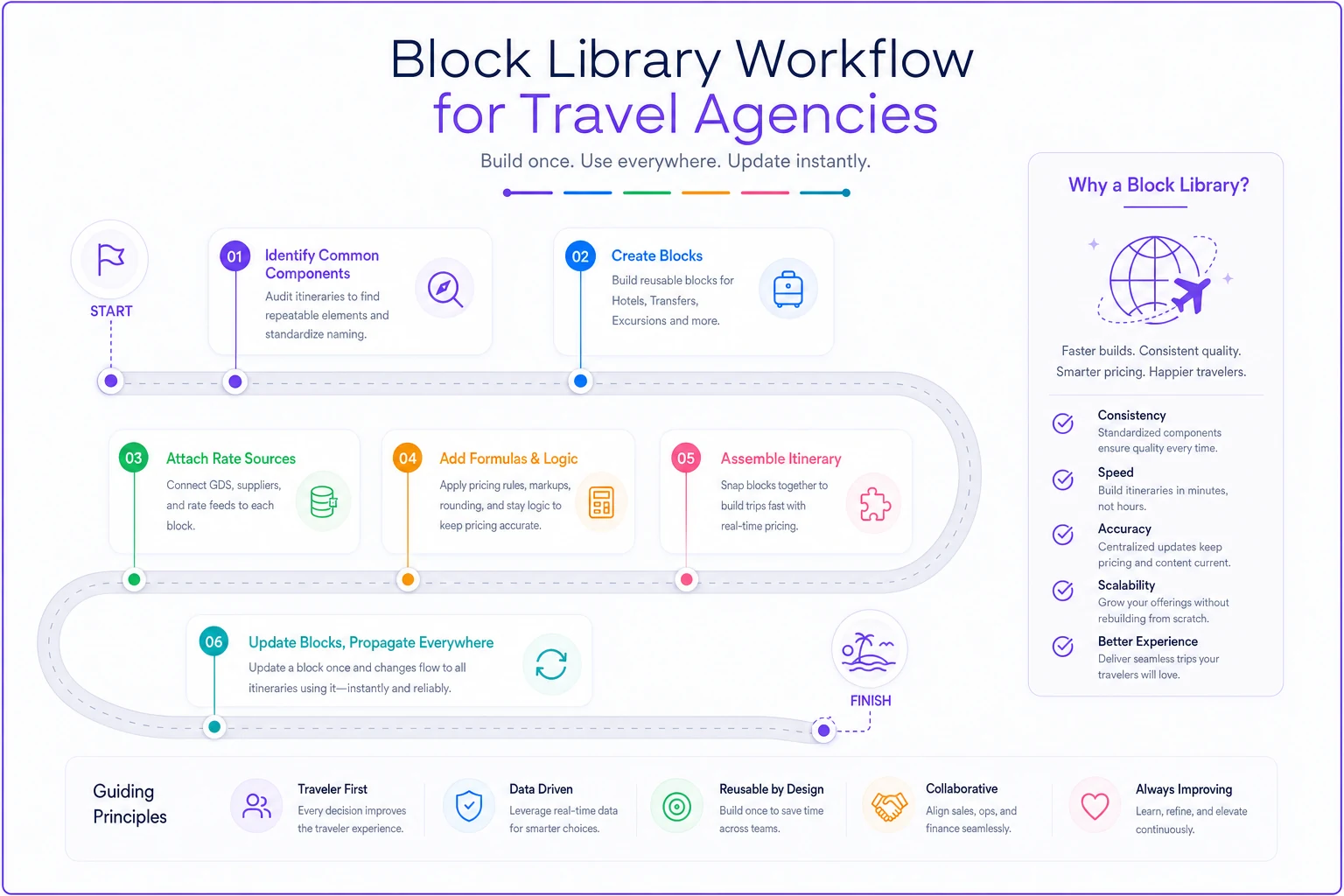
Agencies that succeed with this treat the library as a living thing. Every time an advisor almost rebuilds something, that's a signal a block is missing.
The workflow that ties it together
Where operational platforms help is holding all of this in one place — the block library, the live rate connections, and the formulas — so a change in one propagates everywhere without anyone chasing it manually. When a rate updates at the source, the blocks that use it update, the itineraries built from those blocks flag as changed, and the per-person totals recalculate. No manual sweep required.
That's the difference between a static template folder and a system that keeps itself current. The block approach works on its own; software mostly removes the maintenance work that otherwise erodes the savings over time.
The core idea is simple enough to start this week without any software at all: stop rebuilding what you've already built. Whether you keep your first blocks in a shared doc or a proper platform, the win comes from turning your most-quoted trips into reusable pieces with prices that stay honest and math that runs itself. The agencies that reclaim the most hours aren't the ones with the fanciest tools — they're the ones who stopped opening a blank page for a trip they've sold twenty times.
Ready to elevate your travel agency workflow?
Join 1,200+ travel agencies using Travexly to save time, improve client satisfaction, and boost operational efficiency.