


Cancellation policies create a weird tension for travel agencies. Make them too strict and potential clients bounce off your booking page. Make them too lenient and you're eating supplier penalties while dealing with customers who genuinely misunderstood the terms.
The problem gets worse because different trip types need completely different approaches. A luxury safari booking operates on different timelines than a weekend city break. Group travel has different pressure points than honeymoons. Yet most agencies copy-paste the same generic policy across everything.
Why generic policies fail at both jobs
Standard travel agency cancellation policy language usually follows the "ladder of doom" format: 90 days = 25% penalty, 60 days = 50% penalty, 30 days = 75% penalty, 14 days = no refund. Clean, simple, defensible in disputes. Also completely disconnected from how travel planning actually works.
Think about a family booking a European river cruise. At 120 days out, they're comparing options, getting excited, maybe showing the kids videos of castles. Then the booking page hits them with "ALL DEPOSITS NON-REFUNDABLE" in caps. That excitement turns into hesitation. They decide to "think about it" and never come back.
Or flip it—a couple books a Maldives honeymoon package. The policy says "free cancellation until 60 days before travel." They book immediately, feeling protected. Then at day 61, something comes up. They call to cancel, expecting flexibility. You explain the supplier penalties. They file a chargeback. You lose the booking fee plus hours dealing with the dispute.
The mismatch happens because most cancellation policies are written from an operational perspective—covering supplier terms—rather than a conversion perspective that matches client psychology. They protect the business legally but fail at the two things that actually matter: getting people to book and preventing disputes when plans change.
Language patterns that trigger resistance vs. build confidence
Certain phrases in cancellation policies consistently tank conversion rates. Others reduce disputes by setting clear expectations without scaring people off. The difference usually comes down to framing and timing.
Eliminate booking chaos and streamline operations.
Travexly helps you manage, confirm, and track travel bookings effortlessly.
- Unified booking management
- Automated client communications
- Team scheduling & itinerary tracking
No credit card required
Resistance triggers:
-
"Non-refundable deposit required"
-
"Strict cancellation policy applies"
-
"No exceptions policy"
-
"Penalties will be enforced"
-
"Subject to supplier terms"
Confidence builders:
-
"Flexible rebooking options available"
-
"Travel credit valid for 24 months"
-
"Name changes permitted until [date]"
-
"Payment protection included"
-
"Clear refund timeline provided"
What matters more than the words themselves is when they appear. A "flexible rebooking" message at initial inquiry builds trust. The same message buried in terms and conditions after deposit does nothing. A "non-refundable after X date" warning shown during final payment actually reduces disputes because clients are making an informed decision at the actual commitment point.
The sequencing matters as much as the wording. Early-stage messaging should emphasize protection and flexibility. Mid-stage messaging should clarify commitment levels. Late-stage messaging should reinforce what was already communicated—not introduce new restrictions.
Trip-specific policy frameworks that actually work
Different trip types need fundamentally different cancellation structures. Not just different timelines—different language, different emphasis, different dispute resolution paths.
Luxury/adventure travel ($15k+ per person)
These bookings involve remote locations, limited availability, complex logistics. Clients understand the commitment level but need reassurance about scenarios beyond their control.
Initial inquiry language: "This exclusive experience requires advance coordination with multiple partners. We'll provide detailed booking protection options that cover unexpected circumstances while securing your preferred dates."
Deposit stage language: "Your deposit of $[amount] confirms your dates and begins the planning process. Until [date - typically 120 days], you can transfer this deposit to alternate dates or experiences. After this date, supplier commitments are finalized."
This framing works because it positions the deposit as starting something valuable rather than just holding space. The transfer option reduces anxiety about committing early.
Group travel (8+ travelers)
Group bookings fail for different reasons than individual trips. One person drops out, dynamics shift, payment coordination breaks down. The policy needs to address group-specific scenarios directly.
Booking confirmation language: "Group secured with [X] confirmed travelers. Individual cancellations permitted until [date] without affecting group rates. If group size drops below [Y] travelers, pricing adjusts to current rates."
Payment schedule language: "Rooming lists and names finalized [60] days before departure. Prior to this date, substitutions permitted without penalty. Individual payment plans available to prevent group delays."
Separating individual flexibility from group commitments is what makes this work. Clients need to clearly understand that one person's decision won't tank everyone else's trip.
Short-lead bookings (under 45 days)
Last-minute bookings operate on different psychology. Clients have urgency but also higher cancellation risk. Traditional policies scare them off rather than move them forward.
Immediate booking language: "Book now with full flexibility until [date - typically 14-21 days out]. After this date, standard terms apply. Travel protection strongly recommended for short-notice bookings."
Payment language: "Due to departure timing, full payment processes immediately. Comprehensive travel insurance available at checkout covers most cancellation reasons."
Acknowledging the different risk profile without being punitive is the move here. Push insurance as the solution rather than doubling down on strict policies.
Honeymoons/special occasions
These bookings carry emotional weight. Cancellations often involve sensitive circumstances. Heavy-handed policies create terrible reviews and complaints that spread fast.
Initial language: "We understand this trip celebrates something special. Our booking process includes protection options designed specifically for milestone travel."
Change/cancellation language: "Life happens, and plans sometimes change. Until [date], modifications to dates or destinations incur no penalties. After [date], we'll work with suppliers to minimize costs and preserve as much value as possible."
The key is acknowledging the emotional component and promising advocacy rather than just stating rules.
Timing your policy revelations for maximum conversion
When you reveal different policy elements matters more than most agencies realize. Too early and you scare people off before they're emotionally invested. Too late and they feel blindsided.
A staged approach across the booking journey tends to work best. Below is a rough visual of how that progression looks: [Initial Inquiry] → [Proposal Stage] → [Pre-Deposit] → [Post-Deposit] → [Post-Payment] Flexibility Visual timeline Full terms + Reminder + Trip excitement & protection + key dates protection insurance + reinforcement messaging (positive window add-on of commitment framing) highlighted options
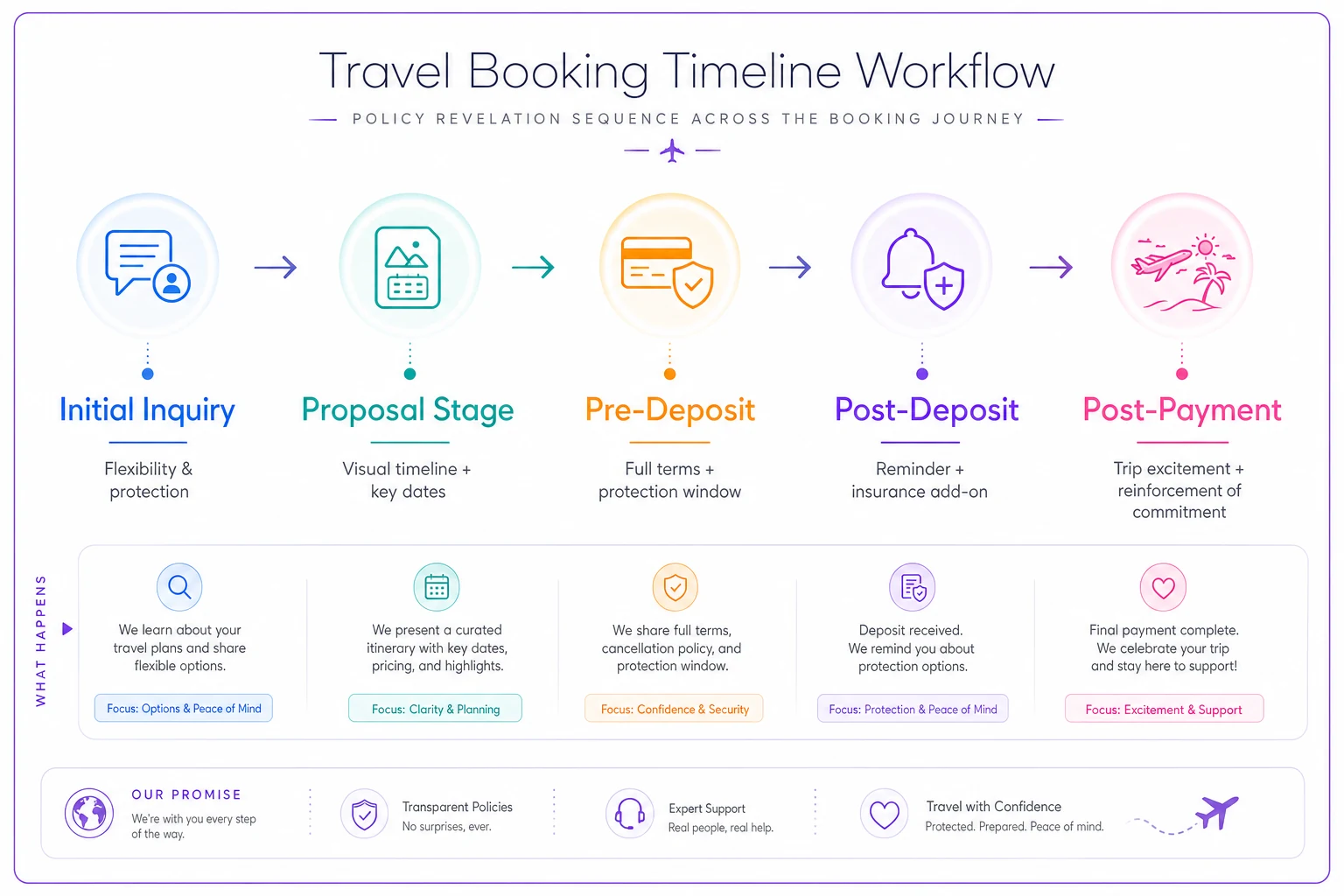
Use this visual to place key messages where they reduce surprise and improve conversion.
-
During initial inquiry (0–7 days) Focus on flexibility and value protection. Mention that "detailed terms vary by trip type and timing" but don't overwhelm with specifics. One reassuring statement about change options is enough.
-
At proposal stage (7–14 days) Include a simple visual timeline showing key dates and what happens at each stage. Use positive framing: "Full flexibility until..." rather than "Penalties begin at..."
-
Before deposit (14–21 days) Provide complete terms but highlight the protection period they're still in. "Booking now gives you [X] days to finalize plans with full flexibility."
-
After deposit but before final payment (30–90 days) Send a "policy reminder" email that restates terms in plain language. Include options like travel insurance or rebooking protection they can still add.
-
After final payment (beyond cutoff dates) Shift focus to trip excitement while gently reinforcing the commitment. "Your adventure is confirmed and suppliers are preparing for your arrival."
This staged approach reduces cognitive load at each decision point while ensuring clients never feel surprised by terms they "didn't know about."
Real disputes and what the language actually caused
These are the kinds of disputes that reveal exactly how policy wording creates or prevents problems.
Scenario 1: The medical emergency dispute
A couple booked a $22k African safari. Their policy stated "cancellations for medical reasons require documentation and are subject to supplier review." The wife needed surgery. They cancelled 40 days out, expecting a full refund with a doctor's note.
The vague "subject to supplier review" language created false expectations. Suppliers only refunded around $8k. The couple initiated a chargeback, posted negative reviews, and the agency spent 20+ hours fighting the dispute.
Better language would have been: "Medical cancellations follow supplier policies which typically recover 30–50% of costs after [date]. Comprehensive travel insurance covering medical cancellation is available for $[amount] and provides full refund in documented medical situations."
Scenario 2: The group breakdown
A destination wedding group of 24 people had individual contracts stating "group rates guaranteed with minimum 20 travelers." No mention of what happens if individuals cancel. Eight people dropped out 35 days before travel. Remaining travelers faced $400 per person increases.
The policy failed to explain the mechanics of group pricing or protect the agency from being the bad guy when rates adjusted.
Better language would have been: "Group pricing based on 20+ travelers. If group size decreases, individual rates adjust to: 15–19 travelers (+$200pp), 10–14 travelers (+$400pp). Consider group travel protection to lock in rates regardless of final numbers."
Scenario 3: The date change assumption
Clients booked a Disney World package for spring break. Policy said "date changes permitted based on availability." They assumed this meant free changes. Called to move the trip to summer, discovered $1,800 in supplier change fees plus fare differences.
The word "permitted" implied no cost. Clients felt misled and left negative reviews despite technically accurate policy language.
Better language would have been: "Date changes possible subject to: supplier change fees (typically $75–200 per ticket), fare differences if prices have increased, and availability. Changes within the same season typically incur lower costs than peak date switches."
Building dispute prevention into policy structure
Strong travel agency cancellation policy language doesn't just state rules—it prevents misunderstandings before they escalate. This requires thinking about how clients interpret terms, not just what protects you legally.
Include specific numbers and scenarios: Instead of "penalties may apply," write "cancellation 45 days before departure typically recovers 50–60% of trip cost, depending on supplier terms."
Address the "what-ifs" explicitly: Create a section called "Common Situations" that covers:
-
One person in a couple needs to cancel
-
Weather affects destination
-
Airline changes schedule significantly
-
Work obligations change
-
Family emergency occurs
Use progressive disclosure in digital formats: Online policies should have expandable sections. Start with simple summaries, allow drilling into details. This prevents overwhelming clients while still ensuring full disclosure.
Create scenario calculators: For complex trips, provide simple tools: "If you book today and cancel on [date], estimated refund would be $[amount] based on current supplier terms."
Separate "legally required" from "how we actually work": Your formal policy might say no exceptions. But add a section about how you advocate for clients, work with suppliers on hardship cases, or help navigate insurance claims.
Pro-tip: Offer expandable summaries on booking pages so clients see a short reassurance first and can click for full supplier details if they want.
The goal with all of this is making the policy feel less like a legal document and more like a transparent conversation. Clients who feel informed upfront are dramatically less likely to escalate when something goes wrong.
The conversion-protection matrix for policy decisions
Every policy decision involves tradeoffs between conversion and protection. But the tradeoffs aren't linear—certain combinations actually improve both metrics.
| Policy Element | High Protection/Low Conversion | Balanced Approach | High Conversion/Low Protection |
|---|---|---|---|
| Deposit amount | 50% non-refundable immediately | 25% with declining refundability | 10% fully refundable until 30 days |
| Change fees | No changes permitted | Changes with fees clearly stated | Free changes anytime |
| Refund timeline | "4–6 weeks after cancellation" | "2 weeks for credit card refunds" | "Immediate refund" |
| Documentation | "All changes require written notice" | "Email or phone acceptable" | "No formal process required" |
| Group policies | "Individual cancellations affect all" | "Protected rates with minimums" | "No group requirements" |
The sweet spot usually involves high flexibility early—driving conversion—with clearly communicated restrictions later to ensure protection. The timing varies by trip type, booking lead time, and client segment.
Language testing reveals surprising conversion drivers
Small wording changes can move conversion rates noticeably. Here's what tends to surface when agencies actually test this stuff:
"Protection" outperforms "Insurance" "Add travel protection" converts noticeably higher than "Add travel insurance." Clients associate protection with broader, more personal coverage—insurance feels like a bureaucratic product, protection feels like a safety net.
Specificity beats vague flexibility "Cancel up to 60 days before" outperforms "Flexible cancellation available." Concrete dates reduce anxiety about hidden restrictions. Vague language makes people assume the worst.
Positive framing wins but needs balance "Keep 75% with 30 days notice" outperforms "25% penalty after 30 days." That said, too much positive spin creates skepticism. Clients start looking for the catch.
Visual timelines crush text explanations Simple calendar graphics showing policy stages convert significantly better than paragraphs. Clients grasp the implications immediately instead of parsing dense language.
"We'll advocate" language builds trust Phrases like "we'll work with suppliers on your behalf" consistently reduce disputes because they set the expectation of partnership rather than an adversarial relationship when things go sideways.
Automation opportunities in policy management
Managing different policies across trip types, updating terms as suppliers change requirements, and ensuring consistent communication creates real operational overhead. This is an area where AI-powered operational software starts making a meaningful difference.
Modern platforms can automatically adjust policy language based on trip parameters, send staged policy reminders at the right intervals, and flag bookings approaching key policy milestones. They also track which policy versions clients actually saw when booking—which becomes critical information when a dispute comes up months later.
Beyond that, these systems can identify which policy elements are causing confusion based on how clients interact with content. When someone reads the same section multiple times or abandons after viewing certain terms, the platform surfaces that pattern. Over time that feedback loop helps agencies refine language that's actively working against them.
The operational efficiency really comes from centralizing policy management while maintaining trip-type customization. Instead of manually updating a stack of documents every time supplier terms shift, you update once and appropriate changes propagate based on rules you've already configured. For agencies managing dozens of active trip types, that's not a small thing.
Moving forward with better policy language
Getting travel agency cancellation policy language right means balancing multiple things at once: protecting revenue, meeting supplier requirements, maintaining client trust, and driving conversions. Generic policies fail because they don't acknowledge these tensions or adapt to different scenarios.
Start by auditing your current policies through both lenses—how well they protect you and how likely they are to convert browsers into bookings. Look for resistance triggers in your language. Map out when different policy elements get revealed in your booking process.
Then build trip-specific frameworks that match how clients actually think about risk and commitment for different types of travel. Test language variations, particularly around timing and framing. Track not just bookings but cancellations and disputes to see which policy elements are causing friction.
Policies are also living documents. As your mix of trip types evolves, as supplier terms change, as client expectations shift, the language needs to adapt. Building systematic approaches to policy management—whether through operational discipline or the right software tools—ensures consistency while keeping enough flexibility to optimize for different scenarios.
The goal isn't to trick clients into booking or build an airtight wall against every possible scenario. It's to create clarity that helps clients make informed decisions while protecting your business from preventable losses. When done right, good policy language reduces both abandonment and disputes—clients book with confidence and honor commitments they understood from the start.
The agencies that get this right treat policy language as a strategic tool rather than a legal box to check. Every word either builds or erodes trust, either clarifies or confuses, either converts or repels. In an industry built on selling experiences and memories, even something as dry as a cancellation policy needs to reflect the same professionalism you bring to the actual trips.
Ready to elevate your travel agency workflow?
Join 1,200+ travel agencies using Travexly to save time, improve client satisfaction, and boost operational efficiency.